

A group of students from Ho Chi Minh City University of Food Industry created table salt from cuttlefish shells that has a similar salinity but only one-third the sodium content of regular salt.
In 2022, Ngo Tran Thuy Vy, along with Tran Hong Anh, Duong Thi Cam Thoa, Nguyen Le Thu Thuy, and Huynh Thi Anh Sang (Faculty of Food Technology), developed a laboratory-scale process for producing edible salt from cuttlefish shells.
Cuttlefish bones are collected, washed, dried, ground, and the extraction process with water is optimized. The extract is concentrated and then further dried to obtain the final product, table salt.
Cuttlefish bone contains not only sodium but also other minerals that contribute to its salty taste, such as potassium, calcium, magnesium, and phosphorus. Notably, cuttlefish bone is rich in glutamic acid, which can create a sweet aftertaste in salt, similar to traditional seasoning granules.
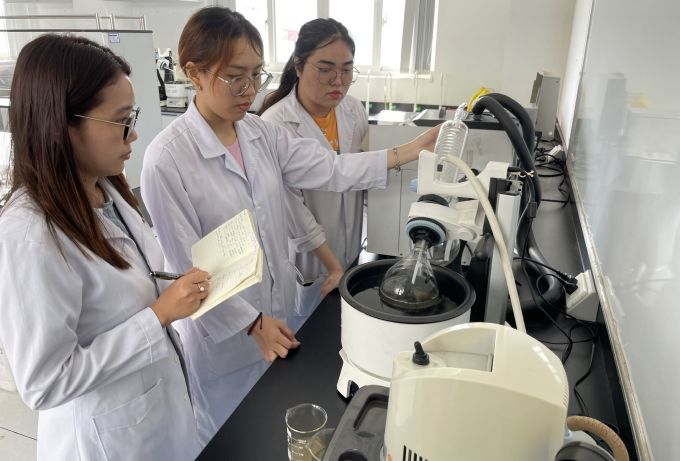
Thúy Vy (left) with her group members at the school's food technology lab. Photo: Hà An
The reason the group sought to create salt from cuttlefish bone is because Vy previously worked in the nutrition department of a large hospital in Ho Chi Minh City and observed hypertensive patients adhering to a low-salt diet. Eating bland food made it unappetizing, difficult for them to finish their meals, and increased the risk of nutritional deficiencies. Scientific reports indicate that Vietnamese people and many other countries consume 10 grams of salt per day, double the recommended amount by health authorities. This increases the risk of developing hypertension, cardiovascular disease, kidney stones, and other health problems.
"Traditional table salt contains up to 97% NaCl, so the high sodium content is a factor that negatively impacts patients' health if consumed in large quantities," Vy said, adding that she wants to create a type of table salt that ensures the right level of saltiness but has a low sodium content.
According to Vy, the most important step in the salt production process is extraction, specifically adjusting the water-to-raw material ratio, temperature, and time to achieve the highest possible total dissolved solids content.
The team conducted an assessment of the salinity similarity between cuttlefish bone extract and traditional brine. The results showed that the salinity of the two was quite similar, but the cuttlefish bone extract had a sodium content that was one-third lower than traditional brine.
However, the salt produced by the group using the direct extraction method, which is not yet refined, retains a distinctive and unpleasant seafood odor. To overcome this, the group plans to mix it with other spices or herbs to mask the smell.
According to the research team, besides cuttlefish shells, other by-products such as clam shells and shrimp shells also have the potential to produce edible salt. Vy believes that the current trend in food consumption favors products that are good for health, so this is a research direction that can be pursued if businesses or investors participate.

The finished products are cuttlefish bone extract and salt, in solid form, packaged in lidded containers. Photo: Ha An
Dr. Nguyen Thi Thuy Duong, lecturer at the Food Technology Department, Ho Chi Minh City University of Food Industry, assessed this as a very promising applied research direction, in line with the trend of using reduced-sodium salts that scientists both domestically and internationally are pursuing. The group has demonstrated that salt from cuttlefish shells has a high salinity but a reduced sodium content compared to regular salt.
However, she suggested that the group should invest in analyzing various other minerals present in the cuttlefish bone extract and their potential effects on human health, including potentially toxic substances, as a basis for a more comprehensive assessment.
"In medical studies, cuttlefish bone is considered a remedy that can treat stomach ailments, so the likelihood of it containing toxins is not high. However, a scientific evaluation and testing of the components by specialized agencies is necessary if the product is to be commercialized," said Dr. Duong.
Ha An
Source link

























































![[Video] Sunset at Lap An Lagoon – Where the sun sets over the fishing nets](https://vphoto.vietnam.vn/thumb/1200x675/vietnam/resource/IMAGE/2026/05/31/1780192137701_beach-landscape-sea-water-nature-grass-745871-pxhere-com.jpeg)



































Comment (0)