

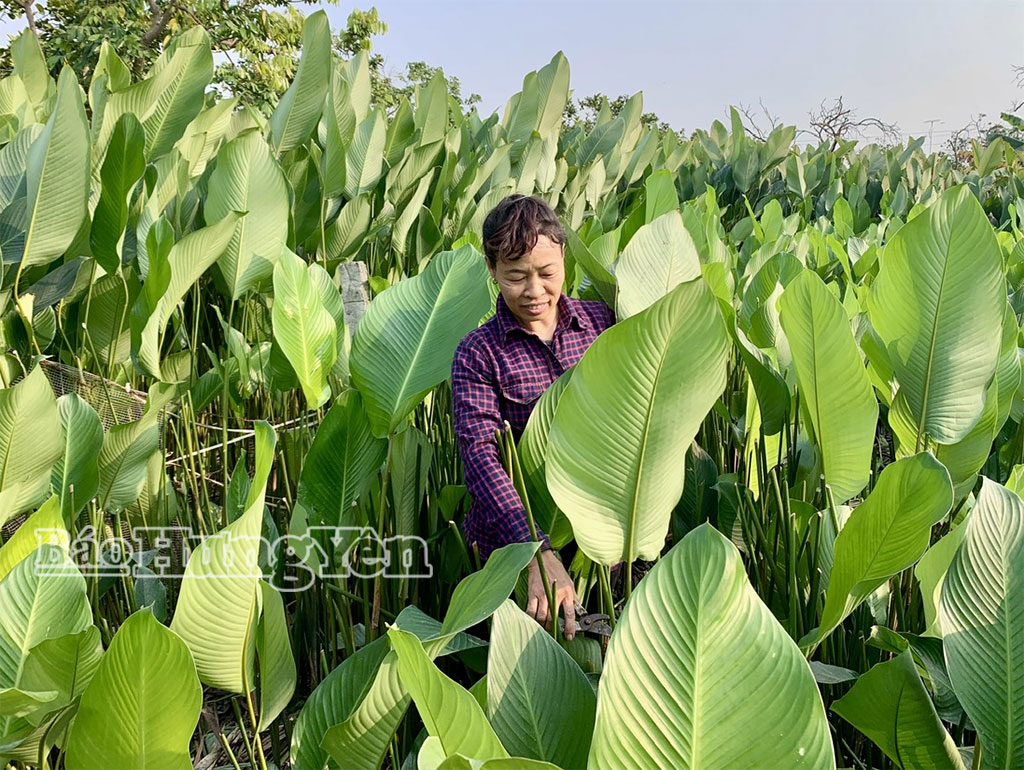
The former Dong Ket commune, now Khoai Chau commune, has long been famous for its tradition of growing dong leaves to supply traditional craft villages that make cakes and process food both within and outside the province, especially for wrapping banh chung (traditional Vietnamese rice cakes) during the Lunar New Year. Thanks to favorable natural conditions, the soil here has a characteristic structure with a ratio of sandy loam and rich alluvial soil, which is very suitable for the growth and development of dong leaves. In recent years, local people have proactively innovated their methods, developing a model of growing dong leaves intercropped under fruit trees, effectively utilizing land area, reducing labor, and providing a stable income year-round.
As Tet (Lunar New Year) approaches, the collection points for banana leaves in the commune become increasingly busy. From early morning to late afternoon, bundles of leaves are transported to the collection points. Some weigh the leaves, others arrange them, count them, and still others clean, trim, and shape each leaf to ensure it is flat, beautiful, and uniform. The gentle fragrance of banana leaves blends with the cool, crisp air of the year-end, creating a unique feeling, as if Tet is just around the corner. Not only serving the domestic market, many banana leaf orders from Khoai Chau are carefully selected for export to markets such as Europe, Japan, and South Korea.

Mr. Do Nguyen Cuong, Party Secretary and Head of Lac Thuy village, Khoai Chau commune, said: “Lac Thuy village has nearly 90 hectares with more than 400 households growing dong leaves, making it the village with the largest area of dong leaf cultivation in the commune. In the village, there are about 10 households specializing in purchasing dong leaves to supply the domestic market and for export. Lac Thuy dong leaves are a type of glutinous dong leaf, with a round, soft, flexible, and tough leaf, a light green underside, and a long stem the same color as the leaf. Compared to wild dong leaves, the quality of dong leaves grown here is far superior. Used to wrap banh te or banh chung (traditional Vietnamese rice cakes), when cooked, the cakes have a beautiful light green color and a distinctive aroma, making them popular in the market.”
Visiting the more than 3-acre garden of Mr. Ngo Quyet Tien's family in Lac Thuy village, we were truly impressed by the lush green banana leaves stretching out, above which the abundant, fruit-laden Dien pomelo trees provided. Having been involved with banana leaf cultivation for over 40 years, Mr. Tien is now one of the largest producers and buyers in the area. Mr. Tien shared: “Banana leaf plants only need to be planted once, and after about a year they can be harvested. From the third year onwards, the plants are strong, produce many branches, and yield a stable harvest. The plants yield leaves year-round, on average once a month. From the ninth lunar month, my family focuses on taking better care of the plants to ensure beautiful leaves for the Tet holiday.”
Besides growing the leaves, Tiến's family also buys and distributes the leaves from other villagers. Every day, his family buys 10,000 to 20,000 leaves, and this number increases two to three times during Tet (Lunar New Year).
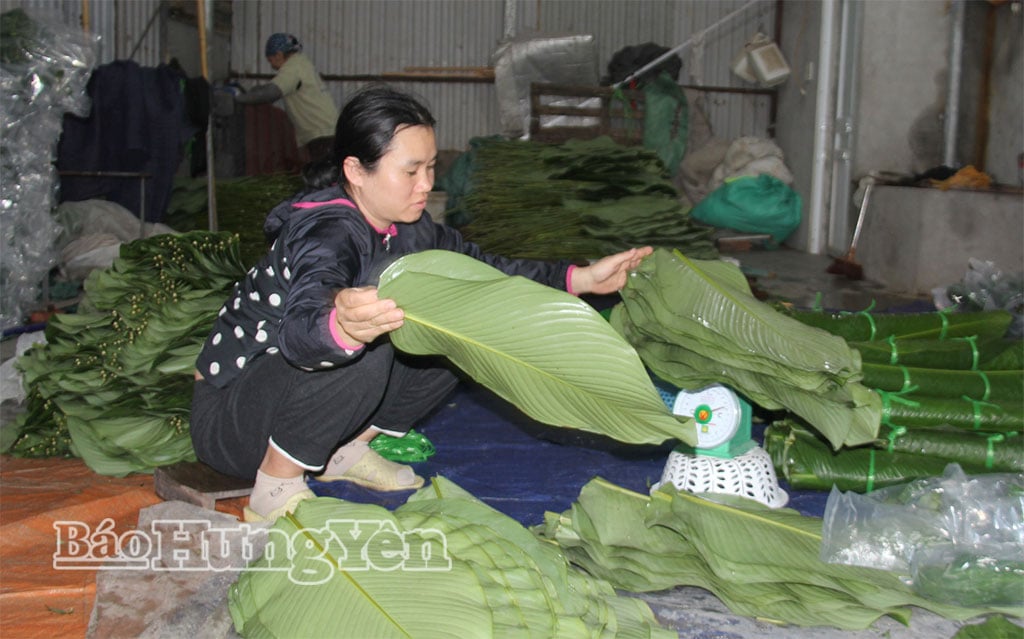
In particular, during the Lunar New Year season, Mr. Tien's family also collaborates with businesses to export banana leaves. Mr. Tien said: "Exported banana leaves are usually purchased from the 11th lunar month to ensure timely shipment. This season, my family purchased and exported about 150,000 banana leaves. Exported banana leaves fetch a higher price than the domestic market, by 200-250 VND per leaf, but the requirements are stricter, demanding more care and processing."
The price of banana leaves on ordinary days ranges from 10,000 VND/100 small leaves used for wrapping banh te and banh khuc cakes; to 45,000 – 50,000 VND/100 large leaves used for wrapping banh chung (traditional Vietnamese rice cakes). During Tet (Vietnamese New Year), the price of banana leaves increases significantly, with large, beautiful leaves potentially reaching 100,000 – 120,000 VND/100 leaves.

Not only large-scale producers, but many families who intercrop dong leaves also have a stable income. Mr. Nguyen Ba Nhung's family in Lac Thuy village currently has 8 sao (approximately 0.8 hectares) of land planted with dong leaves intercropped with longan, banana, and Dien pomelo trees. Mr. Nhung said: "Growing dong leaves is very hard work. Besides fertilizing, with wood ash being the best, growers also have to regularly prune and clean the base leaves so that the plants sprout many new shoots, producing green, broad, lush leaves that are not curled or torn. In return, each sao of dong leaves intercropped with fruit trees brings in an income of 8-15 million VND per year."
Khoai Chau commune currently has about 150 hectares of dong leaf (a type of medicinal plant) intercropped with fruit trees, mainly concentrated in the villages of Lac Thuy, Trung Chau, and Hong Thai. Due to its economic benefits, dong leaf has become a key crop, making a significant contribution to increasing income and stabilizing the lives of the people of Khoai Chau.
Source: https://baohungyen.vn/lang-la-goi-banh-khoai-chau-ron-rang-vao-vu-tet-3190310.html


































![[Video] Sunset at Lap An Lagoon – Where the sun sets over the fishing nets](https://vphoto.vietnam.vn/thumb/1200x675/vietnam/resource/IMAGE/2026/05/31/1780192137701_beach-landscape-sea-water-nature-grass-745871-pxhere-com.jpeg)






























Comment (0)