

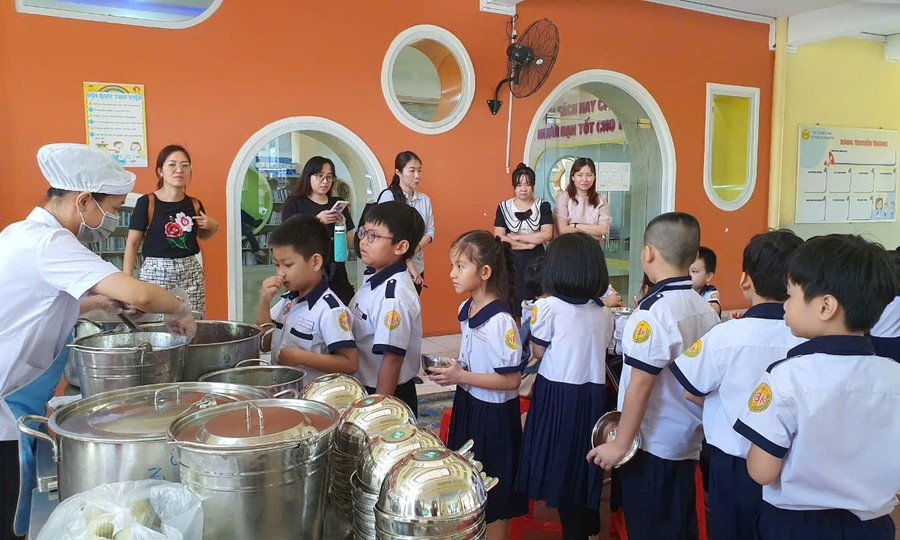
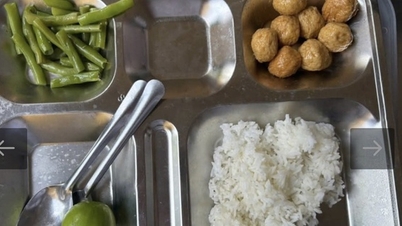
Parents inspect school lunch at Nguyen Binh Khiem Primary School. Photo: MA
To improve the quality of school meals, one solution proposed by experts from the Ho Chi Minh City Department of Food Safety is to install cameras for remote monitoring of the school meal providers.
Prioritize meal quality.
Recently, the Ho Chi Minh City Department of Education and Training, in coordination with the Ho Chi Minh City Department of Food Safety, organized a training program on ensuring food safety in schools in the city for the 2024-2025 school year. The training session was attended by over 2,700 management staff from district education departments, kindergartens, primary schools, secondary schools, high schools, and continuing education centers in Ho Chi Minh City.
According to Mr. Duong Tri Dung, Deputy Director of the Ho Chi Minh City Department of Education and Training, ensuring food safety in schools is one of the important issues of concern to parents, society, and the education sector; it falls under the management responsibility of the head of each unit. The locality currently has more than 2,400 schools, not including independent private kindergroups.
In reality, there is a significant demand from parents for full-day schooling, including the provision of school meals. Meanwhile, school administrators are not food safety and hygiene specialists; their duties primarily involve state management, which includes this aspect.
“Every year, the Ho Chi Minh City Department of Education and Training coordinates with relevant units to organize training and update information on food safety and hygiene management to ensure the quality of meals in schools. The department also participates in the city's inter-agency inspection team to directly inspect food safety and hygiene in school kitchens,” Mr. Dung emphasized.
According to Ms. Pham Khanh Phong Lan, Director of the Ho Chi Minh City Department of Food Safety, to ensure food safety and hygiene in school kitchens, schools need to select professional food suppliers that fully meet food hygiene and safety criteria. At the same time, schools must directly supervise and self-inspect food safety and hygiene practices at the supplier.
"Specialized agencies and local authorities need to continue strengthening inspection, examination, and handling of violations regarding food safety and hygiene in collective kitchens; focusing on reviewing everything from raw materials, processing, one-way kitchen procedures, human factors, and paying attention to food traceability and quality," Ms. Lan emphasized.
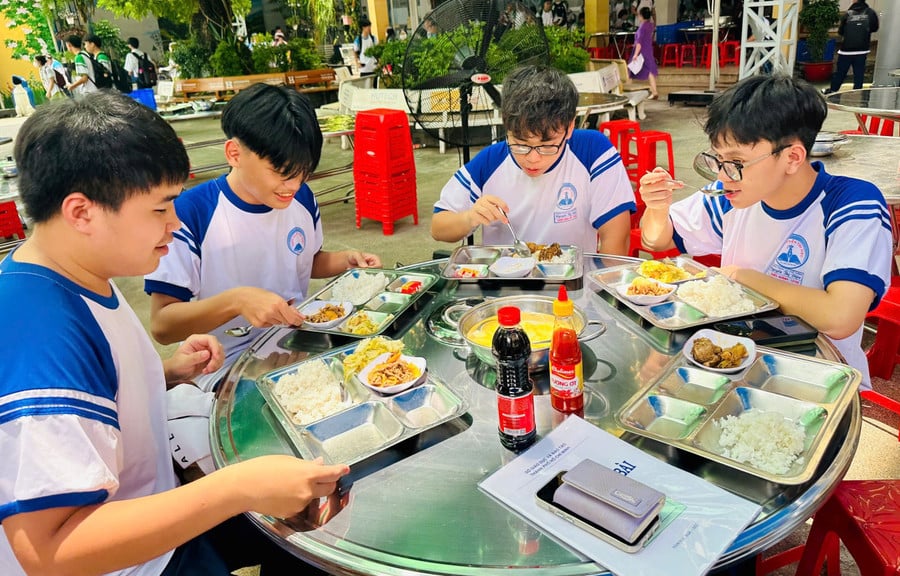
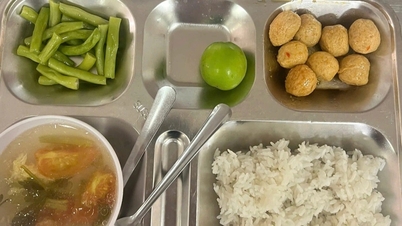
School lunch for students at Nguyen Thi Dieu High School (District 3, Ho Chi Minh City). Photo: TM
According to Ms. Lan, in the 2023-2024 school year, no food poisoning incidents occurred in schools throughout Ho Chi Minh City, however, the risk remains very high. Therefore, researching additional tools for schools to self-assess and evaluate food hygiene and safety standards is reasonable. Ms. Lan also recommended that schools improve the quality of their food sources, meaning that food should not only meet the minimum requirements of food hygiene and safety standards but also higher standards such as VietGAP and GlobalGAP.
“School administrators face a lot of pressure when choosing a provider for school lunches or organizing school canteens because there are many recommendations. However, in any case, I hope that school leaders will always pay attention to standards and prioritize the quality of meals. For meal providers, there must be a strict monitoring plan,” Ms. Lan said.
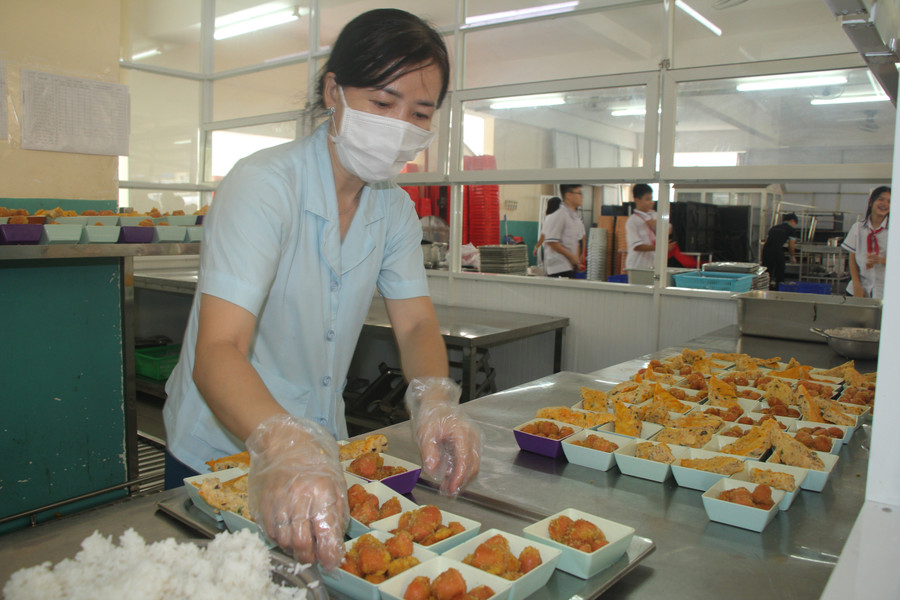
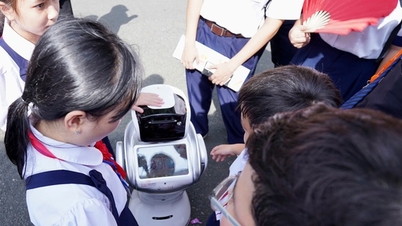
Over the past period, the quality of school meals has always been a top priority for Nguyen Du Secondary School. Photo: MA
Is it necessary to install surveillance cameras?
Speaking at a training session on ensuring food safety in schools in Ho Chi Minh City for the 2024-2025 school year, Mr. Le Phuc Dam, a specialist from the International Cooperation and Communication Department of the City's Food Safety Department, stated that schools need to thoroughly understand regulations on investment and business conditions under state management as well as regulations on food safety.
"Currently, many schools inspect meal providers 2-3 times per school year. If a provider cannot arrange time for on-site inspections, they can request the kitchen to install cameras for remote monitoring, ensuring the quality of school meals for students," Mr. Dam suggested.
In Ho Chi Minh City, 100% of public kindergartens have their own kitchens and do not use industrial meal services, with private kindergartens achieving over 80% compliance. Food safety and kitchen procedures for children are strictly managed and supervised. However, at the primary, secondary, and high school levels, many institutions cannot organize their own kitchens and are therefore forced to contract with catering services.
Therefore, the monitoring and supervision of the food processing procedures have not been carried out regularly. Thus, the proposal to install surveillance cameras at school meal providers is one of the solutions that has received much support from the leaders of educational institutions.
According to Ms. Nguyen Vinh Bao Chau, Deputy Head of the Education and Training Department of District 12 (Ho Chi Minh City), installing cameras at food service providers for schools is reasonable and necessary. School administrators can monitor and supervise regularly. Installing cameras helps to improve the sense of responsibility of each kitchen staff member. In particular, if any problems arise, tracing the steps of the food preparation process and identifying the cause is convenient.
The principal of a high school in District 11 (Ho Chi Minh City) affirmed: "In reality, the principal mainly oversees and focuses on professional work. The boarding school issue is assigned to a vice-principal, but that's not the school's area of expertise. Installing cameras would greatly assist the school in monitoring daily meals for students."
Sharing the same view, Ms. Hoang Thi Ngoc, Principal of Nguyen An Ninh Primary School (Bien Hoa City, Dong Nai Province), believes that the proposal to install cameras is a necessary and reasonable solution. She argues that the companies providing school meals also need cameras to monitor their employees' cooking processes. Therefore, those with genuine care and responsibility will not hesitate to do this.
Meanwhile, Ms. Nguyen Thi Ha, the principal of Uyen Hung Primary School (Tan Uyen district, Binh Duong province ), believes that installing surveillance cameras will improve coordination between the school and the supplier. For example, on days when the school cannot directly inspect the supplier, the school and even parents can monitor the process through the cameras, thus feeling more secure about the quality of students' meals.
From a parent's perspective, Mr. Nguyen Van Quyet, who has two children attending primary school in Thu Duc City (Ho Chi Minh City), believes that schools without on-site kitchens have to contract with external companies, making it difficult to control quality. While these companies have all the necessary permits to supply food to schools, that's not enough.
"Installing surveillance cameras in these units seems reasonable to me. This allows the school administration to monitor the situation regularly, in addition to conducting direct inspections. Furthermore, with surveillance cameras, the kitchen staff will be more conscious, responsible, and careful in their work."
“Regarding school lunch programs for students, direct inspection and supervision, through parent-teacher associations, or via cameras are all very effective. However, installing surveillance cameras is only a solution proposed and shared by the presenter during the training session. To implement it, the Ho Chi Minh City Department of Education and Training and the Department of Food Safety must discuss and agree on many issues. For example, not just anyone can do the job of supervising; it requires expertise in this field…,” Mr. Duong Tri Dung said.
Source: https://danviet.vn/lap-camera-giam-sat-se-quan-ly-tot-hon-bua-an-ban-tru-20240928104327336.htm




































































Comment (0)