

 |
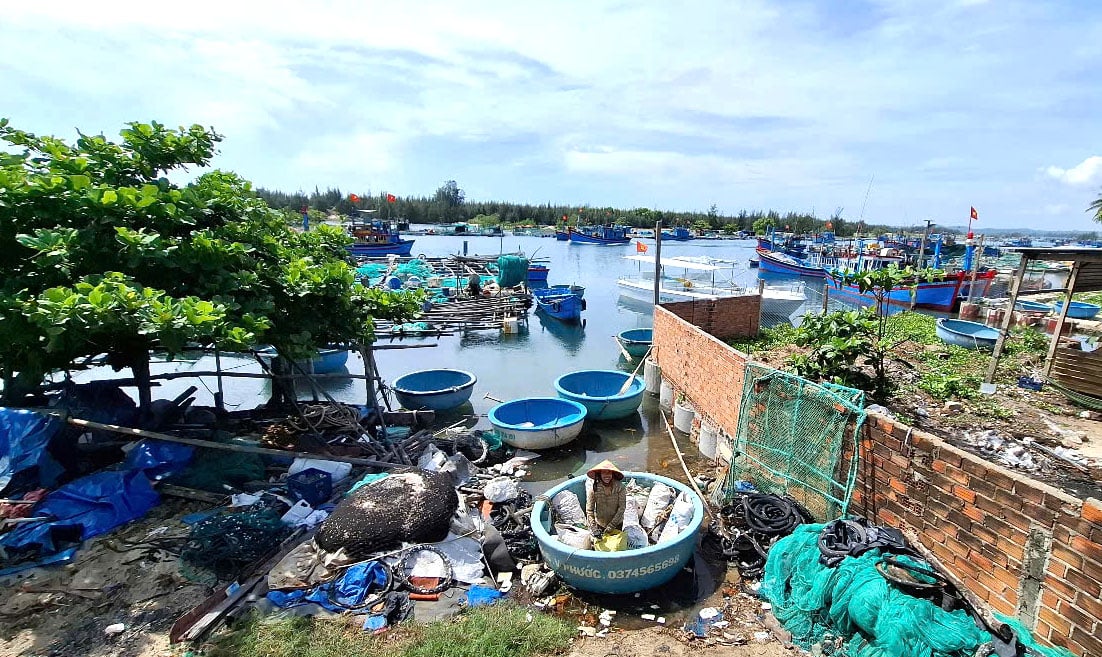
| Plastic waste at Le Thinh estuary, Phu Luong village, An Ninh Dong commune (Tuy An district). Photo: MANH LE TRAM |
Many garbage collection activities
Xuan Dai Bay (Song Cau Town) stretches from Xuan Dai, Xuan Thanh, and Xuan Yen wards through Xuan Phuong commune. Hundreds of people from various places come to this area to raise lobsters and groupers in cages. The lobster and grouper farming activities generate a lot of waste every day, including plastic bags, cans, and bottles.
To reduce marine pollution, functional units of Song Cau town have implemented models such as "Green Beach - No Waste," "Plastic Bag-Free Beach," and "Say No to Plastic Straws." However, while passing through Vung Lam (Xuan Dai ward), we discovered a large pile of garbage covering the sand. Mr. Nguyen Van Tam, a resident of Xuan Dai ward, shared: "Plastic bags are the most common type of garbage in the bay. Aquaculture farmers here, after feeding their shrimp, simply throw the bags into the sea, and the wind carries them ashore, forming piles of trash."
The coastal route down to the Le Thinh estuary, Phu Luong village, An Ninh Dong commune (Tuy An district), has a channel filled with plastic bags, styrofoam, and other plastic waste. While inspecting fishing gear from a small boat anchored near the shore, Mr. Bui Van Long, a local fisherman, said: "The channel near the Le Thinh estuary is where boats anchor during the rainy and stormy season. In the dry season, fishermen cast nets for herring and catch mackerel, while in the rough seas they cast nets for shrimp and lobster larvae. However, the boats sometimes 'stand still' in the middle of the sea because plastic wrap gets tangled in the propellers. Locals along the channel have been campaigning to collect plastic waste, but after a while, it just floats in from everywhere, almost completely filling the channel."
According to Mr. Long, along the road leading down to Le Thinh estuary in Phu Luong village, there used to be an impromptu market where garbage spilled onto the road; plastic bags containing fish and fish sauce emitted a strong, foul odor. The An Ninh Dong commune People's Committee has built a new market and collected garbage to prevent plastic bags from drifting into the sea. However, after each monsoon season, ocean garbage washes ashore at Le Thinh estuary, overflowing into the inland channels.
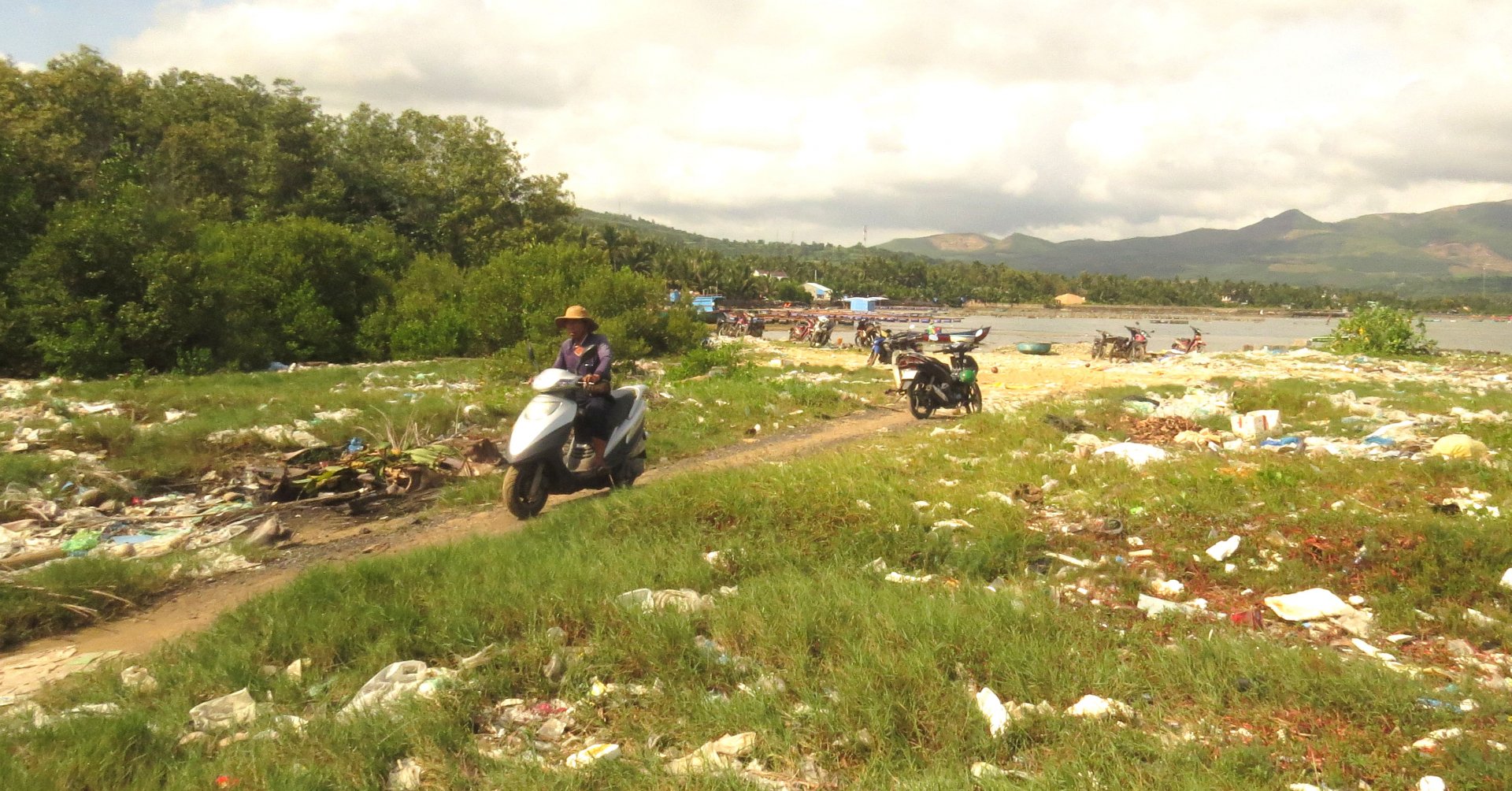 |
| Plastic bags are the most common type of trash found in Xuan Dai Bay. Photo: MANH LE TRAM |
We brought the trash ashore, but there was still... trash.
Vũng Rô is known as the "capital" of lobster and grouper farming. According to statistics from the People's Committee of Hòa Xuân Nam commune (Đông Hòa town), there are currently about 500 rafts for raising grouper and green lobster, and 21 floating rafts operating for tourism along the coast. Recently, a lot of plastic waste has been washing up along the shore, causing environmental pollution. The cause of the plastic waste washing up in Vũng Rô Bay is due to aquaculture farmers discarding plastic bags containing feed. Faced with this plastic waste pollution, the local authorities are managing the waste by requiring the rafts to sign a commitment to bring their waste ashore.
Mr. Tran Van Com, a lobster farmer in Vung Ro, said that local officials went to the lobster farms to encourage owners to sign commitments to bring their waste ashore and voluntarily contribute funds to socialize waste collection. He strongly supports this. However, many people's awareness of environmental protection is still poor, so the results are not very effective. Some people throw away the lobster feed wherever they please; some collect it, others dump it, so even though the waste is brought ashore, there is still a lot of plastic waste in the bay.
According to Mr. Com, the local authorities are doing a good job of managing waste, but whether or not Vung Ro still has plastic waste depends on the awareness of the shrimp farmers.
According to the People's Committee of Hoa Xuan Nam commune, the long-term solution for environmental protection is for the locality to invite households engaged in aquaculture to educate and encourage them to collect waste and bring it ashore, while strictly handling the act of dumping plastic waste into the sea in accordance with regulations.
According to the leaders of Hoa Xuan Nam commune People's Committee, Vung Ro has floating cages and fish farms, with farmers coming from Tuy An district, Song Cau town, and Dai Lan commune (Van Ninh district, Khanh Hoa province). Five years ago, the commune People's Committee conducted a survey and found 380 cage owners with 16,469 cages in Vung Ro; now there are approximately 500 cages/21,636 cages. Regarding long-term environmental protection solutions, the commune People's Committee will invite households engaged in aquaculture to educate and encourage them to collect waste and bring it ashore, while strictly enforcing regulations against the dumping of plastic waste into the sea.
"Healing" the blue ocean
According to environmental experts, plastic bags take 500-1,000 years to decompose in the natural environment; some that are not directly exposed to light will never decompose.
According to a report on the results of the research project on the sources, accumulation points, and solutions to mitigate the impact of plastic waste on coastal communities in Vietnam, published in 2024, with a coastline of 3,260km across 28 provinces and cities, Vietnam's coastal areas play a vital role in economic development and community livelihoods. However, plastic pollution has been and continues to seriously threaten ecosystems, public health, and the sustainability of the national economy. Approximately 730,000 tons of plastic waste enter the marine environment annually, highlighting the urgent need for coordinated action among stakeholders. With over 8,000 tons of plastic waste generated daily, Vietnam is among the top 10 plastic-polluting countries in the world. About 75% of domestic solid waste, including plastic, is mismanaged or improperly disposed of, with less than 30% of plastic waste being recycled.
The sea plays a crucial role in Vietnam's development and integration, acting as a "green lung" against climate change. In its strategy for exploiting and utilizing marine resources with a vision to 2050, Vietnam aims to become a strong maritime nation, prosperous from the sea, and to protect marine biodiversity and the marine environment.
Every year, communities across the country implement numerous meaningful activities, projects, and programs to collectively conserve the ocean. Many communities, young people in Vietnam, and foreigners working in Vietnam simultaneously launch various activities, programs, and weeks of action to clean up beaches and collect plastic waste to contribute to "healing" the blue ocean.
Source: https://baophuyen.vn/xa-hoi/202506/lo-ngai-rac-thai-ven-bien-2cf1767/
































































Comment (0)