

The draft plan for training human resources to serve high-tech development in the period 2025-2035 and orientation towards 2045 by the Ministry of Education and Training also aims for the percentage of people studying STEM (Science, Technology , Engineering, Mathematics) fields to reach 35% at each training level by 2030.
STUDENT ATTENDANCE IS MUCH LOWER THAN IN THE REGION
According to statistics from the Ministry of Education and Training, the scale and proportion of university students studying STEM fields are lower than in some countries in the region and Europe, especially the proportion of female students, and particularly low in science and mathematics.
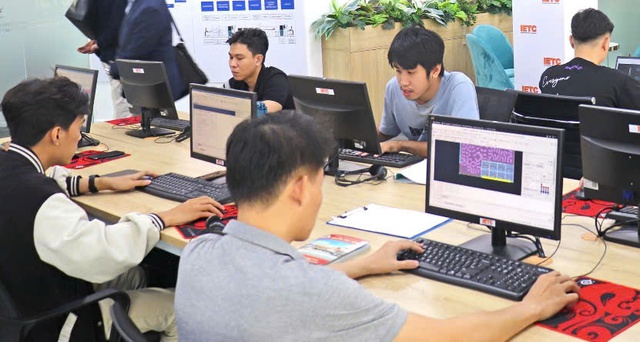
The number of Vietnamese students pursuing STEM fields has increased in recent years, but it remains low compared to many other countries.
PHOTO: PHAM HUU
Specifically, the percentage of university students pursuing STEM fields in recent years has fluctuated between 27-30%, reaching approximately 28% in 2021 (out of a total of 2.1 million students), comparable to Israel and the EU average, but still significantly lower than some countries in the region and Europe.
For example, in 2021, this rate was 46% in Singapore, 50% in Malaysia, 35% in South Korea, 36% in Finland, and 39% in Germany. The Malaysian Minister of Science, Technology and Innovation stated that the percentage of students pursuing STEM fields needs to be increased to 60% to create a pool of STEM talent to catalyze national development.
Specifically for natural sciences and mathematics, the proportion of female students is only approximately 1.5%, which is one-third compared to Finland, one-quarter compared to South Korea, and one-fifth compared to Singapore and Germany. Considering the total number of university students enrolled in 2022, the proportion of female students studying STEM fields in Vietnam is only approximately 6%, which is one-third compared to Singapore, half compared to South Korea and Israel, two-thirds compared to Germany, and the average for European countries.
Therefore, the Ministry of Education and Training plans to increase the scale of STEM education to over 1 million students by 2030. Of these, fields related to information and communication technology and digital technology will account for approximately 60%.
C. LACK OF CORRECT UNDERSTANDING OF THE IMPORTANCE OF STEM
Explaining why the proportion of students studying STEM fields nationwide is still low compared to other countries in the region, Associate Professor Dr. Nguyen Huu Hieu, Rector of the University of Technology ( Da Nang University), said that the most important reason is the limited awareness of the importance of STEM fields. Many students and parents do not fully understand the importance and career opportunities of STEM fields.
"Engineering fields are often considered difficult, and the jobs after graduation are seen as more demanding compared to other fields. Furthermore, some professions offer salaries that are not commensurate with their potential, which is why the number of students pursuing these fields is not high," Associate Professor Dr. Nguyen Huu Hieu commented.
Dr. Vo Van Tuan, Vice Rector of Van Lang University, also believes that there is still a prejudice that some engineering or technology fields are difficult and dry. "A young person might feel that job opportunities in STEM fields are not attractive enough or not clear enough, leading them to choose other fields. Besides, pressure from family and society can cause candidates to choose safer fields instead of taking the risk of pursuing STEM fields," Dr. Tuan shared.
Furthermore, according to Mr. Tuan, the current general education curriculum does not focus enough on STEM subjects, which is also a reason why students lack sufficient foundation and interest in these fields.
"The learning environment at all levels still lacks significant investment in STEM fields, including teacher qualifications and facilities. According to government guidelines, STEM education has only recently received attention and seen initial improvements in both human resources and investment in facilities. However, this is still not commensurate with societal demands. This inadequacy is why students haven't shown much interest in learning STEM subjects," Associate Professor Dr. Hieu pointed out another reason.
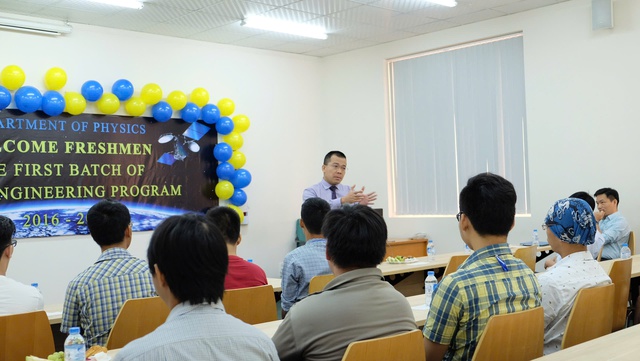
The Ministry of Education and Training plans to increase the scale of STEM education to over 1 million learners by 2030.
PHOTO: YEN NHI
INVESTMENT POLICIES AND INCENTIVES ARE NEEDED FOR STUDENTS TO LEARN.
At Ho Chi Minh City University of Industry, STEM majors account for two-thirds of the total 61 training programs. The number of students studying these majors accounts for more than 50%.
Dr. Nguyen Trung Nhan, Head of the Training Department of the school, stated: "In the last 2-3 years, the interest of candidates in these fields has increased. This is a positive sign. To achieve the national goal of having 35% of people studying STEM at each training level to serve the development of high technology, the government needs policies to attract talented students, such as providing scholarships and tuition fee reductions. The salary mechanism also needs to change. Currently, there is no specific salary mechanism for job positions in STEM fields."
Dr. Nhan also assessed that budget investment in laboratory systems in the fields of basic science and semiconductors for training purposes is still weak compared to the region. "The investment costs are very high, reaching several hundred billion VND per laboratory, so few universities can afford to invest in them themselves. Experience from other countries shows that in addition to state investment, businesses employing workers in these industries also have policies to invest in training facilities," Dr. Nhan stated.
Dr. Tran Dinh Khoi Quoc, Head of Training at Da Nang University, acknowledged that STEM training is very expensive, not only in terms of initial investment but also in the high annual costs of maintaining and operating equipment and consumables. "However, the main difficulty lies in the level of job demand after graduation, which will affect the number of students enrolling, and thus determine the direction of training programs offered by universities," Dr. Quoc stated.
To reduce the burden of investment costs, Associate Professor Dr. Nguyen Huu Hieu suggested that universities could build basic infrastructure, while large businesses could contribute to laboratories and practical training systems. "We can also develop online learning programs and virtual reality simulations in STEM to reduce costs," Associate Professor Dr. Hieu proposed.
















































































































Comment (0)