

Proposal to establish a specialized committee on public real estate.
Following the merger of administrative units as part of the policy to streamline the apparatus, a large amount of public real estate – including offices, land, and state assets – is at risk of being wasted or used inefficiently if there is no clear and transparent management mechanism.
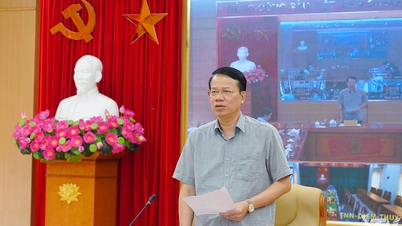
Regarding this issue, in an interview with Tien Phong newspaper, Professor Dang Hung Vo - former Deputy Minister of Natural Resources and Environment (now the Ministry of Agriculture and Environment ) - stated that restructuring administrative units is necessary and consistent with the direction of reforming the administrative apparatus. However, a consequence is the surplus of office buildings and public assets after administrative agencies are dissolved or merged.
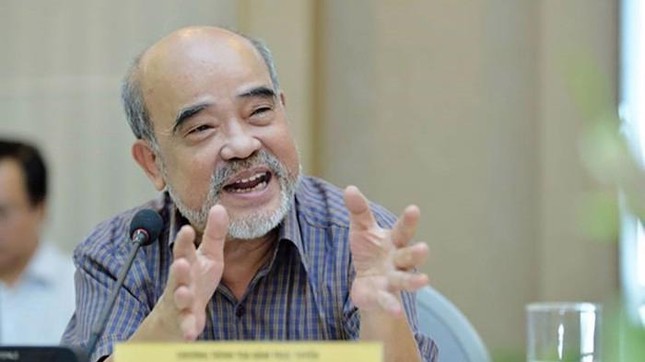 |
| Professor Dang Hung Vo. |
"The surplus of public assets after the restructuring of the administrative apparatus is not a new problem. Since our country transitioned from a centrally planned economy to a market economy (from 1986), a large amount of public assets have become surplus. In 2001, the Prime Minister issued a decision on the restructuring of land use in the public sector. This decision was piloted in Ho Chi Minh City, and five years later, the Prime Minister issued a decision to apply it nationwide. By then, a lot of public assets had already been misappropriated and lost," Mr. Vo said.
According to Mr. Vo, in the past, public assets were handled through privatization by transferring them to state-owned enterprises and public service units. However, reality has proven this ineffective and has resulted in significant losses.
"Currently, the mechanism for managing public assets remains fragmented and unclear. There are assets used by the central government but located within the provinces and cities that are entrusted with their management. So, which provincial or city unit would dare to demand that the central government hand over public land?" Mr. Vo questioned.
Mr. Vo also argued that, without coordinated efforts and effective utilization mechanisms, hundreds of old buildings would fall into disrepair, be abandoned, or even be exploited for opaque transfers, causing losses of state assets.
To prevent losses and wasteful use, Mr. Vo proposed the establishment of a specialized committee to manage public real estate with full authority, responsible for statistics, supervision, and decision-making regarding the use, liquidation, or auction of surplus public assets after mergers.
"The final decision should rest with the Government . We cannot allow a situation where the central government uses the land, the local government manages it, and then no one dares to take action," Mr. Vo emphasized, adding that the recovery and conversion of public land use could become a significant resource if managed transparently and publicly through auctions and tenders. This is not only a solution for efficient use of public assets but also a substantial source of revenue for the budget.
Reorganize surplus public land and properties, prioritizing their use for public purposes.
Mr. Le Hoang Chau, Chairman of the Ho Chi Minh City Real Estate Association (HoREA), believes that to effectively utilize the surplus land and housing fund after mergers, it is necessary to re-plan this fund. Based on that plan, priority should first be given to land serving public interests (healthcare, education, parks, green spaces, etc.). Next, priority should be given to allocating the surplus land and housing for resettlement projects to serve key projects that currently require this resettlement housing, such as public investment projects, PPP projects, and private investment projects to develop urban infrastructure and transportation infrastructure.
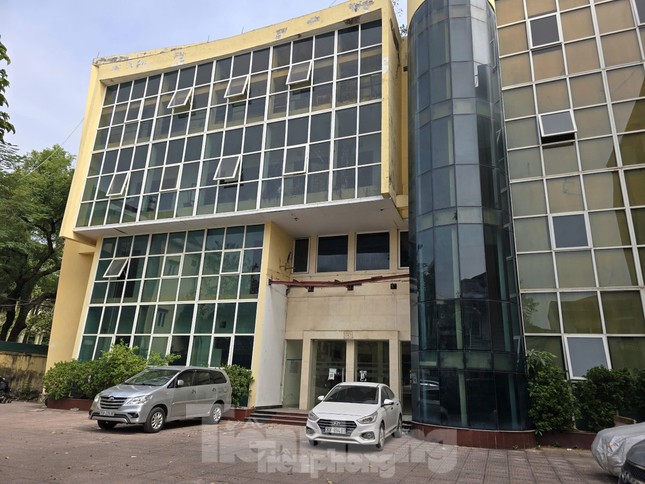 |
An abandoned public building in Hanoi. |
In addition, priority should be given to developing social housing projects in localities. Planning should also focus on developing affordable commercial housing to implement the National Assembly's pilot resolution 171, which allows the use of land other than residential land for commercial housing projects.
"To ensure effectiveness, when approving projects, we could even entrust the implementation to state-owned enterprises to help restructure the currently unbalanced real estate market," Mr. Chau said.
Furthermore, according to Mr. Chau, putting prime locations up for public auction generates significant revenue for the state budget, contributing to the creation of a transparent, fair, and healthy investment and business environment.
According to statistics from the Ministry of Finance, by the end of 2024, there were 11,034 public land and property assets that were unused, underutilized, or used for purposes other than intended. In February 2025, the Ministry of Finance issued a document guiding the handling of public assets when streamlining the administrative apparatus. Subsequently, on April 15, 2025, the Ministry of Finance issued a supplementary document guiding the arrangement, allocation, and handling of public assets when reorganizing administrative units and establishing a two-tiered local government. In addition, the Ministry of Finance also recently sent a document to the People's Committees of provinces and centrally-governed cities to direct the review and assignment of management responsibilities for specialized land and property funds and surplus land and property funds of localities...
Source: https://tienphong.vn/loat-phuong-an-tranh-bo-hoang-lang-phi-nha-dat-cong-doi-du-sau-sap-nhap-post1737782.tpo



















![[Photo] Reception to welcome General Secretary and President To Lam and his wife on their State visit to the Philippines](https://vphoto.vietnam.vn/thumb/1200x675/vietnam/resource/IMAGE/2026/06/01/1780295488620_vna-potal-chieu-dai-chao-mung-tong-bi-thu-chu-tich-nuoc-to-lam-va-phu-nhan-tham-cap-nha-nuoc-toi-philippines-8798060-7855-jpg.webp)























































Comment (0)