

Planting large timber forests not only brings economic benefits but also contributes to enhancing biodiversity, mitigating climate change, and preventing soil erosion. Recognizing this importance, for many years, Thanh Hoa province has implemented models and projects for developing large timber plantations that yield high economic returns, helping to realize farmers' dreams of becoming wealthy from forests.
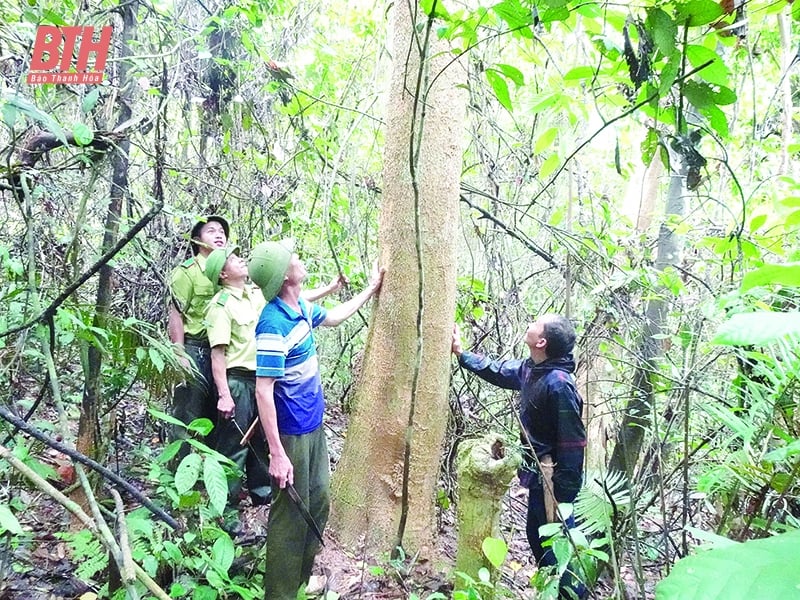
According to calculations by forest owners, profits from large-timber plantations are many times higher than those from small-timber plantations. For example, 1 hectare of small-timber acacia, with a growth cycle of 5 to 7 years, only yields 50 to 70 million VND when harvested, including investment and labor costs. However, with the same area, if the care cycle is extended to 10 to 15 years, the plantation owner can sell the timber at the sawn value, increasing revenue to 250-300 million VND.
Mr. Le Van Hung, from Hamlet 2, Xuan Du Commune (Nhu Thanh District), said that his family received a 9-hectare forest land lease from the Nhu Thanh Protective Forest Management Board. Many years ago, this forest land was mainly used by his family to plant acacia and eucalyptus trees with a cycle of 5 to 7 years. After harvesting and deducting investment costs, his family's income was only 10 to 15 million VND per hectare. Recognizing the low profit from planting small timber trees, in 2023, his family switched to planting large timber trees, with a cycle lasting over 10 years.
Sharing his thoughts on the benefits of this conversion, Mr. Hung stated that large timber forests yield higher economic value. If small-sized acacia forests are converted to large-sized acacia forests, with a care cycle extending from 10 to 15 years, the economic value of the acacia trees can triple. Simultaneously, switching to large-sized timber forests also helps his family reduce many incidental expenses such as labor, fertilizer, and seedlings.
Similarly, the family of Mr. Nguyen Huu Trong, in Ap Cu village, Xuan Thai commune (Nhu Thanh district), has been involved in forestry for many years, but their income from planting small timber trees has been steadily declining. To increase the economic value of their planted forest and reduce investment costs, in 2006, his family switched to planting large timber trees. Today, his family's large timber forest is worth billions of dong. On average, each acacia tree in his large timber forest has a diameter of 50cm or more, and the volume of timber is certainly higher than that of small timber trees. Mr. Trong shared: "Although the intensive cultivation period for large timber trees is long, in reality, the forest owner only has to invest labor and costs in the first 5 years; in the following years, the trees grow on their own. Trees over 5 years old also reduce the risks from weather conditions such as thunderstorms and floods."
Speaking about the benefits of developing large timber forests, Mr. Luong Hong Sy, Head of the Agriculture and Rural Development Department of Nhu Thanh District, said: "Developing large timber forests is one of the correct policies of the Central Government and the province aimed at increasing the value of forests. On December 5, 2016, the District People's Committee issued Decision No. 4341/QD-UBND approving the Project 'Development of large timber plantations and restoration of green lim forest in Nhu Thanh District, giai đoạn 2016-2021, with orientation to 2030'. After 5 years of implementation, the entire district has converted more than 400 hectares from small timber forests to large timber forests; planted more than 3,700 hectares of new large timber forests; and restored approximately 90 hectares of green lim forest."
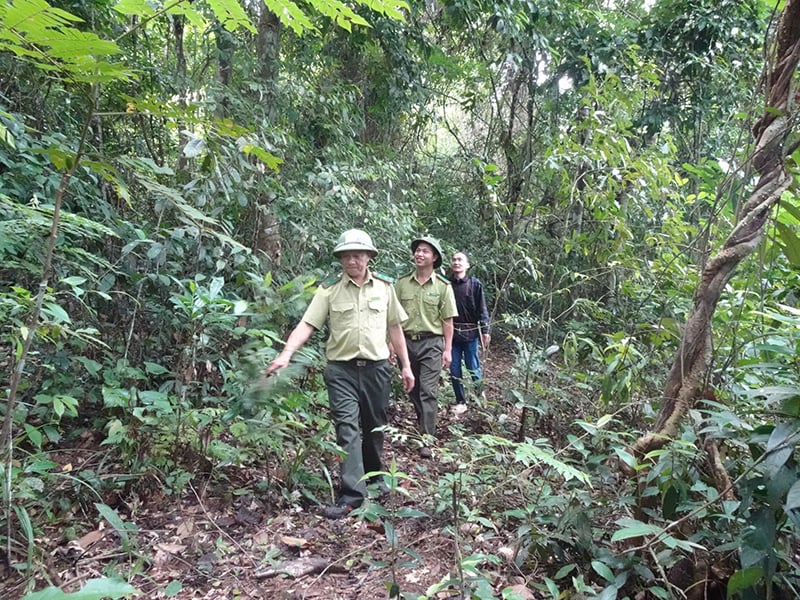
Besides its economic value and income-boosting benefits for the people, planting large timber forests also brings many environmental and social benefits. For example, the model of planting large timber forests combined with water resource protection involves planting native green lim trees and flowering lat trees to restore the natural forest ecosystem. In hilly areas along rivers and streams, and in protective forests, planting large timber forests is established as an ecological solution, both increasing income for forest owners and contributing to reducing the risk of soil erosion and protecting water resources. According to statistics from the Provincial Forest Protection Department, in the period 2011-2015, the entire province planted more than 54,000 hectares of new forest. However, during this period, the area and timber production of planted forests mainly applied the method of planting small timber for commercial purposes, with a cycle of 5-7 years in an extensive manner to produce raw materials for paper and wood chips, resulting in low economic value.
To improve the economic efficiency of planted forests and create concentrated timber raw material areas to supply factories and wood processing villages, Thanh Hoa province issued Decision No. 4170/QD-UBND dated October 27, 2016, approving the Project "Development of large-timber plantation forests in Thanh Hoa province until 2020". As a result, during the period 2016-2020, the entire province developed 56,000 hectares of large-timber plantation forests and has maintained this area stably to date. The main tree species planted for large-timber forests are Australian acacia, tung tree, and Vietnamese mahogany. Of this, over 22,000 hectares of forest with sustainable forest management certification are maintained across 7 districts: Thach Thanh, Quan Son, Lang Chanh, Vinh Loc, Cam Thuy, Nhu Xuan, and Nhu Thanh, with the participation of 5,369 households, forming 7 linkage chains between forest owners (households, groups of households) and wood processing factories. On average, timber production reaches 900,000 m3/year, and the value of forestry production exceeds 2,000 billion VND, an increase of over 800 billion VND compared to 2016 - the time before the project was implemented.
With the goal of maintaining and developing a stable area of approximately 56,000 hectares of large-timber plantations in Thanh Hoa province by 2025, meeting the demand for timber for processing and export, many intensive large-timber plantation models have been implemented and are being replicated in districts such as Lang Chanh, Nhu Thanh, Nhu Xuan, and Thuong Xuan in recent years to expand the area and improve the efficiency of large-timber plantations in the province.
Text and photos: Dinh Giang
Lesson 2: Potential is open, but many "barriers" remain.
Source: https://baothanhhoa.vn/phat-trien-rung-ben-vung-bai-1-loi-ich-kep-tu-rung-trong-go-lon-234193.htm


![[Photo] Prime Minister Pham Minh Chinh presides over the conference announcing the establishment of the International Finance Centre in Vietnam.](/_next/image?url=https%3A%2F%2Fvphoto.vietnam.vn%2Fthumb%2F1200x675%2Fvietnam%2Fresource%2FIMAGE%2F2025%2F12%2F21%2F1766309817714_ndo_br_dsc-3400-jpg.webp&w=3840&q=75)
![[Photo] Prime Minister Pham Minh Chinh presides over a meeting on private sector economic development.](/_next/image?url=https%3A%2F%2Fvphoto.vietnam.vn%2Fthumb%2F1200x675%2Fvietnam%2Fresource%2FIMAGE%2F2025%2F12%2F20%2F1766237501876_thiet-ke-chua-co-ten-40-png.webp&w=3840&q=75)











































































Comment (0)