

From the city to the rooftops of Hoi An halfway up the hill.
Khanh Thuong is the most remote mountainous area in Ba Vi commune, Hanoi . In recent years, this place has witnessed a fascinating reverse migration. This is the emergence of the Lang Gao group, a community of educated people who have left the hustle and bustle and pressures of city life to live here, choosing a lifestyle in harmony with nature and teaching their children to be independent. Among them is the family of Ms. Nguyen Thi Thu Hang (commonly known as Hang Luna).
Before moving to Khánh Thượng, Ba Vì, Hằng and her husband had a stable life in Hanoi that many people envied: high income, readily available vehicles, and their children attending expensive bilingual schools. However, behind that success lay an unsettling void.
Ms. Hang candidly shared about her psychological crisis before relocating: "When we lived in the city, both my husband and I were busy with work from morning till night, leaving very little time to interact with our children. Living in a system with enormous expenses, I was constantly surrounded by fear: fear of losing my job, fear of not having an income and therefore an unstable life, fear of illness from daily exposure to so many cancer cases from medical projects. When I realized my mental state was weak and I was always insecure, my husband and I discussed quitting our jobs at the same time to step out of our comfort zone and find a more spacious living environment closer to nature."
It was a friend's recommendation of the Rice Village group and the pristine Khánh Thượng area, where kindred spirits find solace in each other, that led her family to decide to move there permanently after just one visit. Since moving to Khánh Thượng, her health and spirits have improved significantly. From someone with severe myopia of 4.5 degrees and chronic neck and shoulder pain typical of office workers, her life of labor and gardening in the sun and wind of Ba Vì has helped her recover to the point where she no longer needs glasses.
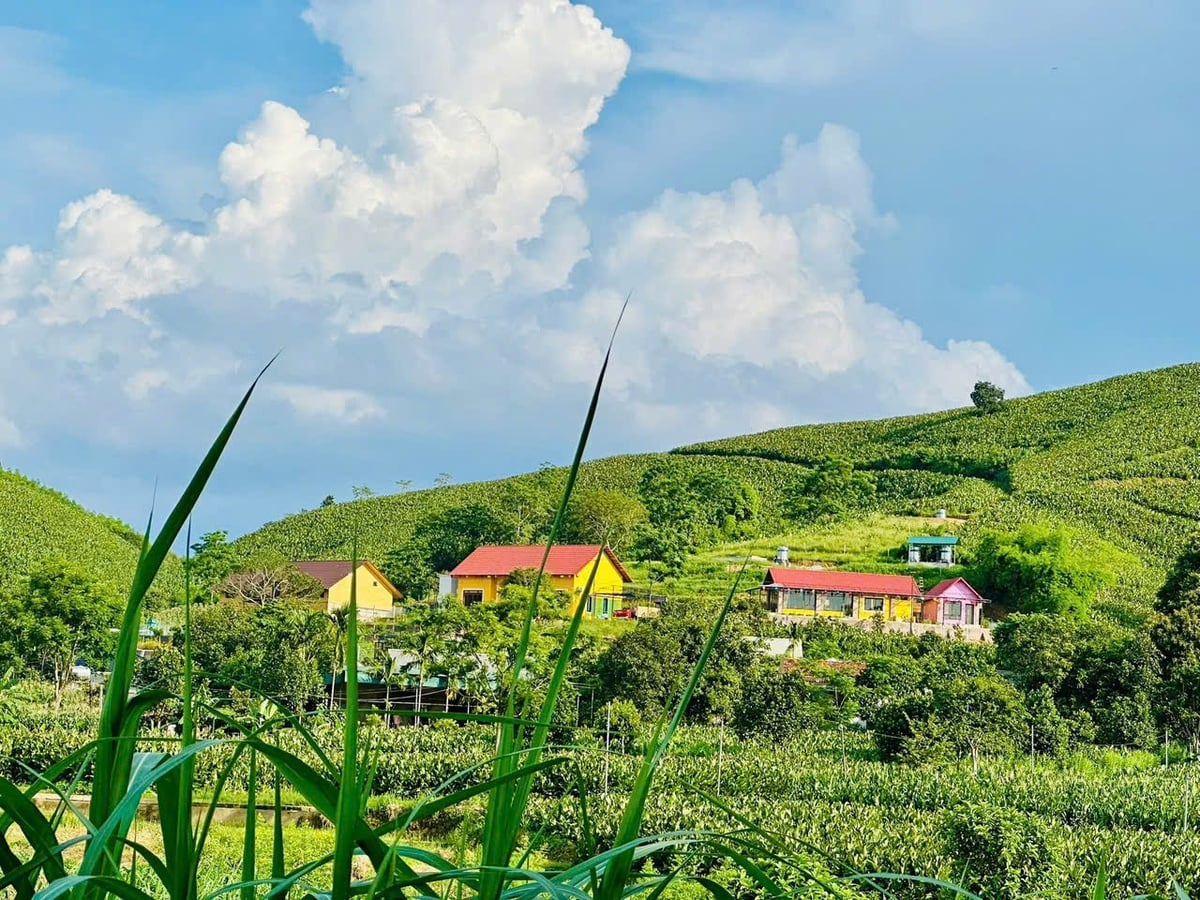
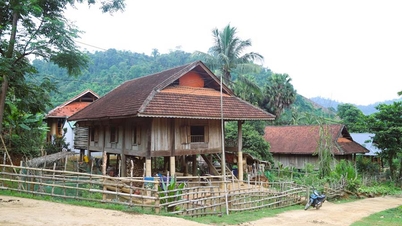
The Hoi An-style house, seen from afar, in Khanh Thuong, belongs to the family of Ms. Nguyen Thi Thu Hang.
Currently, their Hoi An-style house with its warm yellow walls has become an integral part of the village. The family sustains their lives through the wife's online English teaching work, while the husband tends to the garden and personally completes the living space. Their two daughters have also experienced significant changes, leaving expensive private schools in the city to attend the village school near their home. The two daughters quickly adapted to their new life, attending village school during the day and helping their parents with gardening and household chores, while in the evenings they independently participate in the American homeschooling program.
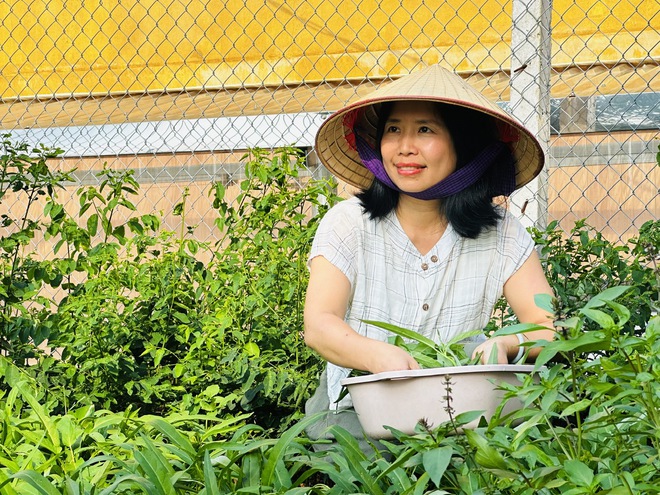
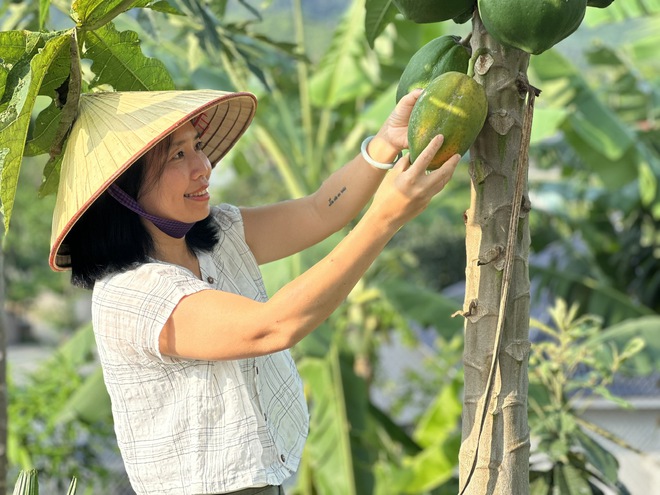
Ms. Hang next to her family's vegetable garden.
Amidst the windswept hills, the life of this family of four flows peacefully and serenely. Free from the hustle and bustle of city life and the pressures of urban life, their time in Khánh Thượng has restored peace of mind and given their children a complete childhood surrounded by nature.
Having found peace in this land and its people, Ms. Hang chose to repay this land with knowledge. She dedicated a spacious and well-equipped area in her house to open a free English class for children in the Muong village.
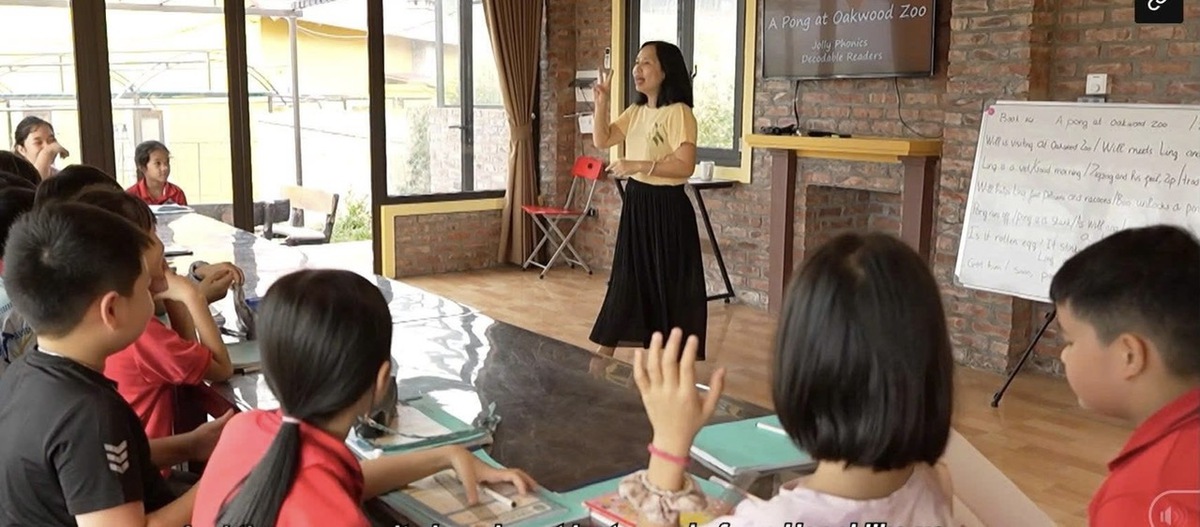
Ms. Hang conducted in-depth research on the American curriculum and personally developed a systematic learning materials system, starting from the most important foundation: accurate pronunciation.
The journey of sowing knowledge and reaping sweet rewards.
Despite graduating with a degree in French from the University of Foreign Languages (Vietnam National University, Hanoi), Ms. Hang has used English as her primary work tool for many years. Her practical experience working continuously in a multilingual environment helped her realize the core importance of accurate learning methods from the very beginning. She thoroughly researched the American curriculum and personally developed a systematic learning system starting from the most crucial foundation: accurate pronunciation.
Regularly, every Monday and Thursday afternoon, right after school, the children excitedly call each other to head up the hill and gather at Ms. Hang's golden house. The class always maintains a stable number of 12 to 15 students. The biggest challenge for this class in the highlands is that the students' mouth shapes and voices are heavily affected by the local dialect; their throats are stiff, so their pronunciation is often slurred.

The spacious classroom
To solve this problem, Ms. Hang's two daughters – children with a strong English foundation from the city – became invaluable assistants. The two sisters acted as teaching assistants, directly correcting each pronunciation error and mouth shape mistakes for the younger students, while also participating in filming sample video clips for homework assignments. The companionship of peers helped bridge the gap in the classroom.
The perseverance of Ms. Hang Luna and her two daughters, after exactly one year, has brought about an amazing change. The hesitant, lisping speech of the past has now been replaced by accurate and clear English pronunciation.

Ms. Hang's second daughter helps her younger siblings with their assignments.
The journey of third-grade student Dinh Ngoc Diep is a remarkable story. Growing up in a farming family where neither parent spoke English, Diep came to school with great insecurity due to her speech impediment and strong regional accent. Correcting the pronunciation of a child from a mountainous region who had never been exposed to a foreign language was truly a challenging task.
Ms. Hang recalled: "Teaching this child was extremely difficult at first because her habit of pronouncing words in a very informal way was very hard to change. She kept saying 'school' for ages. Initially, whenever she stood at the blackboard, she would wrap her sleeves and then her pants legs up, very timid. But I patiently encouraged her. Diệp's mother, although not knowing English, closely supported her at home, following the teacher's instructions. After six months of effort, Diệp overcame her own limitations. Now she can hold an English book and read very well, confidently speaking fluently in front of the class."
Holding a book in her hand and standing confidently in front of the class, Ngoc Diep shared: "Before, I used to be very nervous when I stood up. Thanks to Ms. Hang's guidance and the older girls' help correcting my mouth movements, I can now read correctly and I'm no longer afraid. I want to study really well."
Clip: Student Dinh Ngoc Diep introduces herself and shares her feelings about Ms. Hang Luna's English class in English.
Another equally touching story is that of Dinh Van Phu, a second-grade student. Phu's home is deep in the village, 4 kilometers from Ms. Hang's classroom. His family works hard in agriculture, but Phu's mother has a progressive mindset, wanting her son to receive a proper education so that he can have the opportunity to face the world later. Throughout the past school year, regardless of sunny days or rainy, slippery days, Phu has never missed a single class and has always completed his homework.
Speaking emotionally about her young student, Ms. Hang said, "Phu has made remarkable progress thanks to his hard work and determination. Because of his mother's great dedication and his seriousness, I have decided to teach and support him for the long term."
The educational philosophy of the free class.
The depth in Ms. Hang Luna's educational model lies not in the word "free," but in discipline and self-respect. For her, English is the initial attraction that draws children to class. But what she wants to instill in these children from mountainous regions through her lessons is the ability to learn independently, a sense of responsibility towards themselves, and the perseverance to see things through to the end.
She doesn't accept the mindset that "anything goes since it's free." She sets strict rules: if students don't complete assignments or violate disciplinary requirements, she will ask them to stop attending. In fact, Ms. Hang has already dismissed several students for failing to meet their commitments.
This philosophy contains a profound life lesson that she wants to impart to the children in the highlands: "I want you to understand that nothing in this world comes naturally and for free. Every achievement must be earned through effort, sweat, and self-effort. Receiving support does not mean you have the right to be careless about your own future."
Besides imparting knowledge, she skillfully incorporated lessons on self-reliance and mutual support into her classes. Just as the community of Lang Gao village relies on each other during rice harvesting, peanut planting, and flower gathering, Ms. Hang also teaches the children how to share knowledge as a beautiful way of life. She instills in them a new mindset: being proficient in English isn't about showing off, but rather that English is the best tool, the key, for them to confidently step out of their village and access the knowledge of the world.
As the afternoon class drew to a close, the children chattered excitedly as they descended the hill to go home. After a year, Ms. Hang Luna's class had become a familiar part of the village. Beyond providing knowledge, the teacher's seriousness and love were silently helping the children change each day, making them stronger and more independent on their journey ahead.
Source: https://phunuvietnam.vn/lop-hoc-tieng-anh-0-dong-o-khanh-thuong-238260520155856382.htm













































































Comment (0)