

Improving rice production efficiency
Due to limited rice cultivation area and low income from rice farming, most rice farmers find it difficult to become wealthy. Even with 5 hectares of rice land, Mr. Thieu's family faces challenges in increasing their income, especially given the high prices of agricultural inputs and the frequent, unfavorable fluctuations in rice prices. Notably, in recent times, the prices of many types of commercial rice have often decreased during the peak harvest season. Without the facilities to dry and store the rice to wait for higher prices, most farmers have to sell their fresh rice directly to traders in the fields immediately after harvest, often accepting relatively low prices. This significantly impacts rice production efficiency and farmers' income.
Recognizing these challenges, Mr. Thieu was determined to find ways to stabilize the output price of rice. Through research and understanding market information and demand, he realized a reality: To have a stable output and sell at a higher price than the market, farmers need to connect with units and businesses through guaranteed purchase contracts. In particular, they need to create high-quality or differentiated products to attract higher purchase prices from businesses. Specifically, instead of producing conventional rice for commercial purposes, they should switch to producing rice seeds. Mr. Thieu said: “Through researching market demand, as well as directly connecting and exchanging information with various organizations and businesses, I realized that the demand for rice seeds is very high and many organizations need to cooperate with farmers to produce rice seeds. Therefore, I decided to switch to producing rice seeds. For the past 5 years, I have been producing rice seeds according to orders from organizations and businesses, so the product output is stable and I always sell rice at a price 500-1,000 VND/kg higher than the market price of commercial rice. I also study and apply new scientific and technical advancements to production. As a result, the rice achieves good yield and quality, and many input costs are reduced, helping me increase profits.”
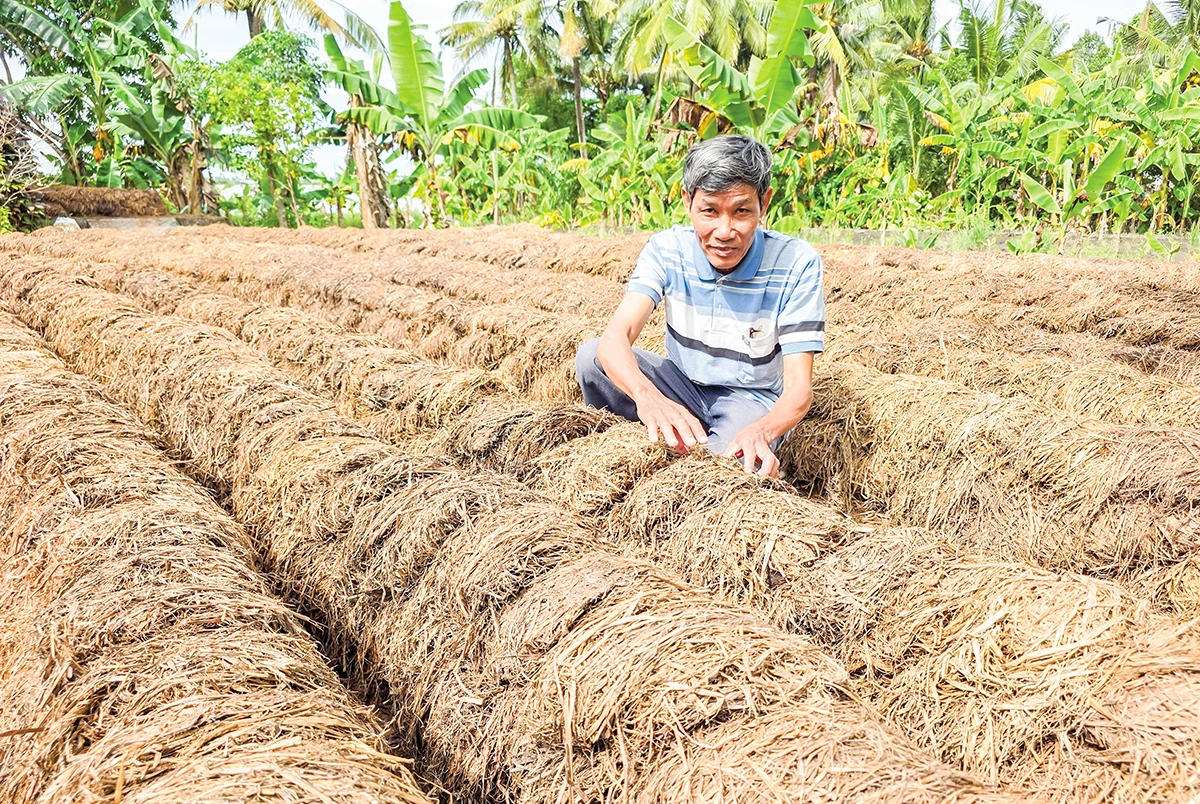
Mr. Pham Dinh Thieu makes good use of the vacant land around his house to grow straw mushrooms in order to increase his income.
During the recent 2025 autumn-winter crop season, rice prices dropped due to the impact of falling export rice prices. Many farmers producing commercial rice (rice for consumption) earned low profits, or even losses, but Mr. Thieu still made a profit of about 25 million VND/hectare from growing rice seeds. In previous summer-autumn and winter-spring seasons, growing rice seeds yielded profits of 30-40 million VND/hectare or more because the rice crops in those seasons were bountiful and sold at high prices.
Increase income from straw by-products.
Mr. Thieu produces three rice crops per year. Therefore, the amount of straw by-product from rice production is substantial, reaching tens of tons. Recognizing that burning straw in the fields is wasteful and creates smoke and dust that pollutes the environment, he has been utilizing this straw to cultivate straw mushrooms on the field edges and vacant land around his house. This cultivation not only solves the problem of straw waste but also provides his family with a significant additional income. The straw residue after mushroom cultivation is an excellent source of organic fertilizer. Therefore, he makes full use of this as organic fertilizer for his crops, reducing input costs and increasing income. With the support and guidance of the Department of Agriculture and Environment of Can Tho City and other relevant agencies, Mr. Thieu has developed straw mushroom production using an indoor cultivation model. This method not only helps proactively prevent adverse weather conditions such as rain and sun but also helps achieve high yields and quality mushrooms. Harvested mushrooms are white and beautiful, and fetch a higher price than mushrooms grown outdoors.
Mr. Thieu said: “I started growing straw mushrooms at the beginning of 2024, initially mainly utilizing the straw readily available from my family's rice cultivation. Seeing the economic benefits, I bought more straw from other households to expand the scale. Especially from the end of 2024, after successfully implementing the indoor straw mushroom cultivation model, I increased my straw purchases and hired more local laborers to boost production.”
Currently, Mr. Thieu uses approximately 170-300 bales of straw per month, yielding an average of 300kg of straw mushrooms. With the selling price of straw mushrooms consistently high, ranging from 50,000-90,000 VND/kg, after deducting expenses, his family earns about 10-15 million VND per month. In addition to this income, he also earns extra income from the straw residue generated during mushroom cultivation. In 2024, he mainly sold this residue to households growing ornamental plants and vegetables. This year, he supplies the straw residue to the Tien Thuan Agricultural and Service Cooperative (Thanh Quoi commune) – where he is a member – for the production of organic fertilizer.
In the future, Mr. Thieu plans to expand the scale of his straw mushroom cultivation, not only to increase his family's income but also to contribute to creating more jobs and stable income for many people in the locality. Currently, he has a 72m2 farm area for his indoor mushroom cultivation model. According to Mr. Thieu, indoor mushroom cultivation allows for multiple consecutive harvests per year, and he can arrange many shelves to maximize space utilization. With an impressive yield of 1.8-2kg of mushrooms or more per straw bale, the indoor mushroom cultivation model is proving its superior economic efficiency, reinforcing his determination to expand this production scale.
Text and photos: KHANH TRUNG
Source: https://baocantho.com.vn/lua-nam-phan-huu-co-mo-hinh-tuan-hoan-tao-thu-nhap-kep-a194749.html

![[Image] Hanoi's urban life under the challenge of a "scorching hot" environment](https://vphoto.vietnam.vn/thumb/1200x675/vietnam/resource/IMAGE/2026/05/25/1779706979265_nang-nong-t5-2026-minh-duy-7-4636-jpg.webp)


![[Image] Close-up view of the interchange connecting the two expressways and Long Thanh Airport.](https://vphoto.vietnam.vn/thumb/1200x675/vietnam/resource/IMAGE/2026/05/25/1779703378210_ndo_br_z7863716673926-224453a31600126cce10622af6290afd-4549-jpg.webp)



































































Comment (0)