

 |
National Assembly delegates vote to pass the draft law at the 9th session of the 15th National Assembly. Photo: VNA . |
On the morning of June 27th, the National Assembly voted to pass the Law on Science , Technology and Innovation with a 91% approval rate.
The scope of the Law covers the implementation, measures to ensure development, and state management of science, technology, and innovation. The Law applies to organizations and individuals engaged in science, technology, and innovation activities in Vietnam or outside Vietnam but with rights and obligations under Vietnamese law, and takes effect from October 1, 2025.
A new feature of the Law on Science, Technology, and Innovation is the principle of risk acceptance in scientific and technological activities. Organizations and individuals carrying out tasks, if they have fully complied with the prescribed procedures and have not misused funds, are exempt from administrative and civil liability when causing damage to the State. Those who approve and manage tasks using state budget funds are also exempt from liability if they have followed the correct procedures.
The law stipulates the exclusion of criminal liability under the Criminal Code for risks arising during the research, testing, and application of scientific, technical, and technological advancements.
The government sets criteria for determining acceptable risks and procedures for assessing compliance with those procedures and regulations.
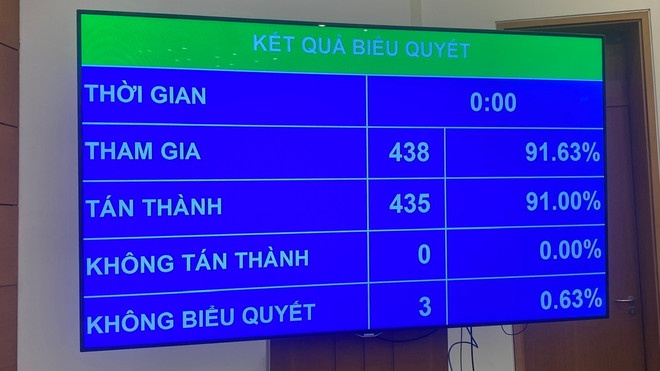 |
Results of the vote on the Law on Science, Technology and Innovation. Photo: Vietnam+ . |
Overall, the Law stipulates that scientific, technological, and innovation activities should be linked to socio-economic development, increased labor productivity, and sustainable growth. The State plays a facilitating role in developing scientific and technological infrastructure, supporting basic research, applied research, and technology transfer.
Businesses are identified as the center of the innovation system. The state implements policies to support, invest in, cooperate with, and assign tasks to develop strategic technologies.
Organizations that lead scientific and technological tasks using state budget funds are entitled to own the research and development results of the task, except in some special cases such as national defense and security or when the results need to be widely disseminated for public purposes.
The owning organization has the right to publish and register the results for protection and is responsible for implementing and commercializing them. Profits obtained from the transfer, assignment, or capital contribution of results from state-funded scientific and technological projects may be used to reward individuals participating in research and development, individuals participating in the commercialization of research and development results, or reinvested in research and development activities.
Source: https://znews.vn/luat-khoa-hoc-cong-nghe-mien-trach-nhiem-hinh-su-neu-dung-quy-trinh-post1564134.html
![[Photo] General Secretary To Lam visits the exhibition space showcasing books, photo exhibitions, and achievements of digital transformation in journalism.](/_next/image?url=https%3A%2F%2Fvphoto.vietnam.vn%2Fthumb%2F1200x675%2Fvietnam%2Fresource%2FIMAGE%2F2025%2F12%2F19%2F1766110879215_1766110240024-jpg.webp&w=3840&q=75)
![[Photo] Enchanting ancient rose garden on the mountainside in Nghe An](/_next/image?url=https%3A%2F%2Fvphoto.vietnam.vn%2Fthumb%2F1200x675%2Fvietnam%2Fresource%2FIMAGE%2F2025%2F12%2F19%2F1766109900916_vuon-hong-chin-do-thu-hut-du-khach-toi-check-in-o-ha-noi-3-20162778-1671624890024-1671624890104198100259.jpeg&w=3840&q=75)







































![[INFOGRAPHIC] Overview of the Hoa Phat Dung Quat Rail and Special Steel Production Plant Project](https://vphoto.vietnam.vn/thumb/402x226/vietnam/resource/IMAGE/2025/12/19/1766111183203_z7339170069817-126a3e5a095f62e606a0be41015c1b80.jpeg)


















































Comment (0)