

Many key projects in the city, such as the expansion of Nguyen Thi Dinh and Chu Van An roads, and the My Thuy intersection, have been delayed or undergone changes in scale, causing costs to increase many times over.
The project to expand Nguyen Thi Dinh Street to 30 meters (2 km long, from Giong Ong To Bridge to My Thuy Bridge, Thu Duc City) has just been approved by the Ho Chi Minh City People's Council with a revised investment plan of 2,100 billion VND.
Eight years ago, when this project was first approved, the total capital for the construction was 1,400 billion VND, including land acquisition and construction. Due to delays in implementation, the project's investment capital has increased by an additional 700 billion VND. Of this, the entire additional capital is allocated to land acquisition, while the construction portion remains at the original level of nearly 295 billion VND.
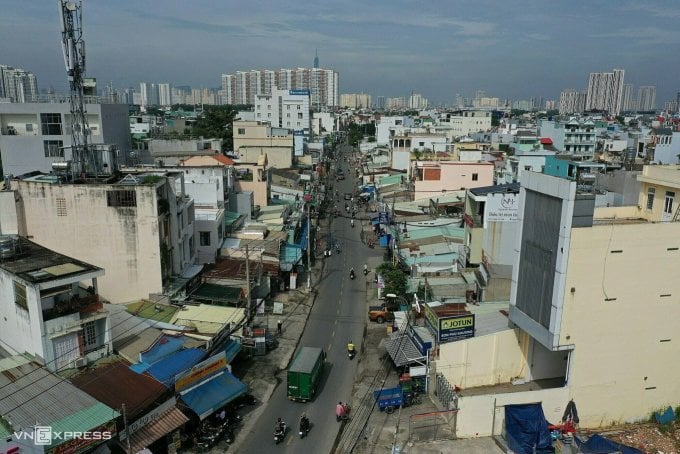
Nguyen Thi Dinh Street, Thu Duc City, from above. Photo: Quynh Tran
Similarly, the Chu Van An road expansion project, from the Binh Hoa five-way intersection to Phan Chu Trinh road in Binh Thanh district, has also recently had its investment plan adjusted with a total capital of over 1,000 billion VND. The 600-meter section will be widened from 5-6 meters to 23 meters, with completion expected in 2026. Compared to the original plan, the project has decreased in scale (both length and width), but the total investment has increased by nearly 400 billion VND after updating compensation and land clearance costs.
Previously, many projects scheduled for 2016-2020 but not yet completed also experienced cost overruns due to increased land acquisition costs. Typical examples include the My Thuy intersection project in Thu Duc City (increased from VND 1,998 billion to VND 3,622 billion); and the renovation of the Hang Bang canal, from Mai Xuan Thuong street to Van Tuong canal in District 5 (increased from VND 188 billion to VND 779 billion). Projects such as the construction of Tang Long and Ong Nhieu bridges (Thu Duc City), and Phuoc Long bridge (connecting District 7 and Nha Be)... also saw increased investment costs compared to previously approved levels.
Dr. Tran Quang Thang, Director of the Institute of Economics and Management of Ho Chi Minh City and a representative of the Ho Chi Minh City People's Council, believes that the increase in total investment capital for infrastructure projects in the city is mainly due to increased compensation costs. "The slow pace of land clearance leads to inflated prices over time," he said.
Analyzing the causes, this expert suggested that in the previous phase, the funds allocated for compensation were insufficient, and the negotiation process for compensation prices between the government and the people often dragged on. Furthermore, some projects were restructured to a larger scale, leading to increased costs for both compensation and construction.
Furthermore, according to Mr. Thang, a subjective reason is the reluctance of officials to carry out tasks, causing delays in project implementation. Many units and individuals who were slow in disbursing public investment funds have been reprimanded and criticized by city leaders. However, regardless of how disciplinary action is taken and responsibility is assigned, the social and budgetary consequences must still be borne.
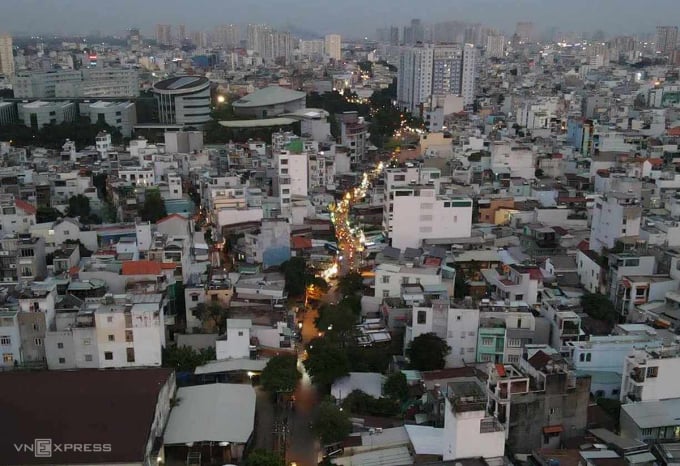
The narrow section of Chu Van An Street from Binh Hoa Five-Way Intersection to Phan Chu Trinh Street is about to be widened. Photo: Dinh Van
Dr. Pham Viet Thuan, Director of the Institute of Resource and Environmental Economics in Ho Chi Minh City, said that the situation of delayed project implementation leading to increased investment costs is not unique to the city; it also occurs in many other localities. Of these costs, over 90% is due to land clearance, while the construction costs, when factoring in inflation and labor costs, only account for a very small increase.
From the local perspective, representatives from the People's Committee of Thu Duc City stated that for public investment projects, when preparing the documents, they will provide an estimated compensation cost as a basis for submitting the investment plan for approval. However, many projects were approved 3-4 years prior to the initial approval date, while land prices have increased and are no longer appropriate, thus requiring adjustments. In particular, the high increase in land prices in Thu Duc City after the merger of the three districts has further complicated the compensation process.
On the other hand, local authorities also argue that changes in the Land Law regulations significantly impact the implementation process, leading to changes in how land types are determined, land prices, and implementation procedures. "The longer a project drags on, the higher the land prices become, greatly affecting compensation work and making the adjustment process very complicated," said a representative from Thu Duc City.
A leader from the Ho Chi Minh City Traffic Construction Project Management Board also stated that the biggest difficulty in the projects is land clearance. It is very rare for investors to receive clean land immediately; most projects are completed in small, intermittent stages. This affects construction efficiency, and many projects have to proceed at a slow pace. Project delays also lead to increased costs for contractors and inflation. "In reality, many projects, after receiving land, should be completed within 12-15 months," he said.
To address the issue of project cost overruns, Dr. Tran Quang Thang suggested professionalizing land clearance procedures. The city currently has many crucial committees related to infrastructure, transportation, and civil engineering, accounting for up to 70% of public investment disbursement. These committees need to coordinate with local authorities, understand local customs and aspirations, and strive for consensus.
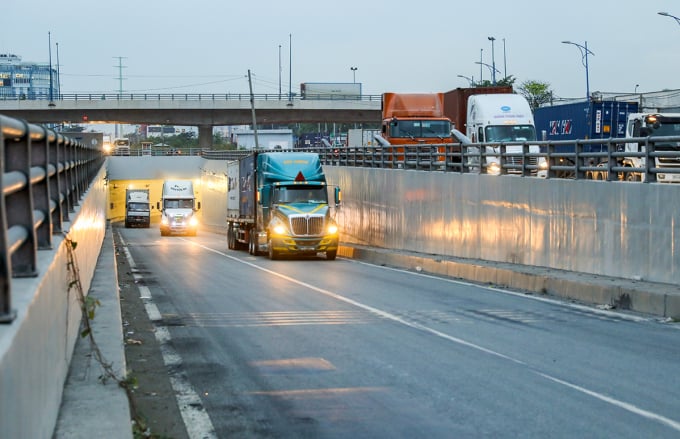
Vehicles drive through the My Thuy intersection underpass in Thu Duc City, after the completion of the first phase. Photo: Quynh Tran.
In addition, according to Mr. Thang, the city should allocate funds early in the year, "not waiting until the end of the year to start," which puts pressure on disbursement. Procedural steps also need to be streamlined to speed up project progress. For example, recently a business wanted to finance the construction of a pedestrian bridge connecting District 1 with Thu Duc City. The design and planning are in place, and funding has been committed, but construction is not scheduled to begin until April 2025. "Such procedures are too lengthy; we need to study ways to shorten them," he said.
Meanwhile, Dr. Pham Viet Thuan suggested reviewing the land preparation process for construction projects. In reality, many projects, from the initial survey and documentation stages to the approval of technical plans, only compensate residents after the land prices have already changed. Furthermore, the initial surveys and cost estimates for these projects are often unrealistic, especially regarding compensation, which accounts for over 50% of the total investment, leading to multiple adjustments to the total investment. This directly impacts the implementation plans of these projects.
"Compensation and resettlement should be separated into a distinct component project to be implemented first. Construction may not begin now, but preparing a clean site early will shorten the implementation time later and limit cost overruns," Mr. Thuan said, adding that the city needs stronger measures during the land clearance process, because in reality, many projects have only a few cases of delayed relocation that affect the entire project.
Le Tuyet - Gia Minh
Source link
























































































Comment (0)