

This August, a section of the upper stage of the SpaceX Falcon 9 rocket is expected to collide with the Moon at speeds exceeding 8,600 km/h (equivalent to supersonic speeds, seven times the speed of sound - Mach 7). This event was detected and tracked by renowned astronomer Bill Gray using specialized orbital prediction software.
According to historical data, this is debris from a rocket launch on January 15, 2025, intended to send American and Japanese lunar landers to the Moon. At that time, a SpaceX Falcon 9 rocket was launched to carry the Blue Ghost and Hakuto-R landers to the lunar surface. The Blue Ghost landed successfully, while the Hakuto-R lander crashed to the surface. At maximum speed, this part of the rocket would have completely vaporized upon impact, leaving only a small crater on the surface of Earth's natural satellite.
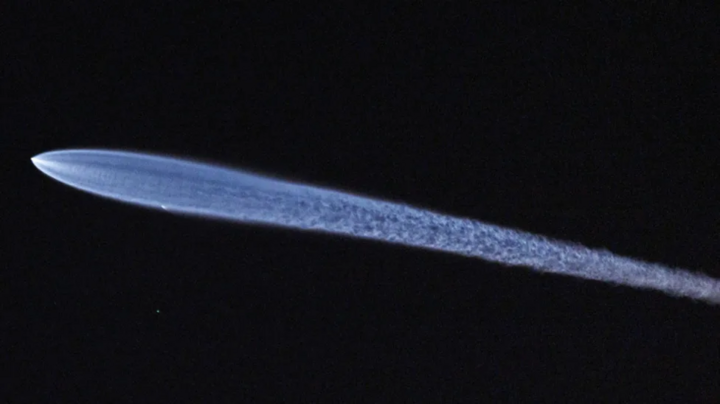
Image of a SpaceX Falcon 9 rocket launching into orbit. (Source: Getty Images)
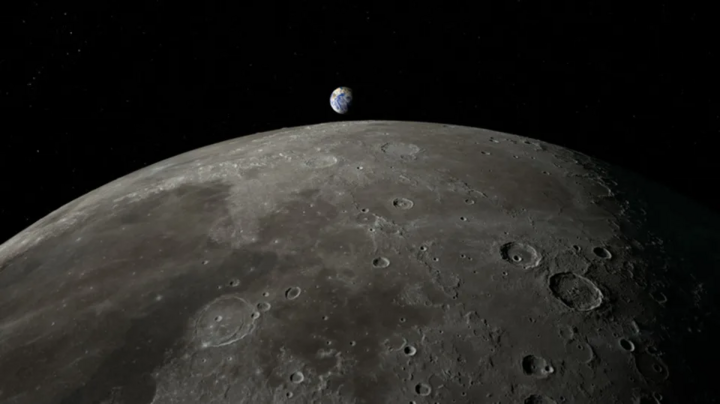
An impact crater on the Moon with Earth in the background. (Source: Getty Images).
Although a single collision of this scale may not cause significant damage, experts warn that similar accidental incidents will become a serious threat in the near future. Currently, government agencies like NASA and private aerospace corporations are increasing the frequency of spacecraft launches to realize the goal of building permanent bases on the Moon.
Astronomer Bill Gray stated: "As space traffic increases, establishing controlled debris disposal orbits is a necessity to protect instruments and people on the surface of celestial bodies."
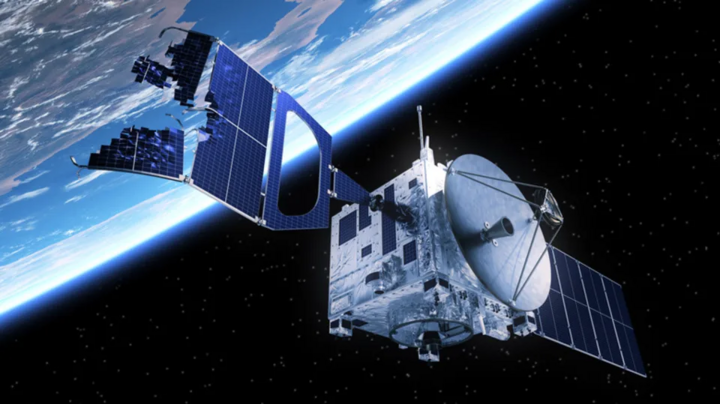
Fragments of a space satellite are orbiting Earth. (Source: Getty Images)
Space debris has long been a troubling issue for scientists . According to a report by the European Space Agency (ESA), the density of man-made objects in orbit has skyrocketed since commercial satellite networks, such as SpaceX's Starlink system with over 10,000 satellites, began operating. The International Space Station (ISS) now has to constantly adjust its altitude daily to avoid debris and prevent catastrophic direct mechanical collisions.
Beyond the dangers of deep space, the problem of uncontrolled space debris threatens the safety of people on Earth as it freely falls through the atmosphere. In early 2025, a piece of debris identified as belonging to an Indian rocket fell into a village in Kenya, causing widespread alarm. Although engineers constantly try to steer defunct satellites back to "Point Nemo"—an isolated area in the South Pacific dubbed a space graveyard—thousands of pieces of free-falling space debris could re-enter the atmosphere at any time.
To thoroughly address this problem, scientists have proposed many groundbreaking technical solutions such as using giant collection nets, electromagnets, or long-range grappling hooks. However, these technologies are still at the experimental conceptual stage and require significant time to optimize costs before being put into practical application.
Source: https://vtcnews.vn/manh-vo-ten-lua-spacex-sap-va-cham-voi-mat-trang-o-van-toc-mach-7-ar1020179.html


![[Photo] The heat at the fireworks display site on the opening night of the Da Nang International Fireworks Festival 2026](https://vphoto.vietnam.vn/thumb/1200x675/vietnam/resource/IMAGE/2026/05/27/1779889741485_ndo_br_z7872039145157-fecaba5112f39e8352544099d7ef4738-5140-jpg.webp)

![[Photo] The courage of new recruits of Brigade 144 on the training ground.](https://vphoto.vietnam.vn/thumb/1200x675/vietnam/resource/IMAGE/2026/05/27/1779881651341_anh-man-hinh-2026-05-27-luc-18-32-52.png)



























































![[Photo] The courage of new recruits of Brigade 144 on the training ground.](https://vphoto.vietnam.vn/thumb/402x226/vietnam/resource/IMAGE/2026/05/27/1779881651341_anh-man-hinh-2026-05-27-luc-18-32-52.png)
































Comment (0)