

THE INFORMATION IS BOTH THERE AND THERE IS NOTHING…
It has been almost a month since the Ministry of Education and Training issued the plan for university and college admissions for early childhood education (collectively referred to as university admissions), but so far very few universities have published their admissions plans. According to admissions officers at several universities, the reason they haven't rushed to publish their plans is because they haven't yet developed a tuition fee collection plan. In reality, even those universities that have published their plans only provide vague and ambiguous information regarding tuition fees. Some universities even publish plans that are practically useless.
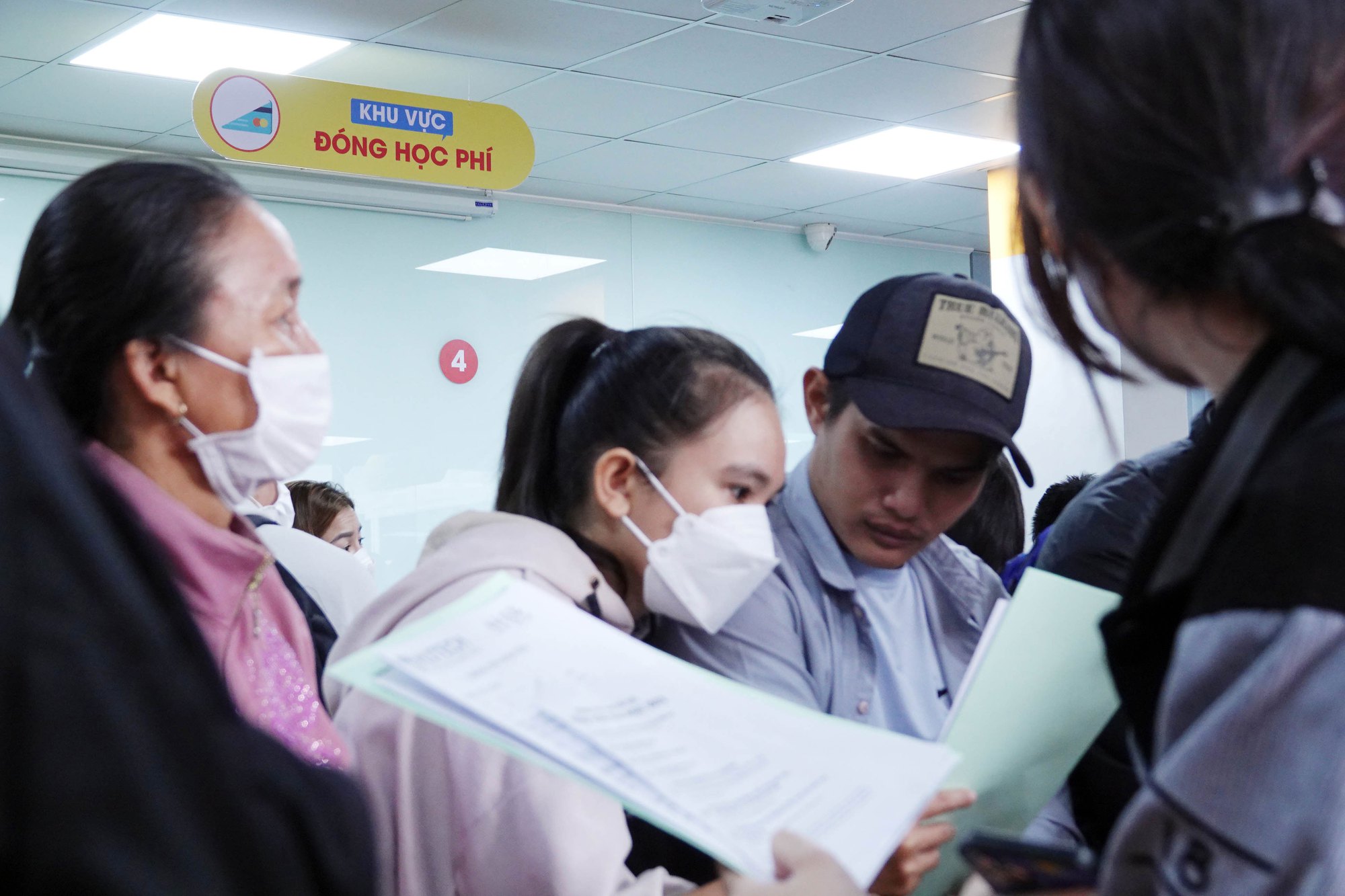
Tuition fees are one of the factors that parents and students consider when applying to university, but they are currently causing confusion for many parties.
Hanoi University of Architecture is one of the universities that announced its 2023 university admissions plan early (from March 20th). The plan includes 78 pages with very detailed information. However, on page 22, under the section "Expected tuition fees for regular students; maximum tuition fee increase roadmap for each year (if any)", the information provided by the university to candidates is only a mere three lines: "Implemented according to Decree No. 81/2021/ND-CP dated August 27, 2021 of the Government stipulating the mechanism for collecting and managing tuition fees for educational institutions belonging to the national education system and policies on tuition fee exemption and reduction, support for learning costs; service prices in the field of education and training".
I DON'T KNOW WHICH FEE TO COLLECT.
It is worth noting that the regulations in Decree 81 are quite broad, covering many cases: higher education institutions that have not yet self-financed their recurrent expenditures; public higher education institutions that self-finance their recurrent expenditures; public higher education institutions that self-finance both recurrent and investment expenditures; and accredited training programs of public higher education institutions. In particular, since the Government issued Decree 81, universities have not implemented the decree even once, due to two consecutive years of the Covid-19 pandemic and the recent "post-Covid" period. Therefore, tuition fees at universities can vary significantly. Even within the same university, within the same field of study, and with the same mass training program, tuition fees can differ by several times due to whether the program has been accredited or not, as mentioned in Decree 81.
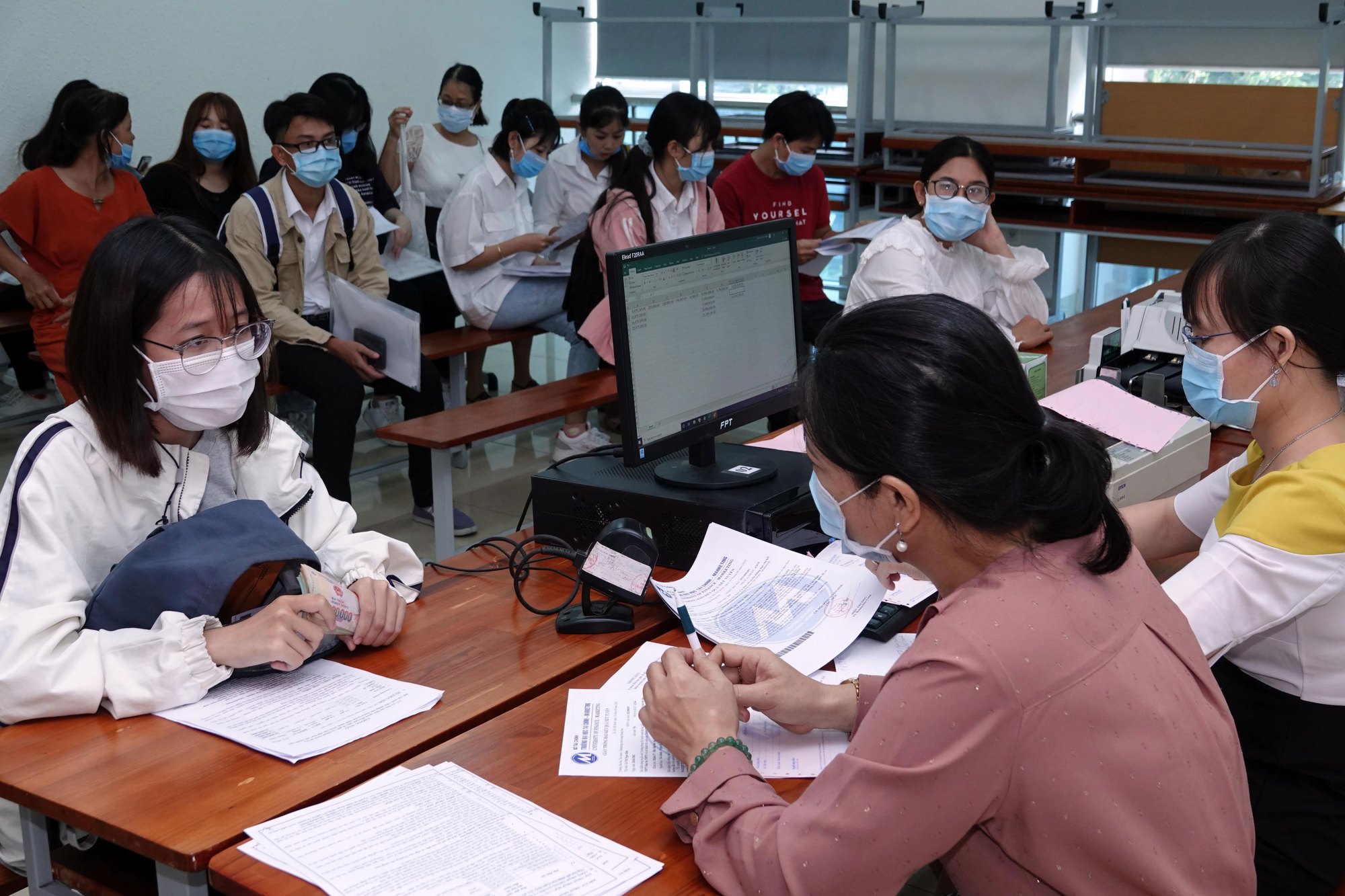
Many universities have yet to provide clear information about tuition fees for the upcoming academic year because they are still unsure of the guidelines on this matter.
When a reporter from Thanh Nien newspaper asked about the specific tuition fees for the 2023-2024 academic year, an official from Hanoi University of Architecture gave an even more cryptic answer: "The university welcomes candidates to learn about and apply to Hanoi University of Architecture. For any information about the university, including tuition fees, candidates can find it on the admissions website or visit the reception department at Office 1 of the university for direct answers and advice."
Some other schools, despite showing efforts to provide information about the curriculum to students, are unclear about it because they are waiting for… instructions.
On April 13th, the Rector of Hanoi University of Civil Engineering approved the university's admissions plan, which clearly stated that the projected tuition fee for students in the 2023-2024 academic year would be 11.7 million VND. However, a university leader later told Thanh Nien newspaper that they would add the following content to the plan: "The projected tuition fee according to the current government regulations is 11.7 million VND/academic year/student. The university will adjust the tuition fee when new state regulations are issued." It is known that 11.7 million VND/student/academic year is the tuition fee for the 2020-2021 academic year for engineering majors in universities that have not yet achieved autonomy, as stipulated in Decree 85 (issued by the Government in October 2015; Decree 81 was issued to replace Decree 85).
Meanwhile, the proposal from the University of Transport (published on February 7th) provides quite a lot of information, but those interested need to use a computer to find out how much they will have to pay. Specifically, the university announces the current tuition fees applied to each major; then it announces the planned increase, with the government allowing a 23% increase, but the university only plans a 10% increase (if we assume an average student takes 30 credits per year, the tuition fee for engineering, mathematics, and information technology majors is over 13.7 million VND/student; for service majors it is 11.7 million VND/student; and for economics majors it is 11.2 million VND/student). But at the end of the tuition fee section, the proposal adds the sentence: "When the school's recurrent expenditure autonomy plan is approved by the competent authority, tuition fees will be collected according to the plan, but the fee for the regular program will not increase by more than 1.5 times, and for the high-quality program by more than 2 times, the tuition fee stipulated in Decree 81/ND-CP for schools that are not yet autonomous." In other words, how much the tuition fee will be remains to be seen!
The Diplomatic Academy has also recently announced its tuition fee plan, which states that it will be implemented according to Decree 81. Specifically, for 6 out of 8 majors that have achieved accreditation, the school will charge 4.4 million VND/student/month; for the 2 majors that have not yet been accredited, the fee will be 2.1 million VND/student/month. The Diplomatic Academy is a public institution that is self-sufficient in covering its operating expenses. According to an official in charge of training at the Diplomatic Academy, if the tuition fee collection schedule stipulated by the Government in Decree 81 is followed, the fee for the 2 unaccredited majors would be 2.4 million VND/student/month. However, because the school has followed the general government policy of not increasing tuition fees for the past two academic years, the increase for the upcoming academic year will only be at an acceptable level compared to last year.
C ... DIRECTOR
According to the schools' explanation, the reason for the lack of clear information about tuition fees for the next academic year is that they are still unsure of the directives from higher authorities on this matter. The government issued Decree 81 (August 2021) when the whole country was facing the Covid-19 pandemic. Therefore, immediately after issuing Decree 81, the government had to instruct schools not to increase tuition fees for the 2020-2021 academic year.
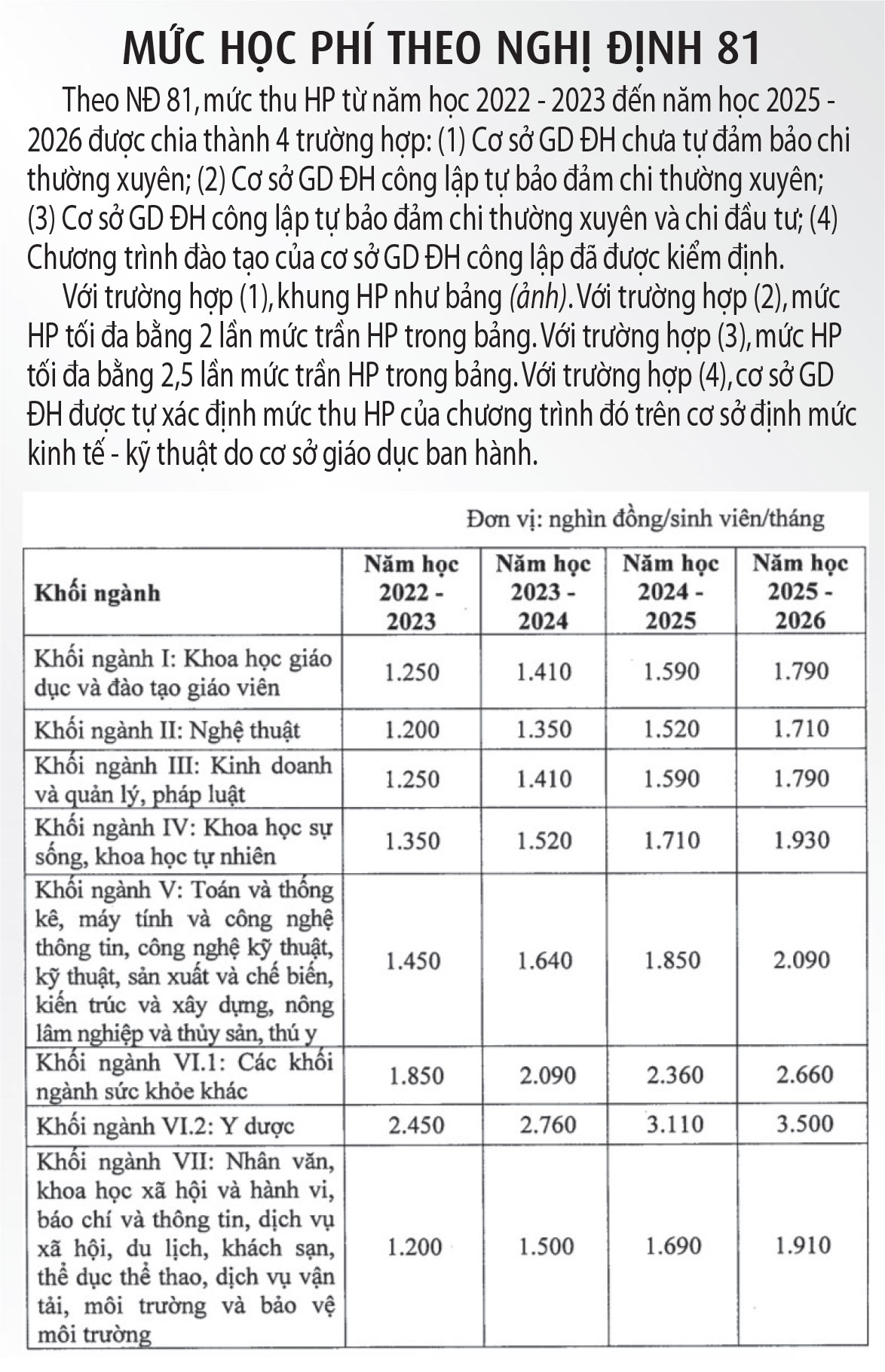
The 2022-2023 academic year began after the Covid-19 pandemic was brought under control. At the start of the year, Minister of Education and Training Nguyen Kim Son announced in official meetings that the Ministry was proposing to the Government a document requiring universities not to increase tuition fees to alleviate the burden on the people. However, a long time later, no such directive was issued, so universities had to collect tuition fees according to the increase schedule stipulated in Decree 81 (but delayed by one year, meaning the actual fee for the 2022-2023 academic year was the same as the fee stipulated in Decree 81 for the 2021-2022 academic year). On December 20, 2022, the Government issued Resolution 165 on tuition fees for public educational institutions for the 2022-2023 academic year. This resolution requires public higher education institutions to maintain the same tuition fee levels for this academic year as in the 2021-2022 academic year.
In implementing Resolution 165, a number of universities had to reissue decisions on tuition fee regulations for the 2022-2023 academic year, and at the same time, assign personnel to calculate the excess tuition fees collected in order to return them to students. "If we still implement Decree 81, universities cannot apply the regulations exactly, that is, collect fees according to the framework of the 2023-2024 academic year in Decree 81. Because if that happens, tuition fees will skyrocket, and people will react. As for collecting fees according to a delayed schedule, the Government must provide specific guidance. Right now, universities cannot simply collect fees based on their own subjective assumptions and then painstakingly calculate how to return the excess money to students," a university leader explained.
Tuition fees at foreign schools in Vietnam
Ms. Le Thi Quynh Tram, Director of Admissions and Financial Aid at Fulbright University Vietnam, stated that the tuition fee has remained at VND 467.6 million per year for many years, and will remain the same in 2023. However, according to Ms. Tram, every year up to two-thirds of the university's students receive partial or full tuition support depending on their specific financial circumstances.
Meanwhile, at RMIT University, tuition fees are paid per semester, based on the number of courses students take. Accordingly, the tuition fee for 2023, for a full course of study, ranges from 288 to 384 credits depending on the major. For a major with 288 credits per year, students pay 318.6 million VND, totaling 955.9 million VND for the entire course. For majors with 384 credits (software engineering, robotics and mechatronics, electronic engineering and computer systems), students pay 318.6 million VND per year, totaling 1.274 billion VND for the entire course.
My Quyen
Source link


![[Photo] Prime Minister Pham Minh Chinh presides over a meeting on private sector economic development.](/_next/image?url=https%3A%2F%2Fvphoto.vietnam.vn%2Fthumb%2F1200x675%2Fvietnam%2Fresource%2FIMAGE%2F2025%2F12%2F20%2F1766237501876_thiet-ke-chua-co-ten-40-png.webp&w=3840&q=75)

















































































Comment (0)