

The X-59 supersonic aircraft promises to fly very quietly over land instead of creating the explosive noise that shook the ground like the Concorde.
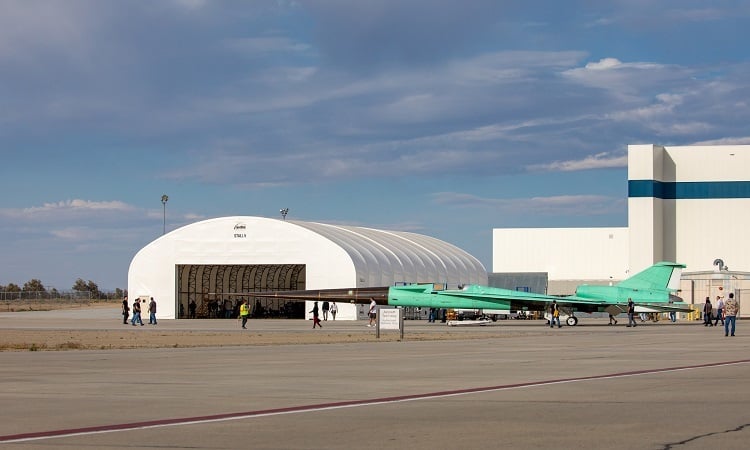
The X-59 aircraft rolls out of the factory. Video : Lockheed Martin
The X-59 QuessT (Quiet SuperSonic Technology) is an experimental jet designed to reduce the amount of sonic boom produced when an aircraft breaks the sound barrier. Instead of the earth-shattering roar caused by reaching supersonic speeds (Mach 1 or 1,235 km/h), the X-59 produces a sound similar to a car door slamming shut. Lockheed Martin, the company building the jet at its Skunk Works advanced aircraft manufacturing facility in Palmdale, California, shared a video showing the X-59 rolling out of its hangar and ready for flight testing, Space reported on August 4th.
The footage reveals the unique shape of the X-59 with its pointed nose extending 11.5 meters. However, due to the length of the nose, the X-59 pilot cannot see out of the cockpit as there is no windshield at the front.
To overcome this, the test aircraft was equipped with an Exterior Viewing System (XVS). Essentially, the XVS is a closed-circuit video system comprising forward-facing cameras and a cockpit display screen in front of the pilot. The system uses custom image processing software and a camera system to create a virtual reality view of the scene ahead for the X-59 pilot, along with flight data graphics, according to NASA.
After assembling the X-59, the NASA and Lockheed Martin teams will conduct ground tests to ensure the aircraft is safe and ready for flight. When the vehicle is ready for flight testing, it will fly over populated areas to analyze how people on the ground react to the sound it produces. NASA will send the collected data to regulatory agencies such as the Federal Aviation Administration (FAA) to apply for commercial supersonic flight authorization.
Supersonic flight over land and within certain areas around the U.S. coast has been banned since 1973, according to the FAA. NASA hopes to develop supersonic aircraft that could halve domestic flight times in the future.
An Khang (According to Space )
Source link



































































































Comment (0)