

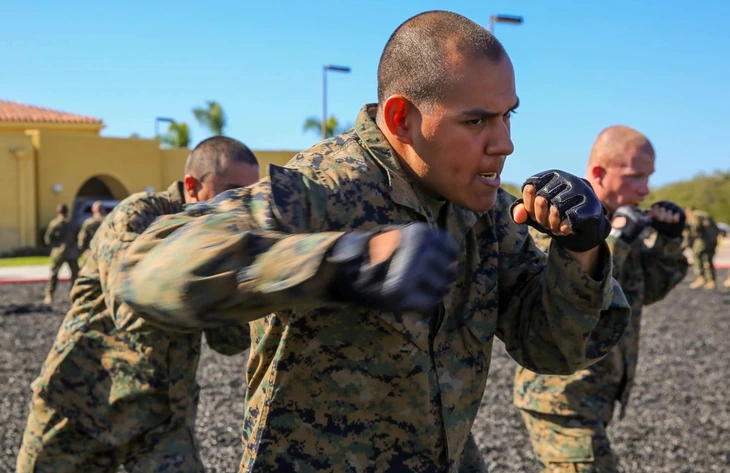
MCMAP is a primary combat skill of US special forces - Photo: DVIDS
What do U.S. special forces soldiers learn at MCMAP?
What martial arts do U.S. special forces soldiers train in? This is a topic that has been of great interest to many martial arts enthusiasts, concerning the combat skills of the most elite and mysterious forces in the U.S. military.
The answer doesn't lie in one particular martial art or style. In reality, the hand-to-hand combat training of U.S. special forces is a comprehensive combat-tactical system, often collectively referred to as combatives.
And renowned special forces units such as the SEALs, Green Berets, Rangers, and Delta Force all train in a common combat skill set called MCMAP.
MCMAP stands for Marine Corps Martial Arts Program, the military martial arts program of the United States Marine Corps, built upon various techniques such as wrestling, judo, Brazilian jiu-jitsu (BJJ), boxing, Muay Thai, and Krav Maga - the renowned Israeli martial art.
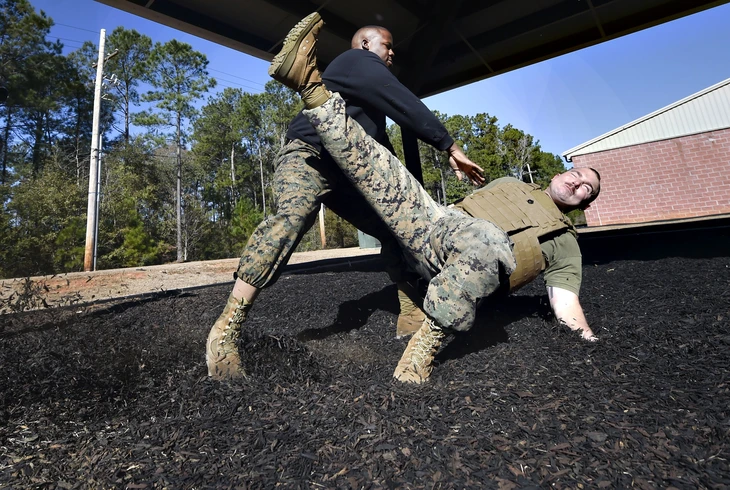
MCMAP focuses on close-combat skills - Photo: DVIDS
MCMAP is not simply about honing pure unarmed combat skills, but also integrates close-range weapon use, tactical thinking in close combat, with the goal of controlling opponents and fighting in confined spaces.
In combatant training, the emphasis is not on flashy or sophisticated techniques, but on simplicity, directness, and effectiveness in combat conditions.
Military combat experts often state that the purpose of combatives is to train combat reflexes, the ability to maintain a position when weapons are lost, or in spaces too cramped to use firearms – such as in houses with limited visibility, tunnels, or when the enemy unexpectedly approaches.
According to martial arts expert Norman Conley, an army officer and combatant trainer, both the Russian and Chinese armies have standard combat martial arts programs in their arsenals, and the US cannot afford to underestimate this issue.
Conley asserted that close-combat skills are "just as important as mastering state-of-the-art weapons, and sometimes even decisive," according to military news outlet DVIDS.
This explains why US special forces units such as the Navy SEALs, Army Rangers, Green Berets, and Delta Force are all trained in combative skills, specifically MCMAP.
One key difference between military combatives and martial arts sports is the ultimate goal.
While competitive martial arts like MMA, taekwondo, or kung fu have rules, referees, and scoring, military combatives aim for survival, control of opponents, and mission completion in the harshest conditions.
There are no "secret techniques".
This led to the selection of techniques from a variety of sources: from striking techniques like boxing and Muay Thai, to grappling and arm locks like Brazilian jiu-jitsu, and even close-range weapon skills when necessary.
We also cannot overlook Krav Maga – the renowned close-combat martial art of Israel. Krav Maga techniques focus on instantaneous reflexes, attacking vulnerable points on the body such as the eyes, throat, groin, and knees to incapacitate an opponent in seconds.
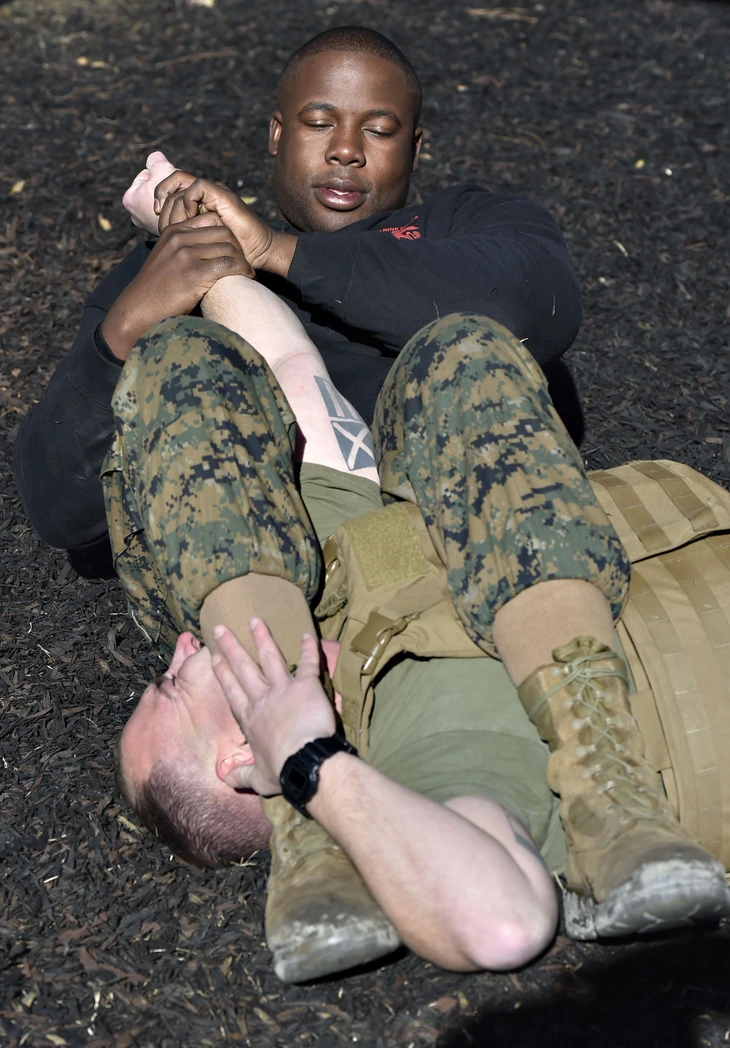
BJJ - an important skill in MCMAP - Photo: DVIDS
Unlike traditional martial arts, Krav Maga has no competitions or demonstrations, but is based on the principle of "go straight - finish quickly".
The technical system includes punching, kicking, grappling, submission holds, escape techniques, as well as defense against weapons such as knives, sticks, and guns.
Training experts also emphasize that MCMAP is not a fixed sequence of techniques like in traditional martial arts. Instead, MCMAP training programs focus on situational awareness and developing students' reflexes.
For Tier 1 units like Delta Force, detailed training information is often not made public for security reasons. Only MCMAP training courses are publicly available.
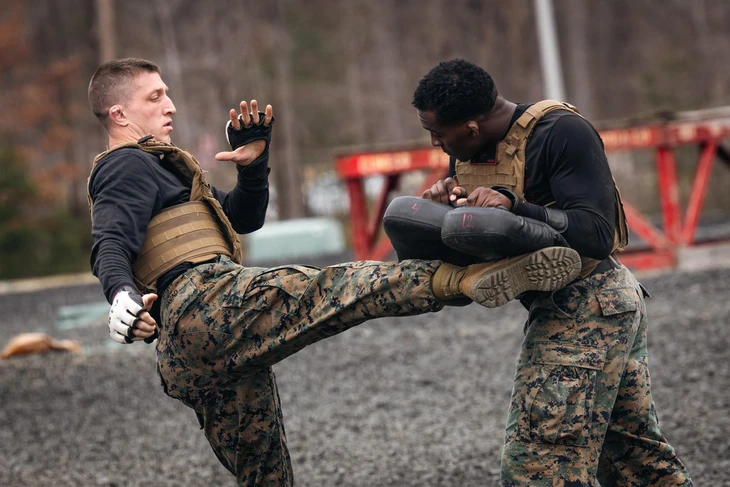
MCMAP includes taekwondo kicks - Photo: DVIDS
"There's nothing to hide about MCMAP. It's a fighting skill system, which you can see similar to in any BJJ, boxing, or Krav Maga class."
"The important thing here is that we train our soldiers in tactical thinking, reflexes, and how to quickly control situations," said Norman Conley.
American media outlets have previously produced several reports on MCMAP training centers within the U.S. military. One such report, by DVIDS, covered the belt promotion exam of the 1st Recruit Training Battalion, Delta Force, in 2016.
“We had to memorize a lot of information from all the MCMAP classes,” said rookie Parker W. Winn. “It wasn’t just about learning different techniques. I think the coaches wanted us to better understand the fighting mindset they were trying to instill in us.”
During this event, each MCMAP coach took their position in the designated area for the test. Twenty recruits simultaneously participated in the test under the evaluation of the coaches.
“Our instructors have trained us to become qualified Marines,” said Winn, 18. “We’ve taken a lot of MCMAP classes, and I think we’re all ready to finally get our own brown belt.”
The brown belt is the first belt a Marine receives as a recruit, and they may eventually be promoted to grey, green, brown, and black belts later in their career.
“They wanted us to prepare for what was coming, even if it was just learning the basics,” said Winn, a native of Tucson, Arizona. “I think now we know enough to at least act when the time comes. It feels great to have the opportunity to experience all of that.”
Source: https://tuoitre.vn/mcmap-vo-thuat-cua-linh-dac-nhiem-my-20260104112649361.htm

![[Image] National Assembly discusses the implementation of the socio-economic development plan.](https://vphoto.vietnam.vn/thumb/1200x675/vietnam/resource/IMAGE/2026/04/20/1776696707422_ndo_br_img-20260420-185419-jpg.webp)

![[Photo] General Secretary and President To Lam meets with National Assembly delegates from ethnic minorities.](https://vphoto.vietnam.vn/thumb/1200x675/vietnam/resource/IMAGE/2026/04/20/1776696701056_a1-bnd-8331-3342-jpg.webp)


















































































Comment (0)