

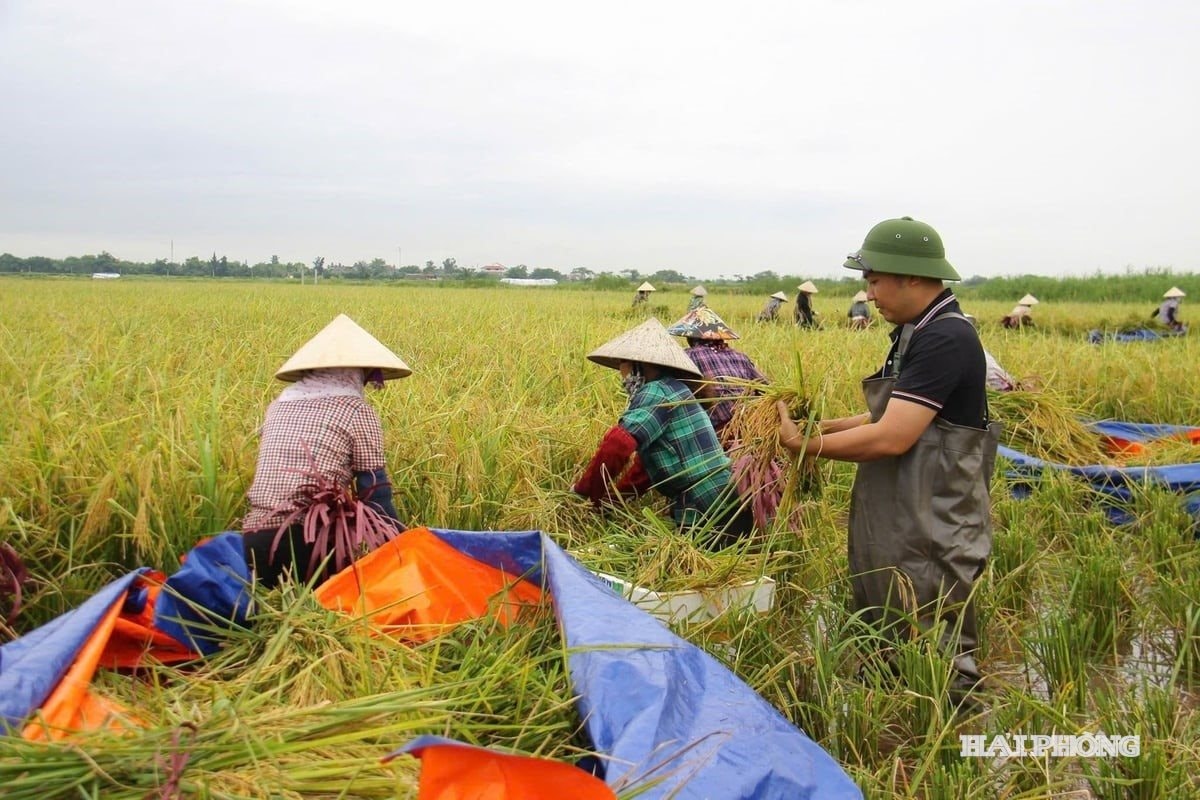
This farming method has increased income and affirmed the value of unique agricultural products.
Natural model
Hai Phong is not only famous for its industrial and port strengths, but in recent years, in the riverside and coastal areas of the former Kien Thuy district, a unique agricultural model has gradually asserted its position: rice cultivation on fields inhabited by earthworms.
The symbiotic relationship between rice plants and earthworms creates a natural organic farming process, producing clean, nutritious rice that is gradually conquering demanding markets and affirming the brand value of this unique local agricultural product.
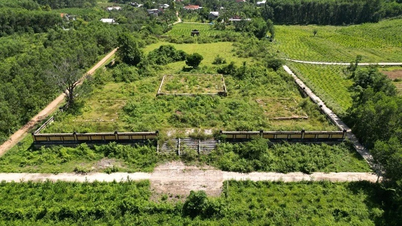
In Nghi Duong commune, the sight of golden rice paddies and mudworm fields has become familiar. This is an alluvial plain along the Van Uc River, where mudworms naturally live in a brackish water environment.
Sharing her journey into this profession, Ms. Nguyen Thi Ha, Director of Thuy Huong Agricultural Production Cooperative (Nghi Duong commune), said: “Farming in brackish water areas, especially with the mudworm species, requires absolute transparency and responsibility. Because even a small amount of pesticide or chemical fertilizer will stop the mudworms from growing, directly affecting the income of the farmers. We consider the mudworm as a 'measure' of the cleanliness of the fields.”
Starting her business in 2017, the biggest challenge Ms. Ha faced wasn't capital, but changing the mindset of farmers who were accustomed to traditional farming practices.
To achieve a breakthrough, she invested over 2 billion VND in a system of rice transplanters, harvesters, and tray seedling seedling systems.
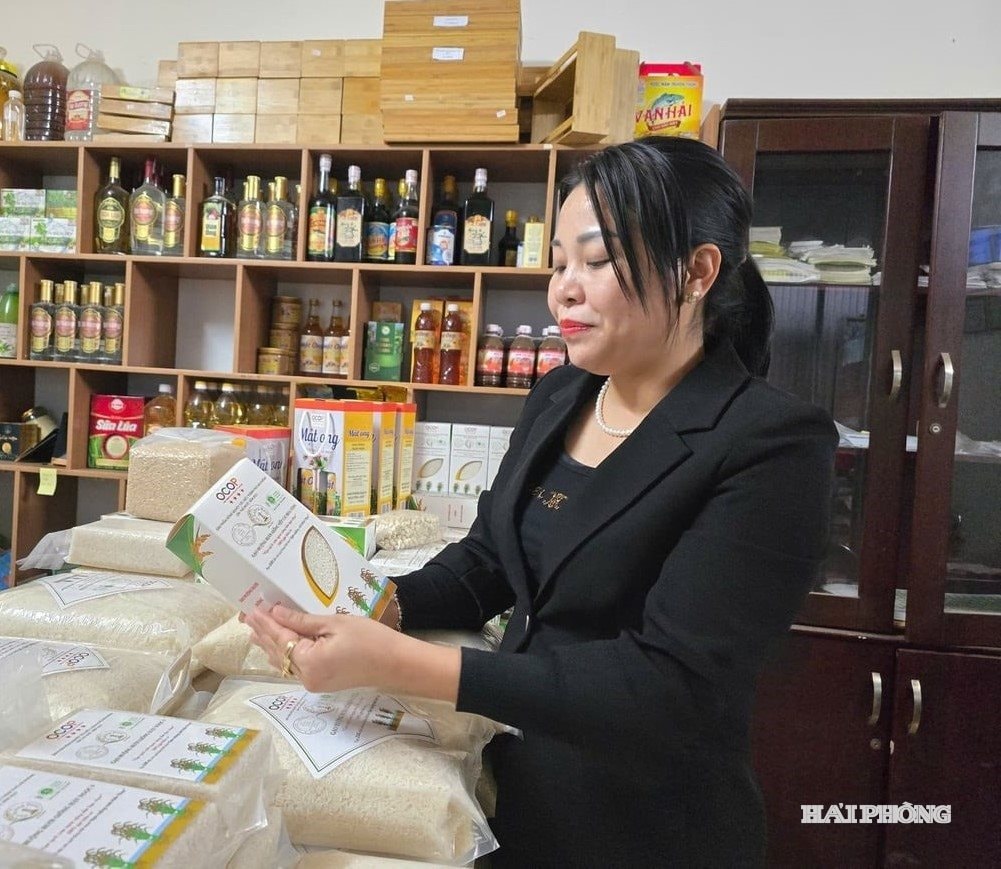
“We went door-to-door to convince people about the benefits of mechanization. Currently, the method of tray seedling cultivation using machines covers more than 80% of the cultivated area in Kien Quoc commune, forming specialized farming areas of 'one variety - one time' to ensure the best growing environment for the mudworms,” Ms. Ha further shared.
That perseverance has paid off. From the pilot plots of land, the rice grown in these fields by the Thuy Huong Cooperative has now been recognized as a 4-star OCOP product, affirming its reputation with consumers and creating strong confidence for farmers in the commune.
Not only limited to cooperatives, many households in this area have boldly converted their traditional rice fields to a rice-worm farming model.
Mr. Luong Van Cuong is one of 28 households participating in a land consolidation model with 30 hectares of rice-mud-farming land, which he has been cultivating since 2015. Mr. Cuong stated that the ST25 rice variety is very suitable for mud-farming land due to its good salt tolerance and resistance to pests and diseases. Although the initial investment in technology is high, he does not have to spend money on pesticides or chemical fertilizers.
“Although affected by weather conditions, the yield of organic rice may be lower than traditional rice, but the value of organic rice is much higher. In the last rice crop, despite many difficulties, my family still earned an estimated 500 million VND. This is a stable source of income, helping people stay committed to farming in the long term,” Cường explained.
Working alongside farmers, Hai Au Viet Investment Joint Stock Company is currently creating an important link in the supply chain in key communes in the rice-growing region.
According to Mr. Tran Van Trung, the company's director, from 2011 to the present, the company has collaborated with farmers in the former Kien Quoc and Ngu Phuc communes (now Nghi Duong commune) to cultivate crops on an area of 75 hectares. The company provides farmers with capital, seeds, technical assistance, and guarantees the purchase of all their produce.
Businesses are standardizing stringent standards such as USDA (USA), EU (Europe), and JAS (Japan) to bring Vietnamese rice to the international market. This collaboration not only helps farmers feel secure in their production but also builds a sustainable value chain for the brand of rice grown in fields inhabited by earthworms.
Sustainable path forward for clean agriculture
Because it is grown entirely naturally, the rice yield is about one-third that of fields cultivated using conventional methods. However, this type of rice is considered to have high nutritional value and is absolutely safe.
Rice grown in fields with earthworms contains many nutrients such as vitamins A, B1, B6, B12, and Omega 3-6-9. Although rice grown in earthworm-infested fields does not yield high productivity, reaching about 2.7 tons/ha, the income from earthworms is 20 times higher than that from rice. In addition to rice, an average of 300-500 kg of earthworms can be harvested from one hectare of earthworm-infested rice field.
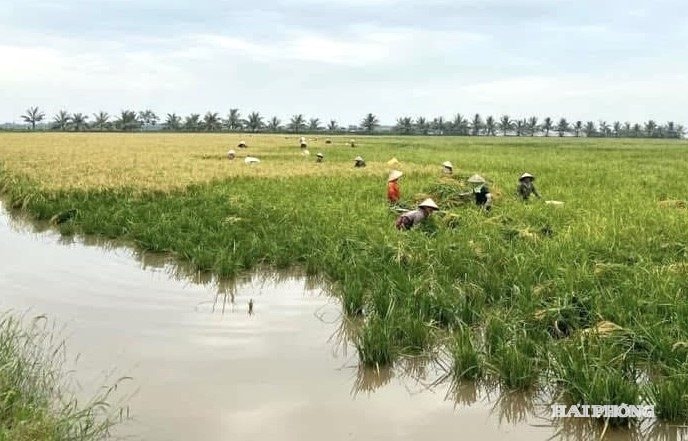
Commenting on this model, Mr. Ngo Trung Kien, Head of the Department of Crop Production and Plant Protection in Hai Phong, said: “In recent years, farmers in the former Kien Thuy area have boldly applied advanced techniques. Rice production on mudflats using a closed-loop organic process not only helps protect the environment but also significantly improves the quality of agricultural products. We encourage households to cooperate with businesses to form a linked chain from production to consumption, ensuring sustainability.”
Currently, Nghi Duong and Kien Hai communes have nearly 100 hectares of rice grown on mudflats in the communes along the Van Uc River. According to Mr. Dao Van Tuan, Vice Chairman of the Nghi Duong Commune People's Committee, Kien Quoc mudflat rice achieved OCOP 4-star status in 2023.
To support local farmers, the authorities are actively planning raw material areas and advising the city on preferential loan mechanisms for farmers. The locality is paying special attention to water environment management, avoiding pollution from neighboring areas affecting the shrimp farms.
According to information from the Department of Natural Resources and Environment, in order to maintain the brand of rice grown in fields inhabited by earthworms, the Department will continue to work alongside farmers to resolve difficulties related to mechanisms, coordinate the organization of conferences and seminars on technical solutions, and promote the central agricultural extension project "commercial earthworm farming and organic rice production linked to product consumption". This is a key solution to improve farming efficiency in riverside alluvial areas.
The model of rice grown in fields infested with earthworms contributes to increasing the value of agricultural products thanks to a clean, safe, and eco-friendly production process. In the future, this model will be expanded by localities, linking ecotourism with agricultural production, thereby elevating the value of this specialty product on the map of Vietnamese agricultural products.
THU HANGSource: https://baohaiphong.vn/mo-hinh-kinh-te-xanh-o-nghi-duong-544425.html



![[Photo] General Secretary and President To Lam presides over a meeting on preparations for the review of one year of operation of the three-tiered government system.](https://vphoto.vietnam.vn/thumb/1200x675/vietnam/resource/IMAGE/2026/06/02/1780391821195_a1-bnd-4595-9717-jpg.webp)








![[INFOGRAPHICS] Development goals for rural crafts and industries in the period 2026-2030](https://vphoto.vietnam.vn/thumb/402x226/vietnam/resource/IMAGE/2026/06/02/1780393054323_1780392879.webp)



















































Comment (0)