

 |
| The lush, endless green tea hills and stunning scenery make Thai Nguyen an ideal destination for tourists. |
When tea becomes cultural diplomacy .
The 2025 Tea Festival demonstrates that Thai Nguyen has proactively taken this transition. Instead of simply displaying products, the province chose to tell a comprehensive story about the cultural space of tea: from the five famous tea-growing regions (the five great teas): Tan Cuong, La Bang, Khe Coc, Trai Cai, and Bang Phuc, to the art of tea processing, tea appreciation, and community life revolving around the tea plant. Tea, therefore, is no longer a "commodity," but has become a cultural practice.
A highlight of this year's festival is its distinctly "open" approach. The collaboration between the Provincial People's Committee and the UNESCO Representative Office in Vietnam has elevated the event from a local festival into a space for international cultural dialogue. The presence of diplomatic delegations, international organizations, artisans, and foreign partners is not merely symbolic, but sends a clear message: Thai Nguyen tea has the depth to participate in the global cultural flow.
The multi-point approach to organizing the festival—from the central square to the tea-growing regions—shows a modern branding mindset, bringing guests and international friends back to where the heritage lives, where cultivation knowledge and processing techniques have been passed down through generations. This is a form of "internationalization on the spot," helping the world discover Thai Nguyen before Thai Nguyen tea goes global.
The event became particularly special with a direct assessment from the Head of UNESCO's Delegation in Vietnam, Mr. Jonathan Wallace Baker. In his speech, he emphasized that tea is not just an economic product, but a cultural memory, an art of communication, and a means of connecting communities – a perspective entirely consistent with the spirit of the 2003 UNESCO Convention on the Protection of Intangible Cultural Heritage.
 |
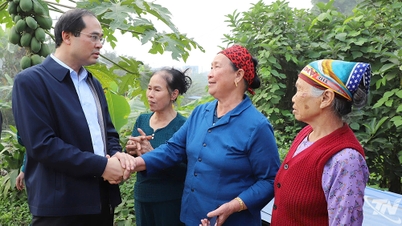
| Mr. Jonathan Wallace Baker, Head of UNESCO's representative office in Vietnam, visits the tea space at the Thai Nguyen Festival - Fragrance and Beauty of Famous Teas, 2025. |
UNESCO highly appreciates how Thai Nguyen has spread its tea culture through festivals, considering this an important basis for researching the possibility of building a heritage dossier in the future. This recognition provides professional guidance and prestige, creating a foundation for the province to continue implementing its roadmap to bring its tea culture closer to the regulations and standards for UNESCO's inscription.
From a development perspective, this recognition helps Thai Nguyen tea shift from a purely commercial promotion story to a higher value structure: community heritage - sustainable development - international cooperation.
Based on the proposal from the People's Committee of Thai Nguyen province, the Ministry of Culture, Sports and Tourism has officially commented on the preparation of a dossier on "Vietnamese Tea Culture" to be submitted to UNESCO for inclusion in the Register of Well-Preserved Practices. The Ministry acknowledges the efforts and proposals of the locality, and also provides clear guidance on the criteria and professional requirements according to the 2003 UNESCO Convention on the Protection of Intangible Cultural Heritage.
This means that tea is not just seen as an exhibit, but as a living ecosystem that answers the questions: who is the subject of the heritage, how is the heritage being practiced, what is the transmission mechanism, what is the role of young people, how is the ecological environment of the tea-growing region protected, and does the economic benefit return to the community? In other words, the UNESCO dossier is a redesign of how to protect and develop Thai Nguyen tea in the long term.
Three pillars for the global journey.
From the experiences gained at the Thai Nguyen Tea Festival - Fragrance and Beauty 2025, a picture of a new strategy to bring Thai Nguyen tea to the world is gradually emerging. It's not just about product promotion; it's a systematic approach that places culture, heritage, and community as the foundation for sustainable development.
 |
| Thai Nguyen tea has become known to many international friends not only as a beverage but also as a rich and distinctive cultural and traditional heritage. |
Three key pillars for Thai Nguyen tea's global journey have been identified: Firstly, the internationalization of the tea culture experience. Accordingly, Thai Nguyen tea will not only be marketed as a product, but also introduced as a complete cultural experience through tea tourism, festivals, artisan exchanges, and tea-drinking spaces that meet international standards.
When international tourists directly experience and understand the depth of tea culture, they will become "cultural ambassadors," naturally and sustainably spreading the value and brand of Thai Nguyen tea.
Secondly, it involves standardizing quality in conjunction with heritage, continuously improving the quality of raw material areas, promoting safe, organic, and traceable production, while linking these technical standards with cultural narratives and environmental protection responsibilities. Therefore, the quality of Thai Nguyen tea is not only measured by its flavor, but also by the philosophy and ethics in its production.
Thirdly, it's crucial to place the community at the center, because any heritage strategy will struggle to succeed without genuine community participation. Tea growers, artisans, and cooperatives must be the subjects of the heritage, the direct beneficiaries, and also the storytellers of tea through their lives, work, and long-standing connection with tea plants.
As the festive atmosphere subsides, what remains is not just the vibrant green of the tea hills budding with new growth or the fragrant aroma of early spring tea spreading through the air, but a clearer, more confident, and deeper vision for development. Thai Nguyen tea is facing a rare opportunity to enter the world map not through quantity or speed of production, but through the depth of its culture, identity, and heritage values built up over generations.
Source: https://baothainguyen.vn/kinh-te/202602/mo-loi-di-san-cho-tra-thai-2f04d0d/
![[Image] Hanoi Police officially crowned champions of V-League 2025/2026](https://vphoto.vietnam.vn/thumb/1200x675/vietnam/resource/IMAGE/2026/05/31/1780244769054_ndo_br_039d561b692be875b13a-jpg.webp)
![[Photo] The General Secretary, President and his wife begin their state visit to the Philippines.](https://vphoto.vietnam.vn/thumb/1200x675/vietnam/resource/IMAGE/2026/05/31/1780230559452_anh-man-hinh-2026-05-31-luc-19-28-11.png)

![[Photo] Admire the coral "masterpiece" amidst the million-year-old heritage of Dak Lak province.](https://vphoto.vietnam.vn/thumb/1200x675/vietnam/resource/IMAGE/2026/05/31/1780221235105_anh-man-hinh-2026-05-31-luc-16-53-27.png)
![[Photo] Solemn bathing ceremony and Buddha procession in Hue](https://vphoto.vietnam.vn/thumb/1200x675/vietnam/resource/IMAGE/2026/05/31/1780228263543_1-jpg.webp)












![[Video] Sunset at Lap An Lagoon – Where the sun sets over the fishing nets](https://vphoto.vietnam.vn/thumb/340x192/vietnam/resource/IMAGE/2026/05/31/1780192137701_beach-landscape-sea-water-nature-grass-745871-pxhere-com.jpeg)



















































Comment (0)