

 |
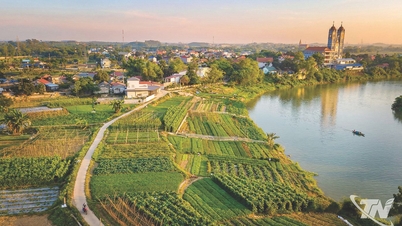
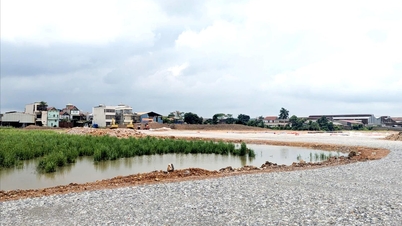
| The tranquil scenery along the Cau River, where the melodies of traditional folk songs once echoed. |
The ups and downs of folk songs and melodies.
Folk songs, particularly the "hát ví" style, are a simple form of spiritual activity for farmers in the lower reaches of the Cau River. Without a stage, musical instruments, or formal training, "hát ví" is sung naturally, like everyday conversation; people sing whatever comes to mind.
The lyrics can be passed down orally through generations, sometimes blending folk songs, proverbs, and even elements from the Tale of Kieu. The singers are not constrained; they are free to create, as long as their songs express love for their homeland, their village, and their romantic love.
Mr. Ngo Manh Tuoc, nearly 90 years old, a former official of Dong Cao ward, took us back in time. He said: "No one knows exactly when folk singing first appeared, only that it was popular during the feudal era and continued until after the August Revolution. On moonlit nights, villagers would gather at the riverside or the village square to sing call-and-response songs between men and women. Most of the participants in folk singing at that time were middle-aged and elderly people."
Then, for unknown reasons, the folk singing movement gradually faded away. It wasn't until after the land reform (around 1954-1957) that cooperatives and labor exchange groups emerged. With land for the farmers, people's lives improved, and the folk singing movement revived and lasted until around 1959, then quietly died out completely as other forms of entertainment appeared and overshadowed it, Mr. Tước added.
By 2014, thanks to the attention of the cultural sector and local authorities, this folk singing style was revived. Thirty people who were once involved in folk singing regrouped to practice and perform scenes from the past: scooping water under the moonlight, meeting in the village square, on the riverbank and on the boat… Sadly, as Mr. Tuoc said, it all “stopped there.”
The people of yesteryear are now old, their breaths are short, and their voices are hoarse. They still remember the songs, still retain the spirit, but their strength no longer allows them to sing as they once did. The most precious thing that remains is the more than 100 folk songs that have been transcribed, as evidence of a vibrant folk culture.
Besides folk singing, the people on both banks of the Cau River are also passionate about chanting. Chanting differs from folk singing in that the singers can respond to each other without seeing each other's faces. A young man can stand outside the village gate and chant, and a girl inside the village can hear and respond. Sometimes, just one chant can last all night, until one side runs out of words.
Mrs. Hoang Thi Van, now in her sixties, famous in the village for her clever singing ability, still vividly remembers a time in 1983 when she sang with a young man from a neighboring village for seven months straight. They knew each other only through their singing, never having met in person, yet they felt a sense of familiarity and understanding.
Mrs. Vân said: "That man sang beautifully and intelligently. I've sung with many people before, but only for a couple of lines and then it was over. Only with him, we sang in call-and-response style continuously for half a year. Then one day, he joined the army, and since then I haven't sung with anyone else."
When I expressed my desire to hear her sing some old folk songs, Mrs. Vân smiled happily, her voice resonating as if transporting the entire space back to the riverside village scene forty years ago.
Ms. Vân recounted that once, when the groom's family asked her name, she improvised: "My real name is Mây (Cloud), and where I live is right up at the gates of heaven." Because she didn't want to reveal her address, she only used a play on words (Vân - Mây).
But the other person immediately retorted: "I wish I could transform into Pham Tuan, fly into space, and go to the moon..."
Memories of her youth flooded back, and Mrs. Vân smiled, her eyes sparkling. One day, she had to stay home picking peanuts and didn't get to go out to sing. As soon as the young man heard her voice, he said, "Where have you been all evening? You've kept me waiting, hoping and hoping." She replied, "My family is busy with their own affairs; there's no one to help with milling and pounding rice."
One day, before his enlistment, he sang, "Go home and ask your mother and father. I'll come to your house on an auspicious day." She replied, "My parents have already asked; this month isn't a good day, let's wait until next month." He sang again, "Go home and ask your mother and father; if we don't get married this month, I'll leave next month." She retorted, "Go ahead and go, I'll take care of the flower garden and the vegetable garden..."
After that night, the singing ended, the young man set off, and from then on, the two never met again through singing."
Preserving the traces of the past in the folk song.
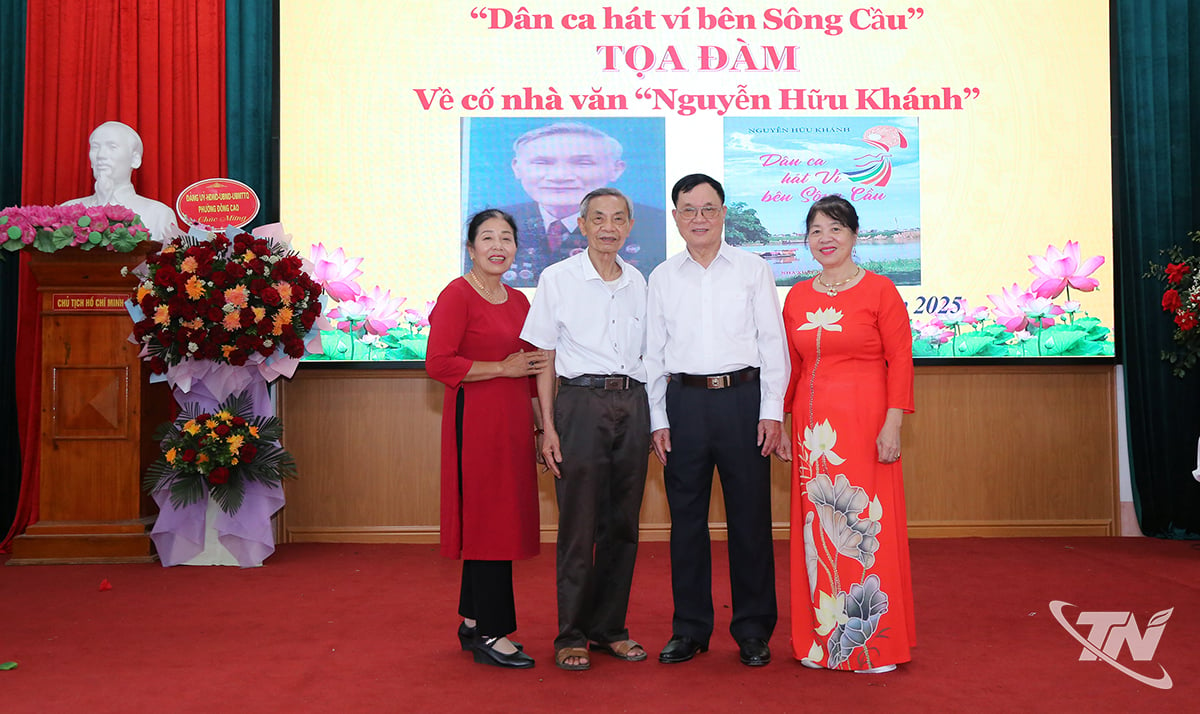 |
| From left to right, Ms. Hoang Thi Van, Mr. Ngo Manh Tuoc, and members of the group that collected and compiled the manuscript of "Folk Songs of the Cau River" at the book launch. |
Today, the pace of industrial life sweeps away many traditional values. Deeply concerned about this, a son of the former Dong Cao region – the late writer Nguyen Huu Khanh – while still alive, developed a survey map. In 2015-2016, he traveled on his old bicycle to more than 10 communes along both sides of the Cau River, meeting over 50 people to listen to their songs and stories. He also meticulously studied dozens of books, searching for fragmented documents to piece together a complete picture of folk singing.
The result of that journey is a substantial work that takes the reader back in time, to the village courtyards and riverside docks of bygone nights of witty dialogue. Even more valuable is the author's message in the manuscript: hoping that readers, those who share his sentiments, will contribute and revise the work to make it more complete. It is this humility that has opened up a cultural stream that deserves to be continued.
Five years after his passing, the unfinished manuscripts of his writings have found their way to readers. A research group of natives of Pho Yen carefully edited, completed, and published the book "Folk Songs and Songs on the Banks of the Cau River" as a way to preserve the spirit of their homeland.
The Cau River flows silently, carrying with it layers of silt and the echoes of the past. The folk songs and melodies may no longer be as vibrant as they once were, but they have never disappeared. They remain in the memories of those who once sang them, in the writings of those who silently preserve them, and in the desire to pass them on.
Source: https://baothainguyen.vn/van-hoa/202509/mot-thoi-ho-doi-ven-song-2706b59/































































































Comment (0)