

From Mrs. Huong's stories, the glorious past unfolds like an old film echoing in the rhythm of today's new life. Traditional values, from revolutionary spirit to patriotism, remain deeply ingrained in every change in the two communes of Vinh Xuong and Khanh Binh, where the Mekong River begins its journey bringing alluvial soil to Vietnam.
Where bamboo forests sheltered the revolution
In the final days of the year, amidst preparations for the anniversary of the founding of the Vietnam People's Army, we returned to Giồng Trà Dên – a revolutionary base once considered a "red fire zone" during the two wars of resistance against French colonialism and American imperialism, now located in Vĩnh Xương commune. Recalling those bloody times, Mrs. Hương's eyes welled up with tears: "Back then, the country was poor, but the people were rich in revolutionary spirit. When the enemy came to our house, even the women fought. The whole village was united in following the Party and Uncle Ho."
In the past, Giồng Trà Dên was a wild, overgrown area of reeds and dense bamboo forests, crisscrossed with canals and winding roads. This rugged terrain became a "natural shield," protecting the revolutionary forces, allowing them to hold meetings, hide cadres, and fight the enemy. Ms. Nguyễn Thị Hà, a veteran who lived and fought there, recalled: "Giồng Trà Dên was divided into three sections: the upper, middle, and lower sections, all covered in bamboo. Cadres dug tunnels among the bamboo thickets. Even when bombs and bullets rained down, the bamboo would break and grow back. People were the same; when someone fell, someone else would rise up and continue fighting bravely."
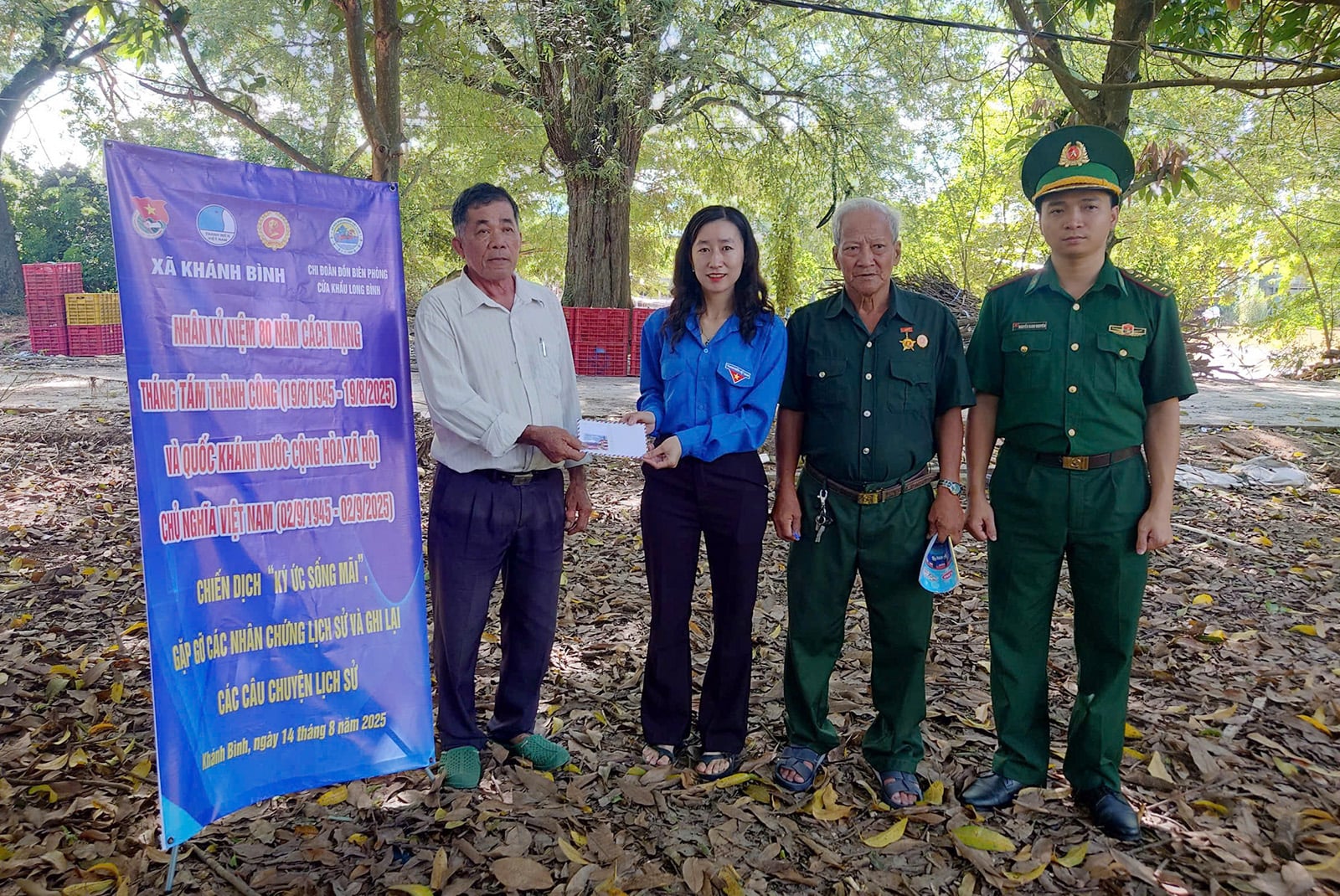
The Khánh Bình Commune Youth Union, in coordination with the Commune's Veterans Association and the Long Bình Border Gate Border Guard Station Youth Union, met with historical witnesses and recorded their historical stories. (Photo: Provided by Khánh Bình Commune Youth Union)
During the early years of the resistance against the French colonial re-invasion, Giồng Trà Dên became a strategic area for the Tân Châu District Party Committee (formerly Tân Châu - An Phú). In 1948, the local army and people eliminated more than 70 enemy soldiers, crushing the notorious Hắc Long detachment, marking an important victory for the local armed forces.
During the resistance war against the US for national liberation, Giồng Trà Dên continued to be a strong base in the southwestern border region. Despite numerous large-scale enemy raids, our troops and people remained steadfast, holding firm to every inch of land. More than 120 soldiers bravely sacrificed their lives, their blood mingling with the soil, becoming a sacred part of the memory of the upstream region of the Tiền River.
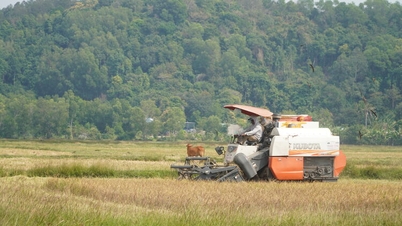
With peace restored, the Vinh Xuong area embarked on a journey of revival. The spirit of clinging to the land and defending the village during the war was carried on by the people into the reconstruction of their homeland. Mr. Huynh Quang Ngu, former Standing Deputy Secretary of the Tan Chau Town Party Committee, recounted: “In 1977, in just 100 days and nights, the people excavated and filled more than 500,000 cubic meters of earth, opening a 23-kilometer-long canal. When the canal brought water in, the fields were opened up, and people sowed rice in abundance. From about 2,000 hectares of rice in 1976, the total cultivated area in the region has now expanded to more than 12,000 hectares, producing three crops per year, becoming an important commercial rice-growing area of the province.” The vast rice fields today are vivid evidence of the vigorous vitality of a former revolutionary base area.
Khanh Binh - the "land of steel" on the front lines.
While Vinh Xuong is associated with the image of steadfast bamboo forests, Khanh Binh, especially the Vat Lai (B3) base, is mentioned as a "steel land" along the border. During the two wars of resistance against French and American aggression, the An Phu - Tan Chau District Party Committee and the Khanh Binh Commune Party Branch established the B3 base here, a particularly important strategic location in the An Giang border region.
Khánh Bình commune has the Bình Di River and a 6.5km border with the Kingdom of Cambodia. The Vạt Lài canal connects the Bình Di River to Cambodia, with dense vegetation on both sides, creating a strategic location. According to the history of the Khánh Bình commune Party Committee, the Vạt Lài base was once the military base for dozens of agencies and units from the commune, district, and provincial levels to the Central Committee. During the resistance war against the US, 14 provincial-level agencies were stationed here, including the Propaganda Department, the Provincial Party Committee Office, the Cờ Hồng Printing House, and the Performing Arts Troupe…
The people of Khánh Bình actively contributed food, sheltered cadres, worked as laborers, and provided information to the revolution. For the people here, Vạt Lài - B3 is not just a historical place but an integral part of their homeland. Standing by the Bình Di River, Mr. Nguyễn Văn Tám, a resident of Khánh Bình commune, slowly said: “Back then, Vạt Lài was all reeds. When bombs and bullets rained down, the people worried about themselves while also trying to defend the base.”
Many veterans still remember Tet in 1969 at the Vat Lai - B3 base. Under the protection of guerrillas and local troops, the people of the liberated area of Khanh Binh enjoyed a rare peaceful Tet. At that time, even though the An Giang Provincial Party Committee had withdrawn, the base still had a rice depot, a weapons depot, and more than 300 revolutionary families living there. Guerrillas from the communes, along with the provincial police force, fought for 13 days and nights, eliminating nearly 100 enemy soldiers and ensuring the safe evacuation of the people.
After the reunification of the country, Khanh Binh continued to fight against the Pol Pot genocidal army for 10 years, firmly defending the southwestern border of the Fatherland. Many outstanding sons and daughters of the homeland fell in battle. Mr. Phan Van Khai, Chairman of the Veterans Association of Khanh Binh commune, said emotionally: “So many people sacrificed their lives so that we could have peace today. No matter what generation we are in, or what job we do, we can never forget our responsibility to the country and to those who were determined to die for the Fatherland.”
Tradition is continued through action.
At the end of July 2025, at the Martyrs' Memorial in Khanh Binh commune, the Youth Union, in coordination with the Commune's Veterans Association and the Long Binh Border Gate Border Guard Post, organized a candlelight vigil to pay tribute. In a solemn atmosphere, young people stood alongside older generations, listening to stories of defending the land on the front lines of the border. Nguyen Thi Be Ba, Secretary of the Khanh Binh Commune Youth Union, shared: “We young people grew up on this heroic land. Maintaining peace on the border, caring for families of war veterans, and building a civilized commune are the most practical ways to show our gratitude.”
This spirit is concretized by the youth of Khanh Binh through many movements. Young soldiers maintain the emulation movement of cultivating virtue and honing skills, worthy of the title "Ho Chi Minh's Soldiers." Young police officers actively implement the six teachings of Uncle Ho for the People's Police. Youth union members and young people in the commune also participate in border patrols and boundary marker inspections. Models of youth-managed roads, crime-free residential areas, and the "three no's" against drugs are effectively maintained. For many consecutive years, Khanh Binh commune has achieved 100% of its military recruitment quota.
The revolutionary spirit is deeply ingrained in the lives of the people and the activities of the Vinh Xuong commune government today. Mr. Tran Van Tien, Deputy Secretary of the Vinh Xuong Commune Party Committee, stated concisely and confidently: “We always consider the education of revolutionary traditions as the spiritual foundation. The Party and the people must be as close as fish and water. When the people trust the Party, and the Party relies on the people, everything will succeed.”
Activities expressing gratitude and remembering one's roots are regularly maintained by many agencies and units in Vinh Xuong. In schools, teachers tell students about the Giong Tra Den base and the ordinary people who made history, so that students understand the value of the land they live on.
Beyond preserving memories, the people here also maintain the sense of community and compassion in their daily lives through initiatives such as providing free rice, offering free patient transport, and building solidarity houses. Ms. Vo Thi Cam, a resident of Vinh Xuong commune, sincerely said: "People cherish each other because of their sense of community and compassion. Everyone contributes what they can, giving and receiving, but everyone is happy because they live with deep sense of duty and affection."
As evening fell, golden sunlight filtered through the bamboo groves along the riverbank. Mrs. Huong gazed silently towards Giong Tra Den: "Our ancestors fell so that their descendants could have a peaceful life today." From the blood-soaked land of yesteryear, Vinh Xuong and Khanh Binh today rise up in a new rhythm of life, their hearts still steadfast, their bonds of affection as deep as the Tien and Hau rivers that tirelessly enrich the beloved land of Vietnam.
Source: https://baoangiang.com.vn/dau-nguon-song-mekong-chay-vao-dat-viet-dau-an-mot-vung-dat-bai-2-truyen-thong-trong-dong-chay-m-a470522.html

![[Photo] Prime Minister Pham Minh Chinh receives Lao Minister of Education and Sports Thongsalith Mangnormek](/_next/image?url=https%3A%2F%2Fvphoto.vietnam.vn%2Fthumb%2F1200x675%2Fvietnam%2Fresource%2FIMAGE%2F2025%2F12%2F16%2F1765876834721_dsc-7519-jpg.webp&w=3840&q=75)
![[Image] Leaked images ahead of the 2025 Community Action Awards gala.](/_next/image?url=https%3A%2F%2Fvphoto.vietnam.vn%2Fthumb%2F1200x675%2Fvietnam%2Fresource%2FIMAGE%2F2025%2F12%2F16%2F1765882828720_ndo_br_thiet-ke-chua-co-ten-45-png.webp&w=3840&q=75)

![[Live] 2025 Community Action Awards Gala](/_next/image?url=https%3A%2F%2Fvphoto.vietnam.vn%2Fthumb%2F1200x675%2Fvietnam%2Fresource%2FIMAGE%2F2025%2F12%2F16%2F1765899631650_ndo_tr_z7334013144784-9f9fe10a6d63584c85aff40f2957c250-jpg.webp&w=3840&q=75)
![[Photo] Prime Minister Pham Minh Chinh receives the Governor of Tochigi Province (Japan)](/_next/image?url=https%3A%2F%2Fvphoto.vietnam.vn%2Fthumb%2F1200x675%2Fvietnam%2Fresource%2FIMAGE%2F2025%2F12%2F16%2F1765892133176_dsc-8082-6425-jpg.webp&w=3840&q=75)








































![[Live] Closing Ceremony and Award Presentation for the "Impressive Vietnam Tourism" Video/Clip Creation Contest 2025](https://vphoto.vietnam.vn/thumb/402x226/vietnam/resource/IMAGE/2025/12/17/1765974650260_z7273498850699-00d2fd6b0972cb39494cfa2559bf85ac-1765959338756946072104-627-0-1338-1138-crop-1765959347256801551121.jpeg)













Comment (0)