

The Lao Dong newspaper conducted an interview with Mr. Nguyen Huu Qua - one of the last remaining artisans of Dong Ho painting village (Thuan Thanh, Bac Ninh ), whose 500-year-old painting craft has just been inscribed by UNESCO on the list of Intangible Cultural Heritage in need of urgent safeguarding.
Dong Ho folk paintings have existed for about 500 years, closely associated with the people of Dong Ho village through many generations. So, what was the image of Dong Ho village like in the memories of the artisans of the past?
- My childhood was filled with the bustling atmosphere of painting during Tet (Vietnamese New Year). Back then, almost every house in the village was busy: woven paper screens covered the yards, woodblocks were displayed everywhere, adults took turns mixing colors and printing pictures, while children ran around, watching and imitating.
During the heyday of Dong Ho folk painting, the entire village had 30-40 households making Dong Ho paintings, with up to 200 workers at its peak. During Tet (Lunar New Year), these households worked day and night. The adults in the family allowed us younger generations to participate in painting according to our abilities, earning extra money for Tet expenses.
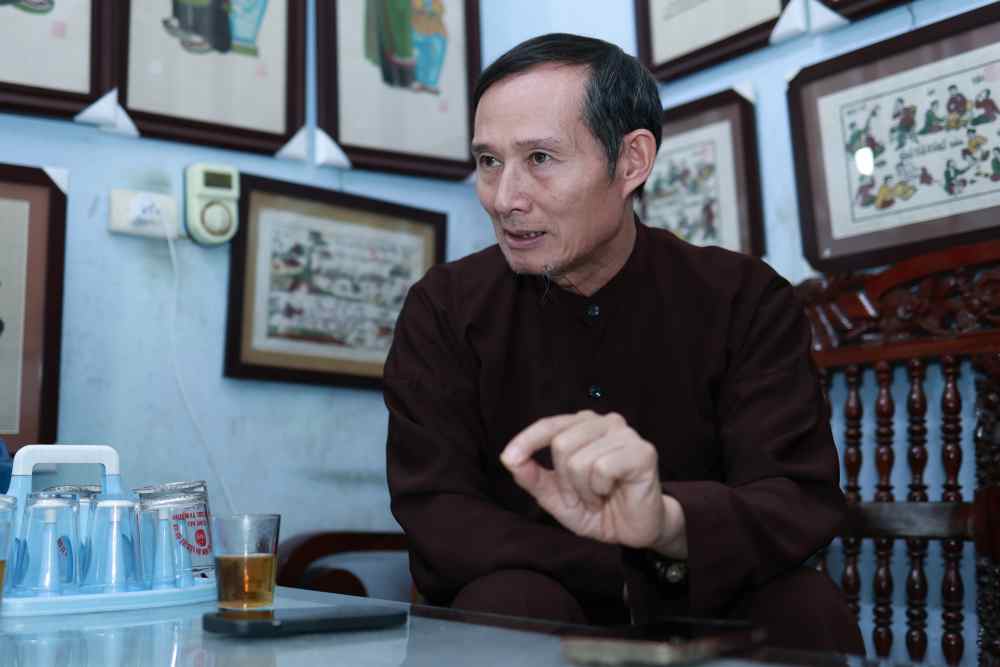
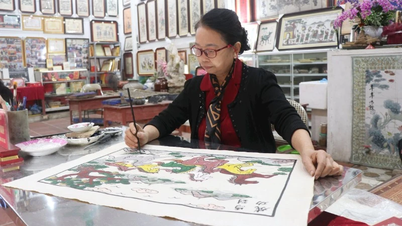
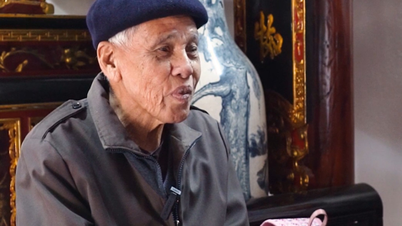
Artisan Nguyen Huu Qua - one of the rare outstanding artisans of the traditional Dong Ho painting craft. Photo: Hai Nguyen.
As an artist who has been involved in and studied folk paintings for many years, what do you think makes Dong Ho paintings special compared to other Vietnamese folk painting styles?
- Dong Ho paintings have very unique characteristics, expressed in many aspects, creating a difference from other woodblock print styles of Vietnam such as Hang Trong, Kim Hoan, Hue paintings or paintings of some ethnic minorities.
First and foremost is the paper material. Dong Ho paintings use "diep" paper, which is coated with scallop shell powder, creating a shimmering surface that is both durable and possesses a unique visual effect unlike any other type of painting.
Secondly, there's the matter of the colors. The colors in Dong Ho paintings are entirely natural: red is derived from crushed cinnabar, yellow from pagoda tree flowers, blue from indigo leaves, white from clam shells, and black from the ash of burnt straw and bamboo leaves. This natural color palette creates a rustic, familiar look that is also very durable over time.
Another unique feature is the woodblock printing technique. Dong Ho paintings are printed with color first, then the black outlines are printed afterward to set the shape. This technique is different not only from other Vietnamese folk paintings but also from many woodblock printing styles around the world .
The overlapping of color layers—perhaps two or three layers—creates beautiful intermediate color tones, such as white over red, yellow over blue, etc. This color effect can only be achieved through manual woodblock printing.
However, achieving that harmony requires the aesthetic eye, experience, and skill of each artisan in color distribution. This is the decisive factor in determining the artistic value of each Dong Ho painting.
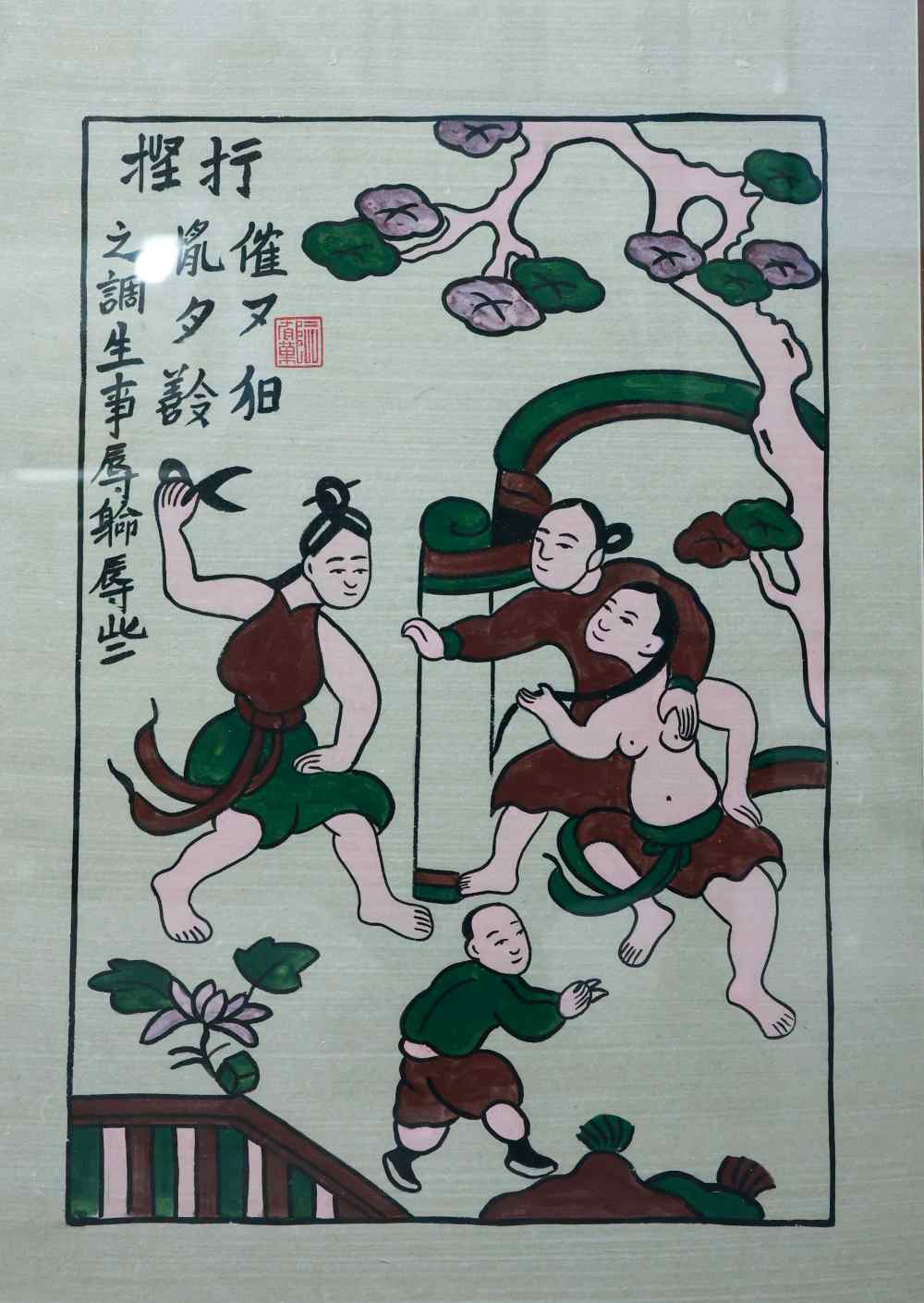
The painting "Jealousy." Photo: Hai Nguyen
Having been involved with Dong Ho paintings for many years, and having witnessed their rise and fall, with only about 3 families and artisans still practicing the craft today, what are the reasons why Dong Ho paintings are increasingly disappearing and becoming difficult to preserve and pass on to future generations?
- The decline of Dong Ho paintings did not happen overnight, but rather over several decades. The root cause stems from the difficult economic times, around the 1970s and 1980s. When life was still full of hardships, the demand for collecting and displaying paintings decreased sharply, leading to a shrinking market for the product.
In the past, people used to buy Dong Ho paintings to hang during Tet (Lunar New Year). At the end of the year, when the old paintings were damaged, they would buy new ones. This consumption cycle was regular, and with many buyers, the painters could make a living. However, since the paintings are now framed and can last for decades, the demand for new ones has decreased significantly. The paintings no longer sell as consistently as before, circulation slows down, sales decrease, and those in the profession can no longer make a living, forcing them to abandon the craft.
The fact that a few families have managed to maintain this craft today actually requires many factors. These families have a family foundation, tools, capital, raw materials, and accumulated craft knowledge. However, even so, they have only been able to sustain it at a precarious level for many decades. Without timely attention and support, this "precarious" phase could very well shrink further, even leading to the risk of complete disappearance, like many other traditional craft villages that have vanished.
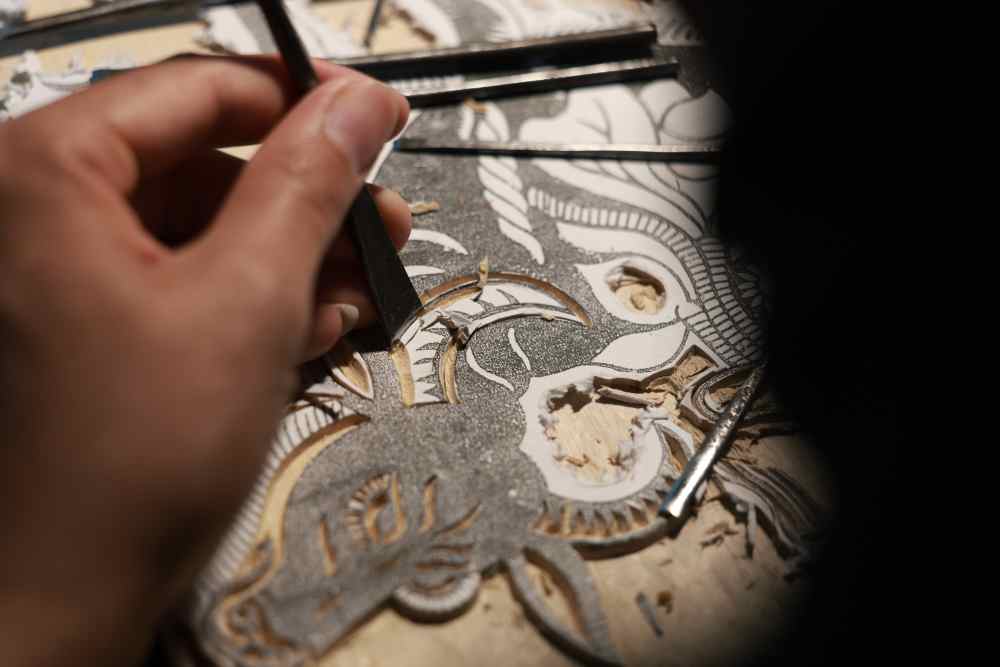
Dong Ho folk paintings are facing the risk of disappearing. Photo: Hai Nguyen
As one of the few remaining artisans who still practice Dong Ho painting, what have you done in recent times to preserve and promote this art form for future generations, sir?
- To preserve the Dong Ho painting craft, I have made long-term efforts and contributions. First and foremost is the work of promotion and introduction. I try to convey the good values, beauty, and depth of Dong Ho paintings so that people understand and appreciate them, and only then will they have the desire to collect and preserve the paintings.
This promotion is not only within the country but also extends to international friends. Many foreigners, such as those from Italy, Spain, and China, are very interested in and appreciate Dong Ho paintings. Some I visited to exchange ideas with, while others came all the way here to learn and research. Since the development of social media, connections have become much easier. In the last 5 years or so, many international friends have connected with me online, and some have even come directly to the village to stay and conduct research.
Besides promoting the craft, I also focus on preserving it. The old traditional cultural values are still maintained, and the painting-making activities within the family are regularly continued. I also try to train the younger generation in the family.
However, the reality is very difficult. Many young women learn the craft, but when they get married, they follow their husbands and abandon the profession. This is a common situation in many craft villages today.
For decades, I have directly supported numerous students from universities such as: Foreign Trade University, Journalism University, National University, University of Culture, Fine Arts University, Architecture University, etc.
Each student group approaches Dong Ho paintings from a different perspective, ranging from culture and economics to fine arts and architecture. I support them with everything from materials and explanations to practical guidance, essay writing, and research papers.
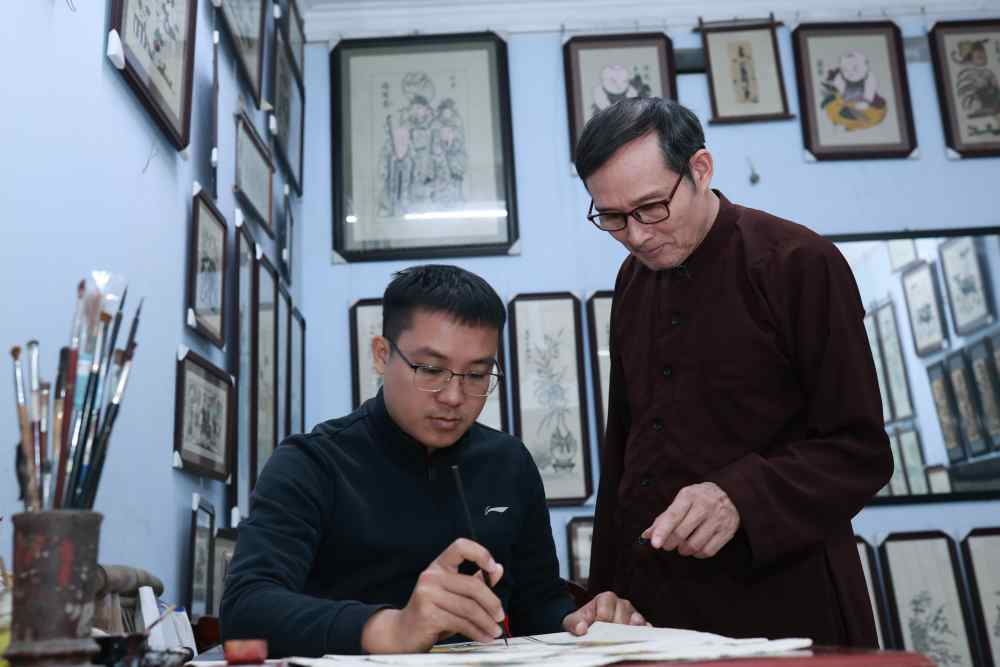
Artisan Nguyen Huu Qua and his son, young artisan Nguyen Huu Dao. Photo: Hai Nguyen
Besides directly passing on the craft, what other work does he focus on to preserve the core values of Dong Ho paintings?
- One task I particularly focus on, even considering it the most arduous and quietest, is researching and correcting the Sino-Vietnamese characters in Dong Ho paintings. Many people can print paintings, but determining whether the characters are correct or incorrect, and whether the interpretation is accurate or inaccurate, is something not everyone can do. There were periods when I was almost the only one pursuing this work.
I spent decades studying and researching Sino-Vietnamese characters to determine the true origins, stories, and profound meanings of each inscription on the paintings. Only by delving into this did I fully understand the ideological and cultural value that Dong Ho paintings contain, and from there I could pass it on to future generations.
The path of learning Sino-Vietnamese characters is truly arduous. It's like swimming in the vast ocean, swimming until you have no strength left. Some characters take a long time to learn, but if you don't read them again for a few years, you'll forget them immediately. Therefore, you have to study them repeatedly. But it is precisely because of this that I understand the roots of the paintings, and understand why Dong Ho paintings are so special.
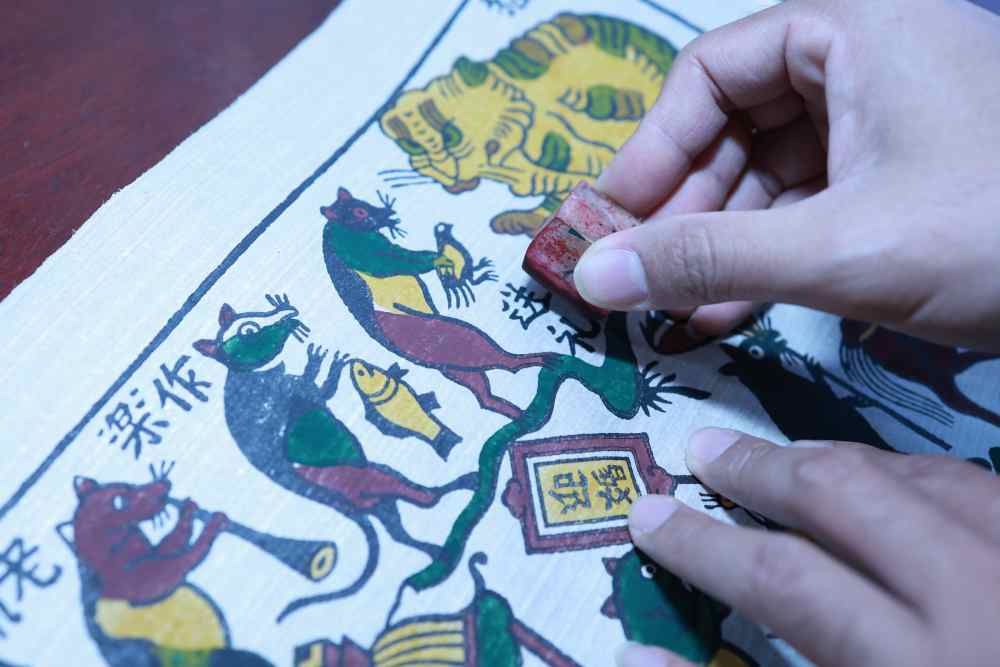
A long-term strategy is needed to preserve Dong Ho folk paintings. Photo: Hai Nguyen
According to the artisans, what are the core solutions for the sustainable development of Dong Ho folk painting?
- In my opinion, we only need to focus on four key solutions: First, ensuring the supply of traditional raw materials. Second, preserving and training artisans, including understanding Han-Nom script and the true cultural values. Third, creating markets for the products.
Finally, there needs to be unified management to avoid distorting the true nature of the paintings. Without understanding the cultural roots, it's easy to misrepresent and misrepresent the value of Dong Ho paintings.
Preserving a craft is not just about printing pictures, but about preserving the soul and essence of the culture. If you venture out into the open sea without knowing your roots, without knowing where to return, that is the real failure.
Ngoc Trang

![[Photo] Prime Minister Pham Minh Chinh receives the Governor of Tochigi Province (Japan)](/_next/image?url=https%3A%2F%2Fvphoto.vietnam.vn%2Fthumb%2F1200x675%2Fvietnam%2Fresource%2FIMAGE%2F2025%2F12%2F16%2F1765892133176_dsc-8082-6425-jpg.webp&w=3840&q=75)
![[Live] 2025 Community Action Awards Gala](/_next/image?url=https%3A%2F%2Fvphoto.vietnam.vn%2Fthumb%2F1200x675%2Fvietnam%2Fresource%2FIMAGE%2F2025%2F12%2F16%2F1765899631650_ndo_tr_z7334013144784-9f9fe10a6d63584c85aff40f2957c250-jpg.webp&w=3840&q=75)
![[Image] Leaked images ahead of the 2025 Community Action Awards gala.](/_next/image?url=https%3A%2F%2Fvphoto.vietnam.vn%2Fthumb%2F1200x675%2Fvietnam%2Fresource%2FIMAGE%2F2025%2F12%2F16%2F1765882828720_ndo_br_thiet-ke-chua-co-ten-45-png.webp&w=3840&q=75)
![[Photo] Prime Minister Pham Minh Chinh receives Lao Minister of Education and Sports Thongsalith Mangnormek](/_next/image?url=https%3A%2F%2Fvphoto.vietnam.vn%2Fthumb%2F1200x675%2Fvietnam%2Fresource%2FIMAGE%2F2025%2F12%2F16%2F1765876834721_dsc-7519-jpg.webp&w=3840&q=75)



































































Comment (0)