

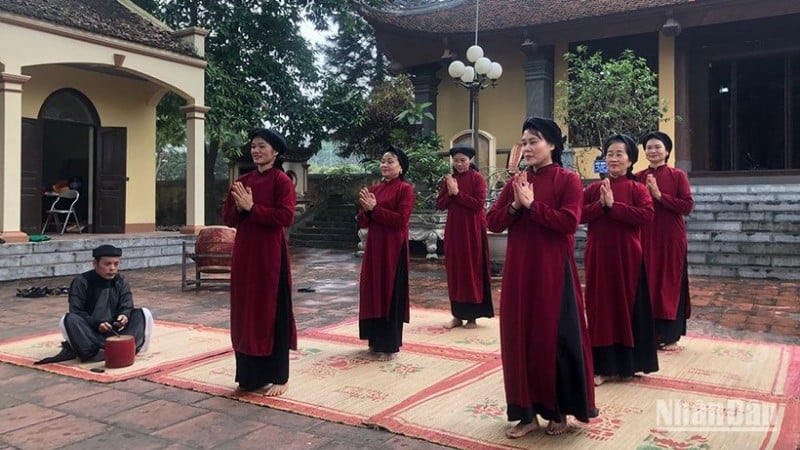
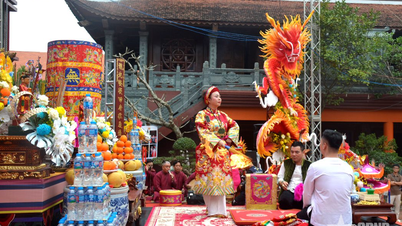
Xoan folk artists perform at Thét communal house, Kim Đức commune, Việt Trì city, Phú Thọ province.
UNESCO's recognition not only affirms the unique artistic value of the heritage but also motivates the community to maintain its skills and expertise, while opening up opportunities to promote Vietnamese culture. From UNESCO-inscribed heritage sites to the national heritage system, the need to develop modern educational programs that integrate indigenous knowledge and are appropriate for each cultural region has become urgent.
In fact, in many localities with heritage sites, besides promoting their value for tourism , the transmission of ethnic culture is an effective solution in preserving unique cultural characteristics.
Once on UNESCO's list of heritage in need of urgent safeguarding, Xoan singing is widely taught in schools and communities. Students learn about ancient melodies, customs, and rituals associated with Xoan under the guidance of artisans. The active participation of the younger generation has contributed to Xoan singing being removed from the list of heritage in need of urgent safeguarding and becoming a representative intangible cultural heritage of humanity.
In Bac Ninh, teaching Quan Ho folk singing in schools has created a class of young "lien anh" and "lien chi" (traditional male and female singers). In Thanh Hoa and Nghe An, folk singing clubs help students get closer to the songs and customs of each region.
In Dak Lak, the education sector, in coordination with the cultural sector, is implementing the "Bringing Heritage into Schools" program in the ethnic boarding school system. This program provides opportunities for students to access gongs, learn about music, and understand the customs and traditions of the indigenous communities. Some schools also incorporate language, writing, music, and handicrafts into their curriculum, breathing new life into the heritage. These models affirm the crucial role of education in cultural preservation. When organized appropriately to the regional characteristics and age groups of the students, the younger generation will develop an attitude of respect and responsibility towards heritage, contributing to ensuring the continuity and dissemination of traditional values in contemporary life.
In the context of traditional values being significantly impacted, both at the grassroots level and in management agencies, there is a consensus that local education plays a crucial role. Many provinces and cities have opened traditional vocational training classes, incorporated heritage content into the general education curriculum, and organized extracurricular activities linked to local cultural spaces.
However, local education programs currently only offer a general framework, lacking specific guidance on content, duration, and teaching methods tailored to the characteristics of each region. In many schools, heritage education is mainly integrated into or implemented as extracurricular activities; educational institutions in ethnic minority areas still lack curricula and materials specifically designed for heritage transmission.
Given these limitations, the Ministry of Culture, Sports and Tourism needs to coordinate with the Ministry of Education and Training to develop a framework for local education programs, clearly defining the proportion of content related to heritage and traditional culture in each region, especially in areas with diverse heritage types or large ethnic minority populations. The integration of heritage into education should be designed according to regional cultural characteristics, aligning with the values, customs, and beliefs of each community. Heritage education must be implemented regularly, systematically, and aim towards forming a network of schools connected to heritage. Furthermore, the digitization of intangible cultural heritage should be accelerated, integrating standardized resources into the new education curriculum.
In light of UNESCO's recommendations, education needs to play a proactive role in preserving traditional cultural values. Improving local education programs must become a long-term task, creating a foundation for nurturing love of national culture and awareness of heritage protection among the younger generation.
PHUONG LINH
Source: https://nhandan.vn/tu-di-san-unesco-toi-nuoi-duong-tinh-yeu-van-hoa-dan-toc-post930113.html









































































Comment (0)