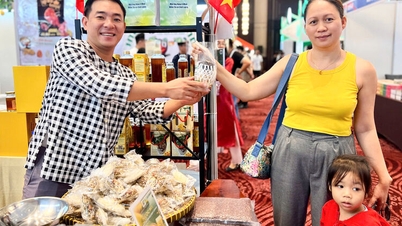
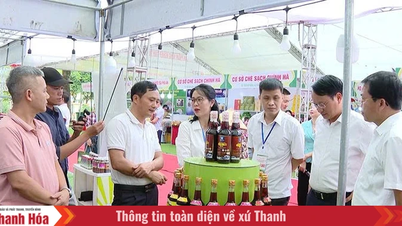
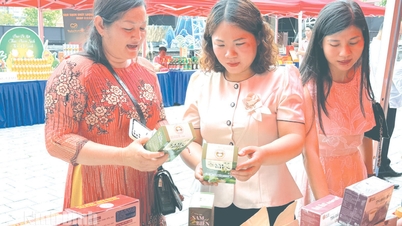
From craft villages that "import" raw materials to keep the flame alive.
To understand the vitality of Me Tri rice flakes, one must first look at the biggest challenge they face: the disappearance of their raw material source. Previously, Me Tri was a fertile land situated between the Nhue and To rivers, famous for the folk verse: "Me Tri's fragrant rice is the best in the region / Du Huong and De Bun are the most delicious rice dishes in the region." But rapid urbanization has transformed the commune into a ward, turning rice paddies into rental housing and public facilities.
When the local rice-growing land was depleted, the people of Me Tri faced the risk of losing their livelihoods. But instead of giving up, they undertook a flexible "reverse migration." The artisans of the village traveled to neighboring regions such as Bac Ninh and Phu Tho to find alternative rice sources. They even took the village's precious glutinous rice variety, "Nếp Cái Hoa Vàng," to other lands, instructing people in distant areas on cultivation methods to ensure the rice grains retained their characteristic sticky and fragrant quality at harvest.
Thus, the Me Tri craft village has now transformed into a "workshop for processing exquisite products." While the geographical location of the raw materials may have changed, the secrets of roasting, pounding, and sifting—the very "soul" of the craft—have been preserved intact through generations of artisans. This is not a break in the traditional craft, but rather a proactive expansion of its living space.
If someone comes to Me Tri hoping to find the romantic rhythm of pounding pestles on a quiet autumn night, as described in Thach Lam's writings, they will probably be disappointed. Instead, they will find a vibrant picture of industrial production.
To meet the growing market demand, the people of Me Tri have boldly mechanized their operations. Roasting machines, grinding machines, pounding machines, and vacuum packaging machines have become invaluable "assistants," replacing manual labor in strenuous processes. In particular, the introduction of industrial freezer systems in production workshops is a major turning point. Thanks to freezing technology, fresh rice flakes can be preserved for months without losing their flavor, color, or texture.
This has broken the "seasonal" nature of the traditional rice flake making craft. Previously, rice flakes were only a treat of the autumn season, but now the people of Me Tri can sell them year-round, especially during the Lunar New Year when the demand for making rice flake sausage, sticky rice cakes, and other traditional dishes increases. However, this modernization also presents new challenges regarding engine noise and cramped production spaces within densely populated residential areas, requiring a more systematic planning approach for the future. Nevertheless, it cannot be denied that this bold change has helped people stay committed to the craft, transforming a heritage into a sustainable livelihood.
You may also like
Gia Lai has two more treasures recognized as national heritage sites.VHO - The Prime Minister has just issued Decision No. 236/QD-TTg on the recognition of national treasures (14th batch). According to this decision, out of a total of 30 artifacts and groups of artifacts recognized nationwide, Gia Lai province has two groups of artifacts that have the honor of being inscribed as national treasures. 
Most people agree with the plan to upgrade 10 communes to wards.DNO - Implementing the city's policy, on June 6th and 7th, the People's Committees of 10 communes in the city organized a survey to gather opinions from each household regarding the upgrading of communes to wards. Initial results show that over 99.9% of the people agree with and support this policy. Reaching a brand turning point.
In the history of Hanoi's cuisine , Com Vong (a type of Vietnamese rice flake) has a long-standing and irreplaceable reputation. Therefore, Com Me Tri – despite its large production volume and comparable quality – is often less frequently mentioned, or quietly plays the role of a silent supplier to the general market. The people of Me Tri previously focused more on production and wholesale, accepting the fact that the flavor of their Com Vong blended into the mainstream of Hanoi's autumn treats without placing too much emphasis on establishing a distinct identity.
However, the "winds" have shifted since the Me Tri rice flake making craft was officially recognized as a National Intangible Cultural Heritage in 2019. This title serves as a fair affirmation of the historical value and quality of the rice flakes from this region, becoming a strong morale boost that helps the villagers feel more confident in their "cultural identity."
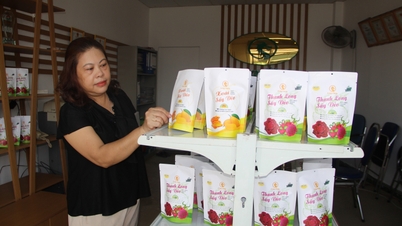
Currently, we are witnessing the rise of a new generation of artisans with a different mindset. No longer content with merely being "production workshops," many families have begun to deeply understand the importance of building their own brands. Names like Com Van, Com Pho Xua, Com Me Tri... have begun to appear prominently and elegantly on product packaging.
Instead of the simple, unlabeled packages of rice flakes tied with bamboo strips, the products are now neatly packaged with clearly identifiable logos. Although the number of businesses with proper investment is not yet the majority – a survey shows that about 30 Facebook pages selling these products have invested in their own images and logos – this is a positive sign. The people of Me Tri have begun to proudly tell their own story, about the simple, fragrant, chewy rice flakes made by the diligent hands of the people of Me Tri ward, without needing to borrow the reputation of any other place. The event of US President Barack Obama's visit to the village in 2016, though long gone, still serves as a golden guarantee of the quality of the local cuisine, cleverly incorporated into the stories of the locals selling their products.
Hoping for a cultural tourism "capital".
The transformation of Me Tri is also clearly reflected in its market approach. The image of creaky carrying poles hawking goods throughout the streets of Hanoi in the past has now faded into history, giving way to bustling "digital stalls."
People who make sticky rice flakes in Me Tri village now sell them on Facebook, Zalo, and e-commerce platforms like Shopee. With just a smartphone, a household can finalize orders for dozens of kilograms of sticky rice flakes every day, delivering them quickly to customers. Vacuum packaging technology helps the product travel further, reaching customers in other provinces and cities, and even as gifts to send abroad.
Although limitations remain, with many small businesses primarily selling to acquaintances based on "social capital" and village connections, and promotion on social groups being largely spontaneous, it's undeniable that technology has opened a huge door. It has helped Me Tri Rice Flakes transcend village boundaries, directly reaching young people and modern customers – those who value convenience but still yearn for traditional values.
Looking back at the tumultuous journey of Me Tri rice flake village, from a purely agricultural village heavily impacted by urbanization to a vibrant heritage craft village today, we see the powerful vitality of Vietnamese culture. The people of Me Tri did not sit idly by and mourn the lost fields; they rose up, adapted, and found a new path.
Emerging brands like Com Van and Com Pho Xua are the "leading lights" heralding a new spring for the craft village. Although much remains to be done to professionalize production processes, improve environmental hygiene, and plan the craft village's space in conjunction with experiential tourism, a solid foundation has already been built.
With the synergy of its National Heritage status, the support of technology, and the increasingly progressive branding mindset of its people, Me Tri sticky rice flakes have every right to dream of a future that is not just a production site, but an attractive cultural destination. There, in the heart of modern Hanoi, visitors can still find the fragrant aroma of young rice, and more importantly, discover the story of the resilience of people who cherish and enrich themselves with the precious heritage of their ancestors. Me Tri sticky rice flakes, therefore, is not just a food item, but a symbol of longevity and development.
Source: https://baophapluat.vn/com-me-tri-cuoc-chuyen-minh-day-kieu-hanh-cua-di-san-quoc-gia.html






![[Photo] Prime Minister Le Minh Hung presides over the thematic session on promoting science and technology development and innovation.](https://vphoto.vietnam.vn/thumb/1200x675/vietnam/resource/IMAGE/2026/06/23/1782207872934_ndo_br_dsc-1724-jpg.webp)