

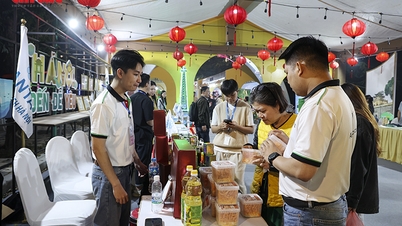
The second Muong Ethnic Culture Festival, recently held at the Vietnam Ethnic Culture and Tourism Village (Dong Mo, Son Tay, Hanoi), recreated the rich cultural life of the Muong community. More than just an opportunity for the public to learn about their heritage, the festival also served to honor those who have silently contributed to preserving this cultural identity, including People's Artisan Bui Van Minh.

At the festival, artisan Bui Van Minh brought with him stories and artifacts connected to the spiritual life of the Muong people. According to him, Mo Muong has long been considered a special intangible cultural heritage, present in every stage of a person's life, from birth to death.
Ancient Mo chants are not just prayers or songs, but also an "epic treasure" preserving legends, myths, experiences in interacting with nature, and the historical imprint of the community. "The Mo are folk scholars, the spiritual anchor of the Muong people. For a Muong person, it is a great misfortune if they die in old age without hearing the Mo's words," he shared.


Having been involved in the shamanic ritual since the age of 19, artisan Bui Van Minh says that what motivates him to dedicate himself to this heritage is not only his family tradition but also his deep love for the ethnic culture. He recounts the years he spent traveling alone throughout the four districts of Bi, Vang, Thang, and Dong in Hoa Binh province to meet elderly shamans, record ancient shamanic verses, and acquire artifacts associated with the life of the ancient Muong people. “Even during difficult times, I still saved money to buy copper pots, antique swords… because I knew that each object contained a part of the cultural soul,” he shared.
But what troubled him most wasn't the hardship of the collecting journey, but the disconnect in the younger generation's understanding of heritage. He shared that many young people visiting the exhibition at the festival didn't recognize familiar items used by the ancient Muong people, such as water-spinning pipes, woven trays, and looms. In the context of technological development and strong cultural exchange, the number of shamans in Muong villages is decreasing, leading to the risk of the loss of valuable folk knowledge.

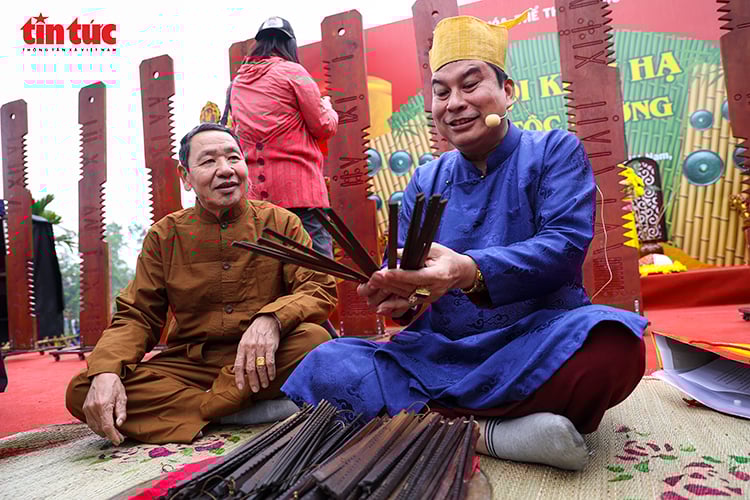
Faced with this situation, artisan Bui Van Minh and other dedicated individuals have strived to find a new direction for the heritage. In 2019, he founded the Mo Muong Club in Lac Son (formerly Hoa Binh province) to create an environment for practicing and teaching Mo to young people. Here, artisans not only perform the rituals but also explain the meaning and structure of Mo songs, helping students understand and "live with Mo."
In addition, he promoted the introduction of the Muong script into schools, considering it a foundation for future generations to access the heritage in a systematic way. He also proposed linking the heritage with tourism so that Mo Muong and Muong culture could be widely disseminated and become a distinctive cultural and tourism product.
One of the most remarkable achievements of artisan Bui Van Minh is his collection of nearly 1,000 Muong artifacts, meticulously preserved over four decades. Among them are many unique items, such as a set of 40 Muong gongs from the Tran Dynasty, a Khot bag passed down through generations of shamans, and fossilized rice grains found in the Trai cave, a site of prehistoric human remains in the Muong Vang region.
"These artifacts not only have material value but also contain stories about the beliefs, knowledge, and interaction of the Muong people with nature," he said.

At the 2nd Muong Ethnic Culture Festival, Muong cultural values were widely introduced to locals and tourists. Artisan Bui Van Minh expressed his emotion at seeing his ethnic heritage strongly disseminated through performances, exhibitions, and especially the impressive parade at Ho Guom Lake. He said that the attention of the State, ministries, and localities is a driving force for the Muong community to be more confident in their journey of preserving their identity.
1. All cultural heritage within the territory of Vietnam, whether originating domestically or from abroad, and regardless of ownership form, shall be managed, protected, and promoted in accordance with the provisions of this Law and other relevant laws.
2. Managing, protecting, and promoting the value of cultural heritage is the right, duty, and responsibility of all agencies, organizations, communities, and individuals.
3. Vietnamese cultural heritage abroad is protected under international law and the provisions of international treaties to which the Socialist Republic of Vietnam is a party.
4. Ensuring national and ethnic interests are harmonized with the legitimate rights and interests of organizations, communities, and individuals; respecting cultural diversity, dialogue between communities, and the unique characteristics of ethnic groups, regions, and areas.
5. Prioritize the protection and promotion of cultural heritage at risk of being lost or forgotten, historical and cultural relics, scenic spots, cultural heritage of ethnic minority communities, mountainous areas, border regions, islands, very small ethnic minority groups, and cultural heritage of value to the entire community and society.
6. Ensure maximum preservation of the original elements constituting the monument and the authenticity of documentary heritage; the inherent value and form of expression of intangible cultural heritage.
7. Respect the rights of intangible cultural heritage subjects and intangible cultural heritage artisans in deciding which elements need to be protected and the forms and extent to which cultural heritage should be promoted; identify risks and impacts threatening the existence and choose solutions for protecting cultural heritage.
8. Integrate the protection and promotion of cultural heritage values into the socio-economic development strategies, plans, and programs of the nation, regions, and localities.
"Preserving cultural identity is not just about displaying artifacts, but more importantly, about instilling cultural values in children so that they can be proud and know how to preserve the beauty of their nation," Mr. Minh emphasized.
With faith in the power of community and the support of society, artisan Bui Van Minh affirms that he will continue to dedicate himself to ensuring that the Mo Muong heritage – the cultural soul of the ethnic group that ranks fourth in population among the 54 ethnic groups – is sustainably preserved for future generations.
This article was commissioned by the Legal Department, Ministry of Culture, Sports and Tourism.
Source: https://baotintuc.vn/van-hoa/nghe-nhan-bui-van-minh-and-hanh-trinh-gin-giu-di-san-mo-muong-20251211230100622.htm

































































Comment (0)