


Iron forging: This is a long-standing traditional craft of the Nung An people. The products of this craft are mainly tools for agricultural and forestry production, highly valued by farmers in Cao Bang and other mountainous provinces. Currently, Nung An forged products are not only reputable within the province but are also popular with people in neighboring provinces and the Central Highlands. In particular, Nung An forged products are widely used by people in the border region with China. Thanks to the market economy and the development of tourism, Nung An forged products are chosen by many consumers and are available nationwide.
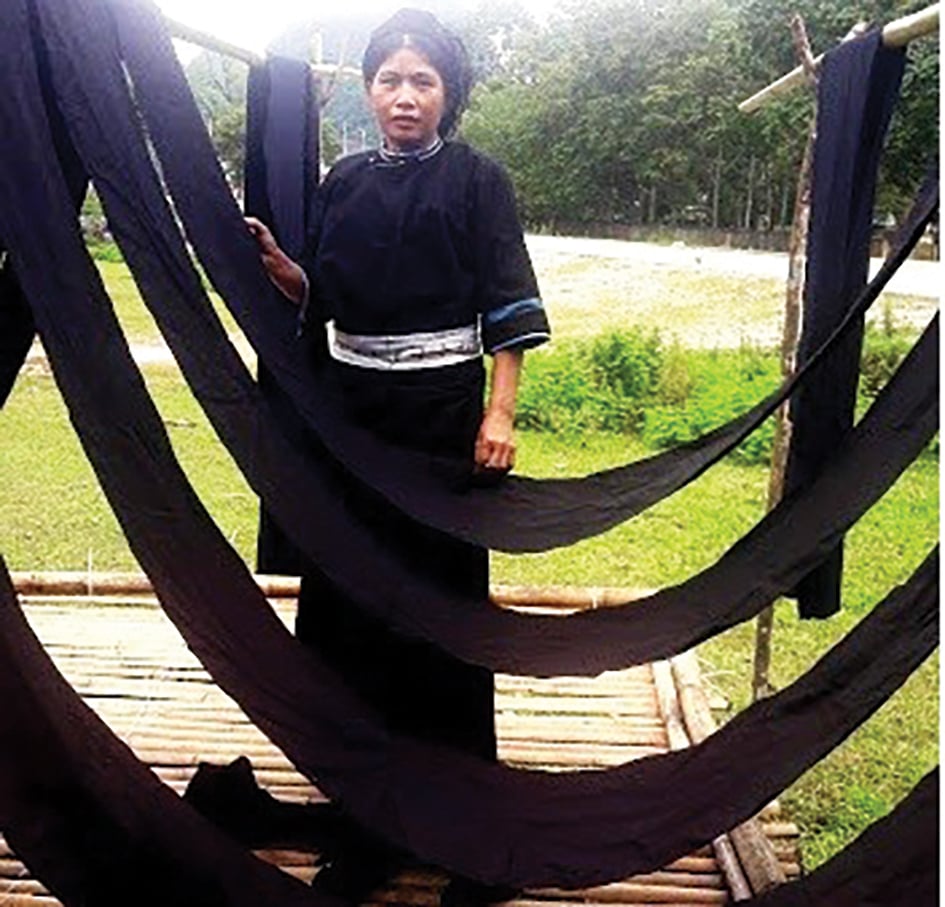
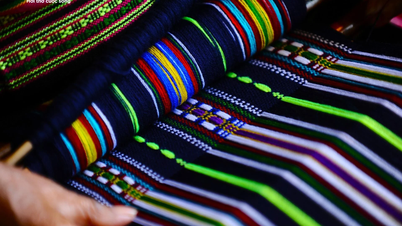
Weaving: This is a traditional craft considered of paramount importance, meeting the clothing and other needs of the people since ancient times. While traditional weaving has declined in many places, the hand-weaving craft of the Nung An people in Quang Uyen commune has been preserved and developed. This is related to the fact that the people regularly wear their traditional clothing. The people here grow their own cotton, spin the yarn, weave, dye, steam the fabric, and cut and sew it themselves. The indigo dyeing technique of the Nung An people is very advanced, especially the secret to dyeing fabric and preserving the color for a long time. Their dyeing technique usually ensures the color lasts longer than in other places. Perhaps this is partly why the clothes of the people here always look new. Besides weaving fabric for clothes, they also weave brocade for blankets and curtains. The brocade of the Nung An people does not have patterns and colors as vibrant as the brocade of the Tay people. The main patterns on the brocade of the Nung An people are borders, wavy lines, and parallel lines. Although simple, these patterns are very sophisticated and possess unique characteristics. In addition, the Nung An people also know how to use various leaves and tree bark of different colors, readily available in nature, to dye the threads used for weaving brocade and embroidery...
Basket weaving: This is a traditional craft practiced by individual families and closely linked to agricultural production. The products of this craft are primarily household items used in daily life and production, such as rice storage baskets, drying racks, winnowing trays, sieves, baskets, and hats. The raw materials are rattan, bamboo, and reeds, processed according to the needs of the weavers. To weave a particular item, they split and shape the rattan to suit the desired style. Basket weaving is done year-round, but is most common during periods of agricultural inactivity.
Woodworking: Although the woodworking products of the Nung An people are not as intricately carved as those of the Tay people, they possess unique and refined characteristics. The main products of this craft are the design of wooden stilt house frames and household items such as tables, chairs, beds, cabinets, chests, plows, harrows, winnowing fans, rice mills, and rice mortars. Particularly noteworthy is the traditional technique of designing, drilling holes for columns, and measuring and cutting the beams of the wooden stilt house frames. This method is lightweight, saves wood, and is still sturdy. The structure of this type of house is airy, and the technique of drilling and joining mortise and tenon joints is meticulously measured and calculated; once drilled and assembled, they fit together seamlessly. In their design and construction, Nung An houses do not use iron nails or binding strips; everything is calculated using precisely drilled holes and sawn cuts.
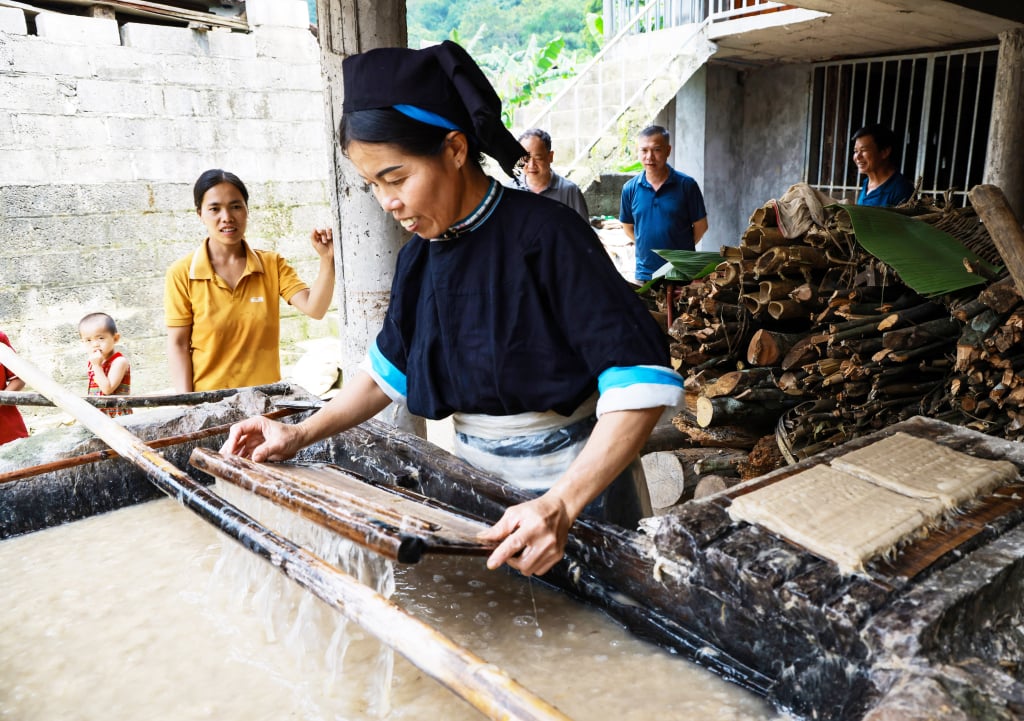
Do paper making (chia sla): This is one of the oldest traditional crafts of the Nung An people, which once declined, with very few people practicing it and almost disappearing completely. Currently, due to consumer demand and tourism development, this craft has been revived. The main material is the bark of the duong tree (nang may sla). This type of paper is very durable and strong; Taoist priests often use it to write Nom characters, for use in spiritual ceremonies, and the people use it to cut into paper money for offerings.
Incense making: This craft is usually practiced during periods of agricultural inactivity and consumed during festivals and holidays, serving religious and spiritual rituals. The incense-making technique of the Nung An people is very simple. The main ingredients are split bamboo sticks; the incense powder consists of powdered decaying wood and powdered leaves of the Hát plant (a type of plant that grows naturally in the forest and has a fragrance similar to cinnamon leaves), dried, ground, and sifted until very fine. The main step is pounding the incense to ensure the powder from the bark and leaves adheres to the stick. Once the stick is evenly coated with both powders, it is dried and then stored for sale.
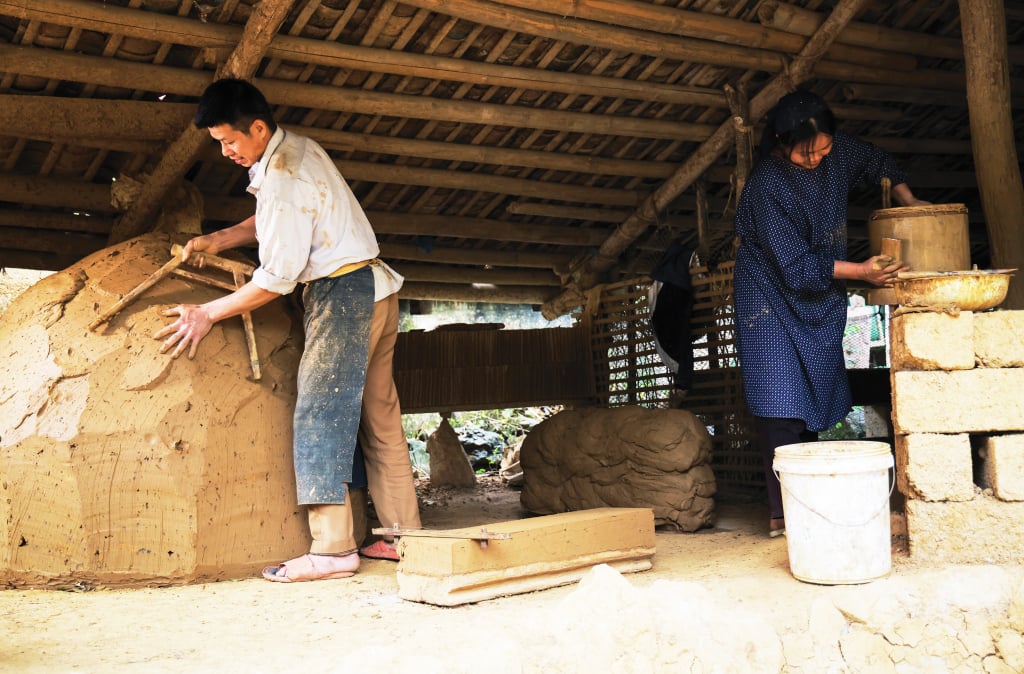
Tile-making: Since ancient times, the Nung An people have practiced the craft of making interlocking tiles (yin-yang tiles) for roofing their houses. Technically, they only need to select fine clay free from stones. The tiles made by the Nung An people differ from those made elsewhere in that they are large, uniformly thick, durable, and less prone to breakage during transport. The tile-making craft of the Nung An people had once declined. However, with the development of tourism and the increasing demand for diverse construction materials, the craft has been revived.
Stone carving: Similar to other traditional crafts, stone carving here primarily serves daily life, producing household items such as grinding mills, mortars, water troughs, rollers, stone blocks for house pillars, and stone staircases. Notably, people also carve stones to fence gardens, fields, and villages. Due to the geographical location of this area, which is mainly situated in a rocky valley, the stone carving craft still exists in Quang Uyen commune.
Cast iron casting: The Nung An people's cast iron casting craft is preserved and developed alongside the other crafts mentioned above. Products made from cast iron include tools for daily life such as plow blades, harrow blades, pots, pans, etc.
Source: https://baocaobang.vn/nhung-net-van-hoa-dac-sac-ve-nghe-lang-nghe-cua-nguoi-nung-an-3183185.html















![[Image] Close-up of the newly discovered "sacred road" at My Son Sanctuary](/_next/image?url=https%3A%2F%2Fvphoto.vietnam.vn%2Fthumb%2F1200x675%2Fvietnam%2Fresource%2FIMAGE%2F2025%2F12%2F13%2F1765587881240_ndo_br_ms5-jpg.webp&w=3840&q=75)




















































Comment (0)