

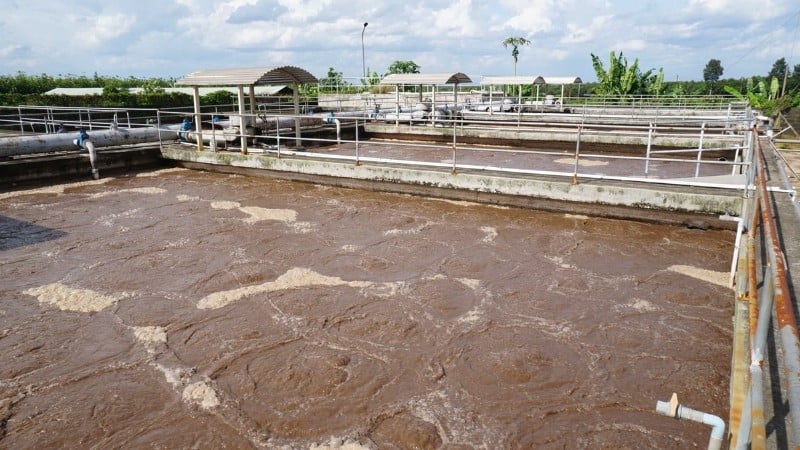
Green infrastructure for sustainable development
Established in 2012, Tan Binh Industrial Park covers an area of over 320 hectares and is located on the main connecting axis of the Southeast region, considered the "industrial gateway" of the area. From the planning stage, the investor identified three pillars that must go hand in hand: modern infrastructure, a sustainable environment, and safe production, considering these as core factors to attract investment, especially from international investors who value environmental standards.
Based on that orientation, over 1.1 trillion VND has been allocated to investment in technical infrastructure, with the centralized wastewater treatment plant with a capacity of 2,300 m³ /day considered the "green heart" of the entire area. This project is not only a mandatory technical item but also a declaration of an approach to industrial development linked to environmental protection.
According to Mr. Nguyen Quoc Thai, Deputy General Director of Tan Binh Industrial Park Joint Stock Company, projects wishing to enter the industrial park are carefully screened, prioritizing industries with low pollution levels and plans for waste treatment and reuse. In addition, Tan Binh Industrial Park focuses on green space ratios and the rational arrangement of production areas, warehouses, service infrastructure, and buffer zones between industrial and residential areas, thereby minimizing the negative impact of industrial activities on people's lives.
The centralized wastewater treatment plant operates continuously 24 hours a day, with the treated water regularly monitored to ensure it meets standards before being discharged into the natural environment. While investing in a sophisticated treatment system increases operating costs, according to company leaders, this is an investment in the future, contributing to a safe working environment and providing a significant competitive advantage when working with global corporations that are tightening their requirements for sustainable development. The environmental effectiveness of this model is becoming increasingly evident.
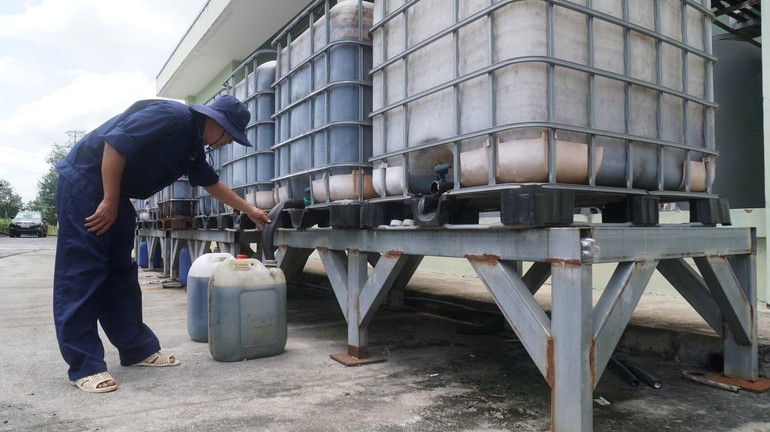
Modern processing technology, transparent monitoring.
At the wastewater treatment plant, all processes are designed as a closed-loop system with multiple stages. According to Mr. Pham Ngoc Huy, a technical officer at the plant, wastewater from the factories first passes through a trash screen and a sand settling tank to remove coarse debris and inorganic impurities. Next, the lighter solids are separated by flotation with ozone bubbles, which reduces the load on subsequent stages and provides initial deodorization and decolorization.
The pre-treated water is fed into an anaerobic biological system, where specialized microorganisms break down complex organic matter into simpler compounds, which are then converted into methane ( CH4 ) and carbon dioxide ( CO2 ). Simultaneously, an ozone oxidation system further treats the water, eliminating bacteria and reducing pollutants such as COD, BOD, and SS by up to 90% and Coliforms by up to 95%, creating a foundation for subsequent treatment stages.
Wastewater after biological treatment is directed to a flotation and secondary sedimentation unit to thoroughly remove any remaining suspended solids. The separated sludge is classified for reuse: heavy inorganic sludge can be used as raw material or additive in the production of construction materials; light organic sludge is mixed and composted to make fertilizer and improve soil, thereby reducing the amount of waste that needs to be landfilled and gradually forming a circular economy model within the industrial park.
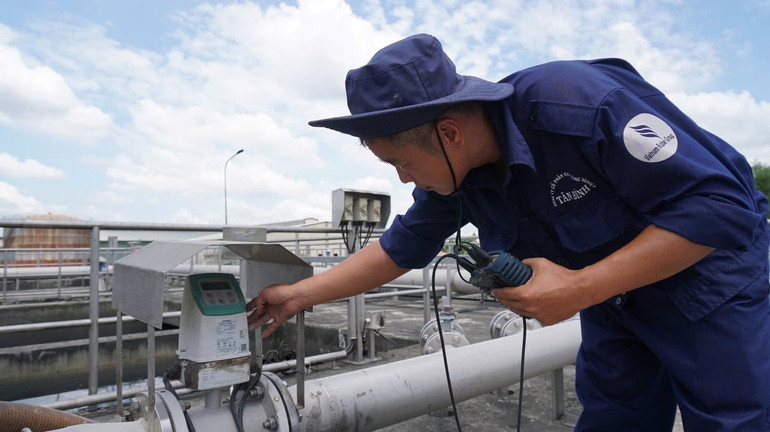
The highlight of the plant is its SCADA system – an automation technology that allows for the monitoring and control of the entire wastewater treatment process on a digital platform. From the central control room, parameters such as flow rate, pH, pollutant concentration, and equipment operating status are updated in real time. When abnormal fluctuations occur, the system immediately issues alerts so that technical staff can make timely adjustments, minimizing the risk of environmental incidents.
According to Mr. Pham Ngoc Huy, the application of SCADA helps to increase transparency in operational data, creating conditions for state management agencies and partners to monitor and verify the quality of wastewater treatment when necessary. Compared to manual monitoring methods, this model improves accuracy and saves manpower, creating a foundation for the industrial park to continue upgrading to increasingly stringent environmental standards.
In the context of increasingly clear demands for green development, greenhouse gas emission reduction, and a shift towards a circular economy, the modern wastewater treatment plant model in Tan Binh Industrial Park demonstrates a proactive approach by infrastructure businesses. This "green heart" not only protects the regional environment but also contributes to enhancing the image and investment attractiveness of a dynamic industrial zone transforming towards sustainability.
Source: https://nhandan.vn/khu-cong-nghiep-tan-binh-trai-tim-xanh-tu-he-thong-xu-ly-nuoc-thai-hien-dai-post930141.html












































































Comment (0)