

System-wide effort
In Can Tho City, there are currently approximately 82,634 people with disabilities, equivalent to 1.96% of the population. Of these, 364 are receiving specialized education, and 792 are receiving inclusive education at various educational institutions. According to Mr. Vo Hong Lam, Deputy Director of the Department of Education and Training of Can Tho City, the care and education of children, especially those with disabilities, is a priority for the entire political system. Early care, education, and intervention from the first years of life help children maximize their potential, minimize secondary disabilities, and create a favorable foundation for their integration into school and the community later on.
Over the past period, the Department of Education and Training of Can Tho City has implemented many comprehensive solutions to support students with disabilities. Schools have developed individualized education plans, adjusted teaching content and assessment according to students' progress; while also focusing on developing life skills, ensuring benefits for teachers, and mobilizing social resources. The Education sector has collaborated with the Norwegian Alliance to open training courses on inclusive education, guide the development of individualized education plans, and organize workshops for parents. In the period 2021-2025, training activities on inclusive education will be expanded. A survey report on knowledge, attitudes, and practices in inclusive education, conducted in December 2024, shows that attitudes towards inclusive education are generally positive.
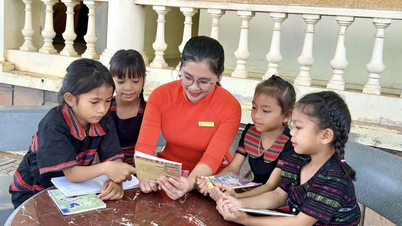
Besides policies, the teacher's love plays a decisive role. Ms. Nguyen Huynh Nhu, a teacher at Thoi Binh 1 Primary School in Ninh Kieu Ward, has applied visual methods in teaching and collaborated with parents to educate children together. Ms. Huynh Nhu shared: "Encouragement through affection, such as a teacher's gaze and a hug, is very important. It is this love that has helped about 10-15 students I have supported to successfully integrate. Some children, who previously didn't know how to communicate, now know how to do math, read, and express love. That result has given me great motivation."
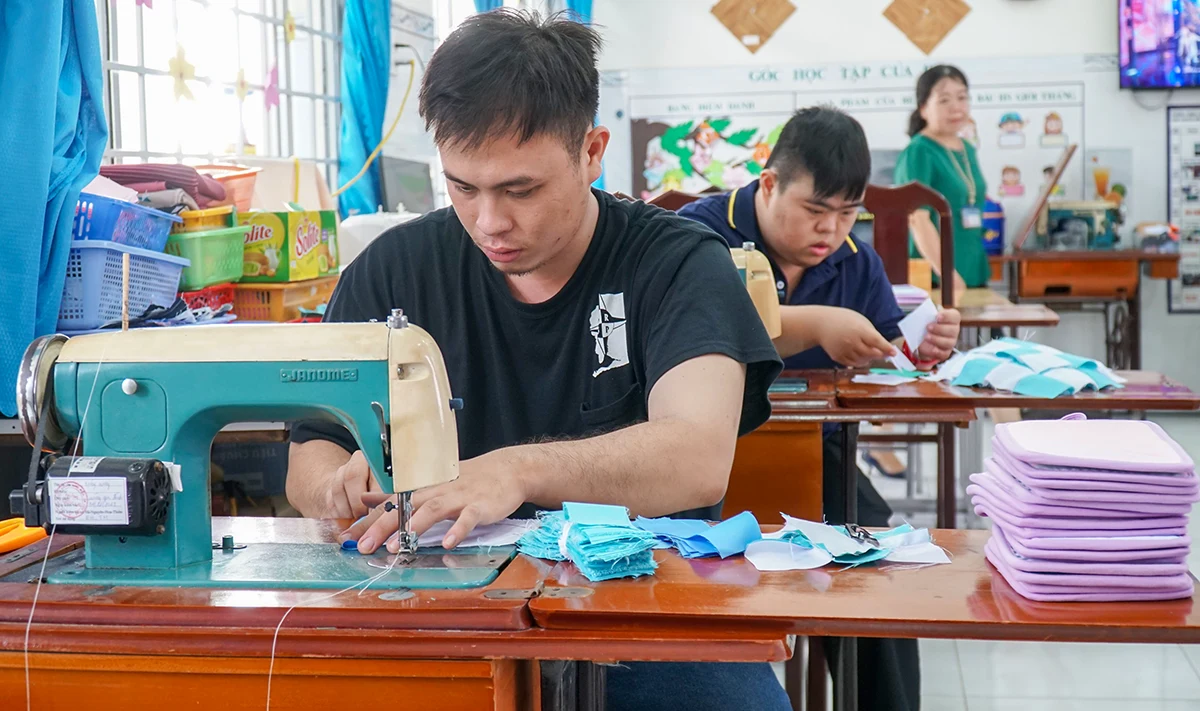
Students at Tuong Lai School ( Can Tho City) participate in a practical sewing lesson. Photo: B.NG
Fundamental solution
In Vinh Long province, the enrollment rate of students with disabilities in school reached 98.7%. To achieve this figure, the provincial Department of Education directed schools from preschool to high school to collaborate with support centers to provide direct counseling to each student with disabilities. Simultaneously, they required the creation of individual student profiles according to specific plans, serving as a basis for schools to organize appropriate care, management, and guidance methods.
Mr. Vo Van Luyen, Deputy Director of the Department of Education and Training of Vinh Long province, said that homeroom teachers must closely monitor students with disabilities to develop basic skills to help them access the 2018 General Education Program; and closely coordinate with families in advising and helping them overcome difficulties and integrate well into the learning environment.
It can be said that family is a very important factor in helping children with disabilities integrate into the community early. Mr. Hua Minh Tam, Deputy Director of the Center for Supporting Inclusive Education Development in Vinh Long, said: "Through many years of implementing inclusive education, we have noticed that the rate of children with disabilities attending school is high thanks to the support of parents." According to him, when parents accept their child's condition from preschool and understand that children learn according to their own abilities, capabilities, and needs, the number of children attending school increases, and the quality of inclusive education also improves. The education sector ensures that children learn in a friendly environment where they learn to love, share, and progress together.
Education can help develop a child's strengths. With early and timely intervention, children will develop well, acquire many skills to go to school, integrate with friends, become self-sufficient, and later be able to work and live more independently. Therefore, he recommends that parents pay attention to signs of delayed speech, walking, and motor skills so that their children can be examined early, because parents are the first and most important people in helping children develop and integrate.
To further improve the quality of early intervention and inclusive education, representatives from local education departments have made several important recommendations. Specifically, they suggest the need to promptly issue standards and quotas for specialized support teachers in inclusive schools (no more than 2 students with disabilities per class); and to develop a unified, in-depth training program for general education teachers on basic therapy skills.
Delegates also proposed strengthening cooperation mechanisms, sharing experiences and professional resources among provinces and cities in the Mekong Delta region, especially in building a shared learning resource repository and piloting a model for inter-provincial transfer of students with disabilities. Ms. Cao Thi Tieng, Director of the Center for Supporting Inclusive Education Development (the center) of Dong Thap province, affirmed that the unit will continue to advise on the development of inter-sectoral coordination plans, promote early disability identification, and develop infrastructure to ensure the best interests of students with disabilities in the region.
According to Dr. Ta Ngoc Tri, Deputy Director of the Primary Education Department, Ministry of Education and Training, education is the key to the integration of people with disabilities, and "early detection and early intervention" is a crucial prerequisite requiring close coordination between the education and health sectors. In the future, localities should proactively establish public centers based on the actual population size, while also encouraging the establishment of private centers that meet the necessary conditions, under the direct management of the education sector.
B. KIEN
Source: https://baocantho.com.vn/chung-tay-giao-duc-hoa-nhap-cho-tre-khuyet-tat-a195449.html


![[Photo] Secretary of the National Assembly Party Committee, Chairman of the National Assembly presides over the meeting of the Standing Committee and Executive Committee of the National Assembly Party Committee.](https://vphoto.vietnam.vn/thumb/1200x675/vietnam/resource/IMAGE/2026/06/03/1780480353201_ndo_br_bnd-2585-jpg.webp)
![[Photo] General Secretary and President To Lam presides over a meeting with the Central Organizing Committee.](https://vphoto.vietnam.vn/thumb/1200x675/vietnam/resource/IMAGE/2026/06/03/1780482764658_a1-bnd-4741-3342-jpg.webp)




















![[Photo] General Secretary and President To Lam attends the 14th Congress of the Vietnam Trade Union](https://vphoto.vietnam.vn/thumb/1200x675/vietnam/resource/IMAGE/2026/06/04/1780543339765_anh-man-hinh-2026-06-04-luc-10-22-07.png)


























![[Video] Sunset at Lap An Lagoon – Where the sun sets over the fishing nets](https://vphoto.vietnam.vn/thumb/1200x675/vietnam/resource/IMAGE/2026/05/31/1780192137701_beach-landscape-sea-water-nature-grass-745871-pxhere-com.jpeg)
































Comment (0)