

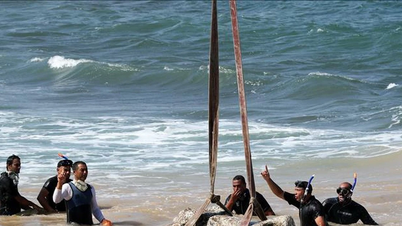
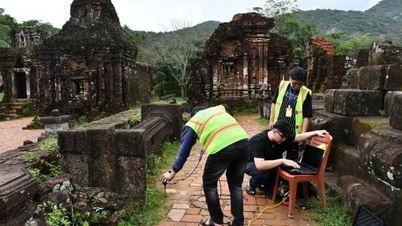
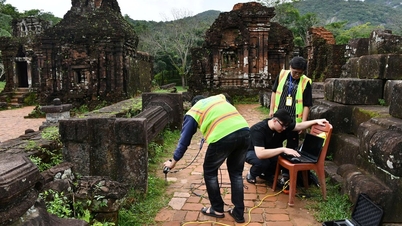
The My Son World Heritage Management Board (Thu Bon commune, Da Nang city) has officially announced the results of archaeological excavation and research on the architectural structure of the access road from Tower K to the central temple complex of the My Son sanctuary. The research on this road was carried out by the My Son World Heritage Management Board in coordination with the Institute of Archaeology (Ministry of Culture, Sports and Tourism). The first exploration began in June 2023, followed by the first excavation in March 2024, covering an area of 220 m². The excavation in 2025 will be expanded to a total area of 770 m², aiming to further clarify the structure, function, and role of this unique architectural route.
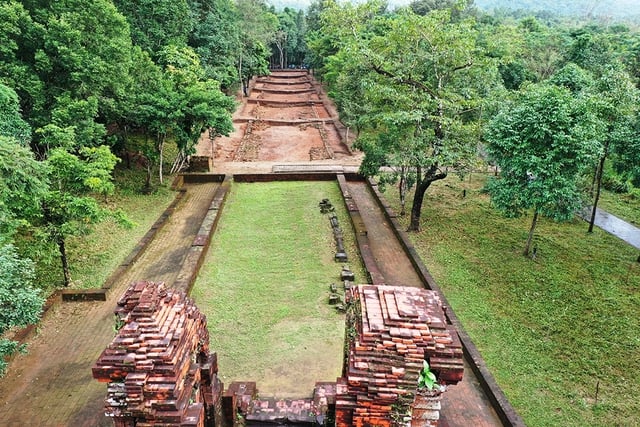
The sacred path leading to the heart of the My Son sanctuary.
PHOTO: MANH CUONG
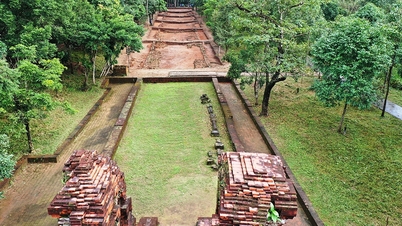
Excavations have uncovered a 75-meter-long road leading east of Tower K, running east-west and slightly north. Thus, the total length of the road identified from the base of Tower K to date is 132 meters. The road's cross-section is approximately 9 meters wide, with a carriageway width of 7.9 meters; the surface is flat, composed of compacted sand, gravel, and broken bricks, with a thickness of 0.15-0.2 meters. On either side of the road are brick walls, their foundations reinforced with a layer of pebbles and brick dust. To date, archaeologists have identified four gate locations on the southern wall, with traces of stone gate beams, square mortise holes for supporting stone pillars, and round mortise holes for the rotating gate posts.
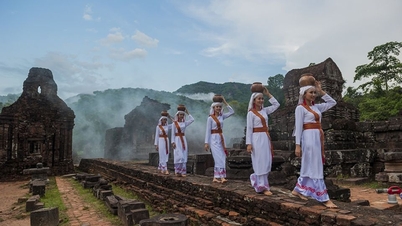
According to experts, the results of the 2025 survey and excavation have provided important scientific evidence, confirming that this was a sacred road – a ceremonial path leading deities, kings, and Brahman priests into the My Son sanctuary, existing around the 11th-12th centuries. This discovery also shows that My Son played a central religious role in the Champa kingdom throughout history, with the sacred space expanding or contracting depending on the dynasty.
Notably, preliminary comparative studies suggest that the sacred road at My Son is a unique phenomenon within the Champa relic system. Unlike other sites, where the road typically leads directly from the outside to the central temple, this road leads into a vast complex of relics, reflecting the unique architectural and ritualistic thinking of the ancient Champa people.
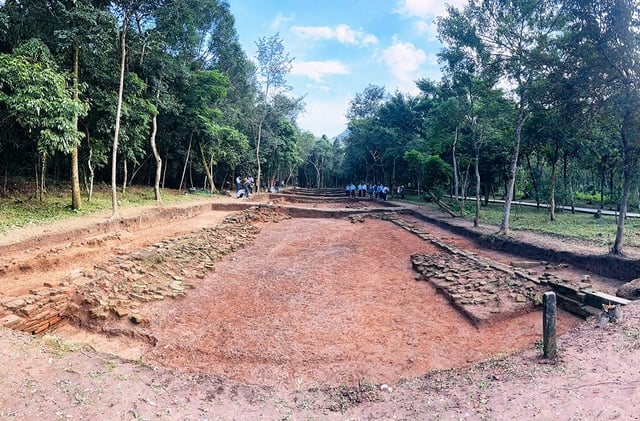
The Sacred Road is considered one of the most important archaeological discoveries in Vietnam in modern times.
PHOTO: MANH CUONG
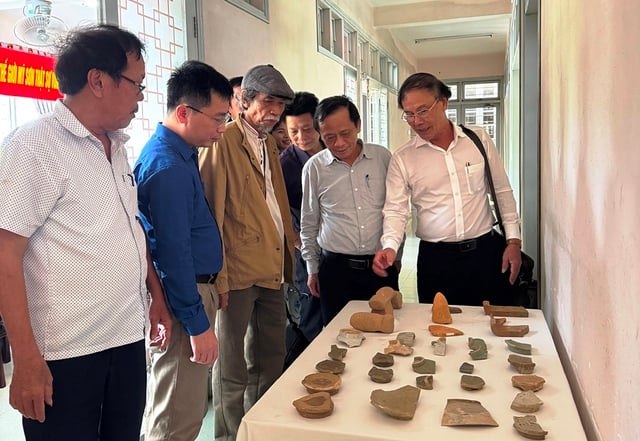
The excavation also uncovered numerous fragments of earthenware and glazed pottery, dating from the 10th to 12th centuries.
PHOTO: MANH CUONG
"THE BIGGEST ARCHAEOLOGICAL EVENT IN VIETNAM"
Associate Professor Ngo Van Doanh, former Deputy Director of the Institute of Southeast Asian Studies (Vietnam Academy of Social Sciences), stated that since the French discovery of the My Son Sanctuary in the late 19th century, the uncovering of the sacred road leading to the site is "the biggest archaeological event in Vietnam in modern times." "The unique value of the road lies not only in its architectural style but also in its location and function as a gateway to the temple complexes, things that researchers had never previously recognized," Professor Doanh affirmed.
Mr. Nguyen Cong Khiet, Deputy Director in charge of the My Son World Cultural Heritage Management Board, said that in the coming time, the unit will continue to coordinate with the Institute of Archaeology to develop a comprehensive research program to clarify the entire scale, structure, and appearance of the road within the overall context of the relic site. Simultaneously, restoration and preservation work will be carried out to enhance the heritage value, gradually organizing tours for visitors along the "heritage road" that the ancient Cham people created.
Source: https://thanhnien.vn/dien-mao-con-duong-thieng-doc-nhat-dan-vao-thanh-dia-my-son-185251214204524209.htm
























































Comment (0)