

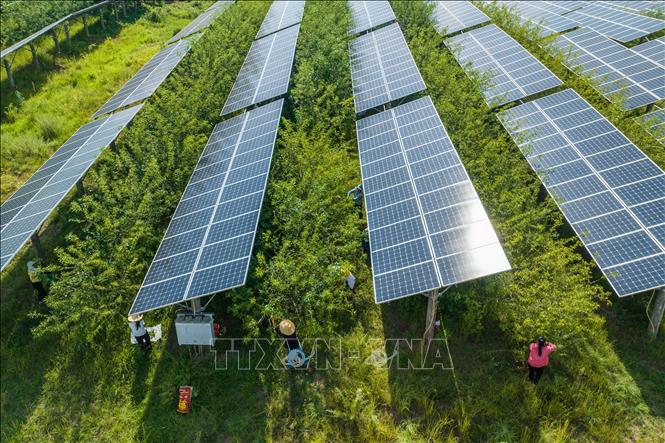
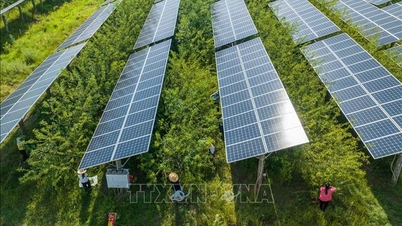
Solar panels in Guizhou province, China. Photo: AFP/VNA
While 2026 may not be the time for countries to make major climate commitments, it will see growth, resilience, and competitiveness in the energy sector.
The International Energy Agency (IEA) estimates that global energy investment in 2025 could exceed $3.3 trillion, with more than 60% (equivalent to $2.2 trillion) focused on clean energy technologies, even if climate issues are not given as much importance as security and affordability.
By 2026, the top priority for countries may be to boost growth through competition in the industrial sector. Industrial and economic policies are now considered the main levers for energy transition policies. Instead of traditional energy policies, countries will focus on industrial policies to achieve economic and strategic goals. Specifically, this could be a race to build factories, not just solar and wind farms.
The global energy transition has taken a historic turn as the cost of producing electricity from renewable sources has become more competitive than ever. According to two United Nations (UN) reports, over 90% of newly built renewable energy plants now have lower electricity production costs than even the cheapest fossil fuel alternatives. UN Secretary-General Antonio Guterres believes the world is on the threshold of a new energy era. He argues that the age of fossil fuels is coming to an end, giving way to clean energy.
Data from the International Renewable Energy Agency (IRENA) also shows an impressive drop in costs. Solar power is now 41% cheaper than fossil fuels, a dramatic change considering it was four times more expensive not long ago. Similarly, offshore wind power is also up to 53% cheaper, becoming the most affordable new renewable energy source.
Furthermore, in its annual "World Energy Outlook" (WEO) report, published in November 2025, the IEA stated that renewable energy is expanding much faster than fossil fuels globally, despite policy changes in the US, and that oil demand could peak around 2030.
In this year's report, the IEA presented three different scenarios for the future of energy, and in all of these scenarios, renewable energy is projected to grow faster than any other major energy source, with solar power leading the way. Specifically, the three scenarios presented by the IEA include: the current policy scenario (CPS), which only considers existing policies; the stated policy scenario (STEPS), which includes policies that have been announced but not yet implemented; and the net zero emissions scenario by 2050.
According to the CPS scenario, demand for oil and natural gas will increase by 16% by 2035 and continue to rise until 2050. The IEA has removed this scenario from its reports since 2020. According to the STEPS scenario, oil demand will peak around 2030, fall to 100 million barrels per day in 2035, and then decline further in subsequent years.
In its WEO 2025 report, the IEA suggests that the Earth's temperature increase will exceed 1.5°C compared to pre-industrial levels. Under the CPS scenario, global temperatures will rise above 2°C by around 2050, reaching 2.9°C by 2100, and then further increasing. Under the STEPS scenario, temperatures will rise above 2°C by around 2060 and 2.5°C by 2100. Under the Net Zero scenario, the temperature increase will peak at 1.65°C by 2050 and then fall below 1.5°C by 2100.
The WEO 2025 report also indicates that electricity demand is rapidly increasing due to the formation of data centers and AI in developed economies and China, along with rapidly growing demand for air conditioning in developing countries. In all scenarios, China remains the largest market for renewable energy, accounting for 45-60% of total global capacity deployment over the next 10 years.
China is currently the world's largest spender on clean energy, nearly equaling the combined spending of the United States and the European Union (EU), and leads the world in manufacturing across most clean and advanced energy supply chains. India is also demonstrating ambition in this race, with the government enacting a series of incentive policies for domestic manufacturing and mandatory regulations for clean energy deployment. For example, India's Dhirubhai green energy complex is expected to become operational next year and aims to house factories producing solar panels and batteries.
Furthermore, geopolitical tensions have brought energy security back to the forefront of the agenda, making resilience the second-largest topic in 2026. China is expected to continue its efforts to enhance the resilience of its energy infrastructure and increase its leadership in new technologies. Europe is shifting away from Russian fuels, aiming to completely phase out Russian gas, oil, and nuclear power. The US is diversifying and increasing its domestic supply of lithium, cobalt, nickel, and rare earth elements.
Against the backdrop of rising energy demand, the World Economic Forum (WEF) advocates an integrated approach to energy solutions, including energy storage, advanced nuclear power, clean fuels, hydrogen, and decarbonization. According to the WEF, no single technology can solve the energy transition alone; a combination of solutions is needed. Different regions, industries, and businesses will have their own strategies, but they must cooperate with each other.
Source: https://baotintuc.vn/the-gioi/kinh-te-2025-du-bao-2026-nang-luong-sach-xu-the-khong-the-dao-nguoc-20251217070445670.htm

![[Live] 2025 Community Action Awards Gala](/_next/image?url=https%3A%2F%2Fvphoto.vietnam.vn%2Fthumb%2F1200x675%2Fvietnam%2Fresource%2FIMAGE%2F2025%2F12%2F16%2F1765899631650_ndo_tr_z7334013144784-9f9fe10a6d63584c85aff40f2957c250-jpg.webp&w=3840&q=75)
![[Photo] Prime Minister Pham Minh Chinh receives the Governor of Tochigi Province (Japan)](/_next/image?url=https%3A%2F%2Fvphoto.vietnam.vn%2Fthumb%2F1200x675%2Fvietnam%2Fresource%2FIMAGE%2F2025%2F12%2F16%2F1765892133176_dsc-8082-6425-jpg.webp&w=3840&q=75)

![[Image] Leaked images ahead of the 2025 Community Action Awards gala.](/_next/image?url=https%3A%2F%2Fvphoto.vietnam.vn%2Fthumb%2F1200x675%2Fvietnam%2Fresource%2FIMAGE%2F2025%2F12%2F16%2F1765882828720_ndo_br_thiet-ke-chua-co-ten-45-png.webp&w=3840&q=75)
![[Photo] Prime Minister Pham Minh Chinh receives Lao Minister of Education and Sports Thongsalith Mangnormek](/_next/image?url=https%3A%2F%2Fvphoto.vietnam.vn%2Fthumb%2F1200x675%2Fvietnam%2Fresource%2FIMAGE%2F2025%2F12%2F16%2F1765876834721_dsc-7519-jpg.webp&w=3840&q=75)











































































Comment (0)