

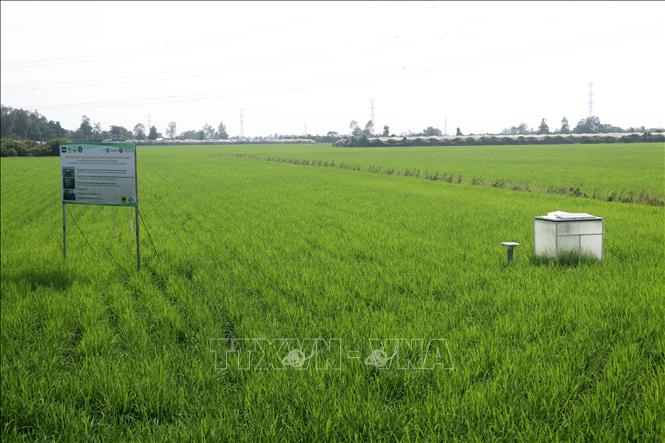
This places demands on the export supply chain, especially for Vietnamese agricultural products, to set emission reduction targets for the entire chain. According to experts, in addition to the potential for developing carbon credits, sustainable packaging is considered one of the "green passports" that contribute to increasing the value of Vietnamese exports.
Experts say that post-harvest losses of fruits and vegetables in developing countries are 30-44%. The main reason is that rudimentary packaging and transportation methods reduce the value chain of the product, while the general trend is towards environmentally friendly packaging that meets ESG (environmental, social, governance) standards.
Typically, some countries like Japan have set a target of reducing plastic waste by 50% by 2030, increasing the recycling rate from 34% to 70%. Currently, this country is also banning difficult-to-recycle plastic packaging: PVC, colored PET bottles, labels on PET bottles, etc. Meanwhile, China has proposed developing a policy on EPR (Extended Producer Responsibility), promoting plastic recycling, starting with PET plastic, requiring packaging to have traceability information printed on it.
In Vietnam, the current state of fruit export packaging has the advantage of diverse basic materials meeting standards, implemented traceability mechanisms, and improved printing and design capabilities. However, the industry still faces challenges such as low sustainability, continued reliance on virgin plastics, cartons that do not meet high recycling standards, a lack of proactive preservation technology resulting in high post-harvest spoilage rates (15-30%), and a lack of smart packaging that does not integrate sensors for real-time quality monitoring.
Given the above situation, Mr. Nguyen Ngoc Minh Thy, Vice President of the Vietnam Packaging Association (VINPAS) and General Director of Liksin Packaging Printing Corporation, believes that Vietnam can apply packaging technology and the cold chain with a range of smart, biodegradable packaging products, or optimally designed carton boxes for cold storage using sustainable, recycled, and single-material sources. In particular, digitized and traceable packaging will increase trust, transparency in the supply chain, reduce risks, and meet the control requirements of demanding markets.
“The value chain practices, from packaging standardization at the farm to the packing facility, and the application of packaging technology and the cold chain, not only improve sustainable packaging but also enhance the image of Vietnamese goods in both domestic and export markets. VINPAS is currently developing several packaging standards, continuously updating them to reflect changes and regulations in international markets,” Mr. Thy further shared.
From a professional perspective, Peter Johnson, an international expert on the tropical fruit value chain at GQSP Vietnam (Global Quality and Standards Program in Vietnam), pointed out that the importance of carton durability lies in protecting fruit during long-distance transportation, ensuring product appearance and export quality, and supporting stacking in cold storage and containers. Therefore, optimal carton design will help minimize product loss, reduce transportation costs, and improve the overall sustainability of the supply chain.
To enable Vietnam's tropical fruit industry to expand its exports into modern retail, Peter Johnson emphasized the need to start addressing core packaging issues. Businesses should view packaging as an investment, not necessarily an expense.
Sharing the same view, Ms. Nguyen Mai Minh Thu, Director of Mai Thu Packaging Company, believes that each industry, such as fruits, vegetables, meat, and seafood, requires different packaging, so packaging must be standardized according to the industry. At the same time, packaging standardization also contributes to reducing costs, damage, and increasing value for the industry.
Furthermore, in the context of globalization and increasingly deep international economic integration, Vietnam is actively fulfilling its commitments to trade cooperation, opening up many new opportunities for industries; among them, the printing and packaging industry is an indispensable link in the production and consumption supply chain, not only contributing to enhancing the competitiveness of Vietnamese goods but also promoting sustainable development.
The printing and packaging industry also plays a crucial role in supporting Vietnam's manufacturing sectors. Therefore, as global supply chains develop, innovation and sustainability are no longer just trends, but essential directions for long-term growth. According to a report by Vietnam Report Joint Stock Company, the green consumption trend has prompted many F&B, retail, and e-commerce businesses to set goals for reducing single-use plastics, replacing them with paper packaging, single-component films, or bioplastics.
In the long term, the green consumer trend helps pioneering businesses build a competitive advantage and strengthen their position in international markets that prioritize sustainability. As domestic consumption and export markets recover, the synergy between domestic and international demand will become the driving force for Vietnam's packaging industry to maintain stable growth in the coming years.
Furthermore, the booming e-commerce sector, especially cross-border trade, has increased the demand for carton boxes designed for multimodal transport, leading to the Vietnamese paper packaging market directly benefiting from this surge. This is also one of the sectors driving the Vietnamese paper packaging market to reach US$2.6 billion (in 2024) and is projected to reach US$4.14 billion (in 2029).
Source: https://baotintuc.vn/kinh-te/ho-chieu-xanh-gia-tang-gia-tri-hang-viet-xuat-khau-20251217113859532.htm
![[Image] Leaked images ahead of the 2025 Community Action Awards gala.](/_next/image?url=https%3A%2F%2Fvphoto.vietnam.vn%2Fthumb%2F1200x675%2Fvietnam%2Fresource%2FIMAGE%2F2025%2F12%2F16%2F1765882828720_ndo_br_thiet-ke-chua-co-ten-45-png.webp&w=3840&q=75)


![[Live] 2025 Community Action Awards Gala](/_next/image?url=https%3A%2F%2Fvphoto.vietnam.vn%2Fthumb%2F1200x675%2Fvietnam%2Fresource%2FIMAGE%2F2025%2F12%2F16%2F1765899631650_ndo_tr_z7334013144784-9f9fe10a6d63584c85aff40f2957c250-jpg.webp&w=3840&q=75)
![[Photo] Prime Minister Pham Minh Chinh receives the Governor of Tochigi Province (Japan)](/_next/image?url=https%3A%2F%2Fvphoto.vietnam.vn%2Fthumb%2F1200x675%2Fvietnam%2Fresource%2FIMAGE%2F2025%2F12%2F16%2F1765892133176_dsc-8082-6425-jpg.webp&w=3840&q=75)
![[Photo] Prime Minister Pham Minh Chinh receives Lao Minister of Education and Sports Thongsalith Mangnormek](/_next/image?url=https%3A%2F%2Fvphoto.vietnam.vn%2Fthumb%2F1200x675%2Fvietnam%2Fresource%2FIMAGE%2F2025%2F12%2F16%2F1765876834721_dsc-7519-jpg.webp&w=3840&q=75)






































































Comment (0)