

Vietnamese footwear businesses are entering a mandatory transformation phase as the European Union (EU) implements a roadmap for the adoption of the Digital Product Passport (DPP) from 2025.
Under these new "rules of the game," each pair of shoes not only needs to meet requirements in terms of design and price, but also must provide complete digital data on its origin, emissions, and product lifecycle. Digitalization is therefore no longer an option, but a ticket for Vietnamese goods to continue their presence in the EU market.
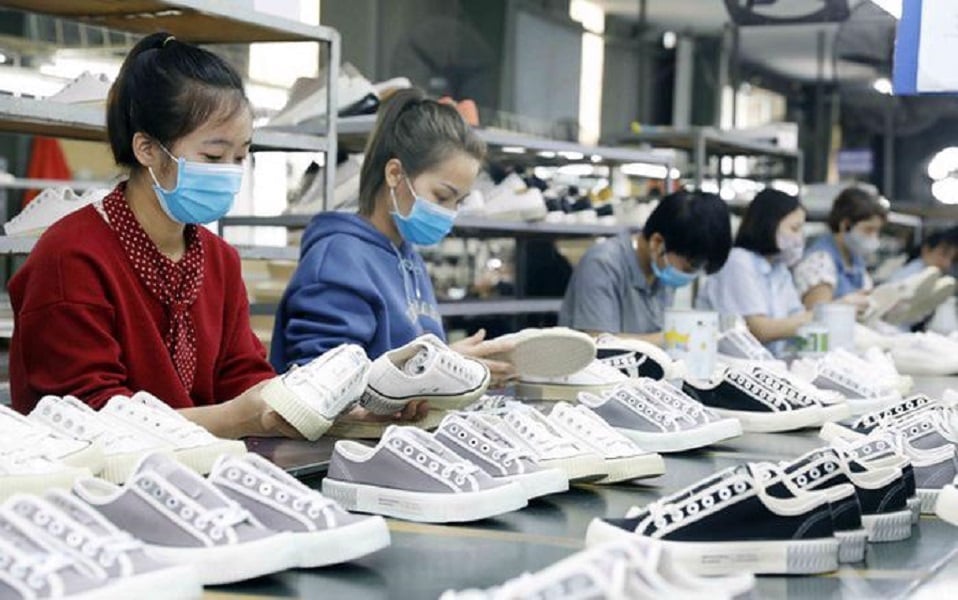
Exports from the footwear industry continue to recover and grow. Photo: Vu Khue.
According to the Eco-Design for Sustainable Products Regulation (ESPR No. 2024/1781), issued by the EU at the end of 2024, textiles and footwear are among the first priority sectors to adopt the DPP, with a roadmap starting in 2025-2026. This regulation requires each product circulating in the EU market to have a “digital identifier,” usually represented by a QR code or RFID chip, allowing regulatory authorities, distributors, and consumers to access the product's standardized data set.
For footwear, the DPP must clearly show the origin of materials, the percentage of recycled materials, the types of chemicals used in the tanning and finishing processes, energy consumption at the factory, the carbon footprint throughout the entire lifecycle, as well as instructions for repair, recycling, and disposal when the product reaches the end of its lifespan. In other words, each pair of shoes must "speak" with data, and that data must be verifiable.
This change creates significant pressure on exporting countries, including Vietnam, which currently ranks second in the world for footwear exports. The EU is one of the key markets, accounting for a high proportion of the industry's total export value. When the DPP (Demand-Free Partnership) becomes a mandatory requirement, failure to comply means the risk of being excluded from the supply chain, regardless of how competitive the product is or how large the production capacity is.
Against this backdrop, Vietnam's leather and footwear industry's growth targets are accompanied by unprecedented pressure for transformation. Ms. Phan Thi Thanh Xuan, Vice President and General Secretary of the Vietnam Leather, Footwear and Handbag Association (LEFASO), stated that the industry aims for an export turnover increase of approximately 10% compared to 2024, potentially reaching US$27-29 billion.

Ms. Phan Thi Thanh Xuan, Vice President and General Secretary of the Vietnam Leather, Footwear and Handbag Association. Photo: Thanh Tuan.
According to Ms. Xuan, to maintain their position in the global supply chain, businesses cannot continue to approach things with the old mindset, focusing only on processing capabilities. "Greening" and "digitalization" have become mandatory conditions. The EU is not just buying products, but also the production process behind those products. If businesses lack data, or if their data is substandard, orders will shift to countries that provide better solutions.
In fact, the requirements of the DPP are not separate but closely linked to other EU environmental and climate policies. Information on carbon footprint, energy consumption, and hazardous chemicals forms the basis for the EU to assess the sustainability of products and prepare for more sophisticated regulatory tools in the future. The DPP is therefore considered the data "backbone," connecting policies on circular economy , emission reduction, and supply chain transparency.
Faced with this pressure, many Vietnamese footwear businesses have begun to accelerate their digitalization. Large corporations and enterprises are proactively investing in traceability systems, production data management, and greenhouse gas inventory. Recording electricity consumption at each stage, tracking raw material inputs, and calculating the percentage of recycled leather are no longer done manually but are integrated into production and supply chain management software.
Adopting international environmental and social standards is becoming the foundation for businesses to move towards Digital Product Planning (DPP). Environmental management systems such as ISO 14001, chemical and textile safety certifications like OEKO-TEX, and social responsibility requirements are considered crucial "inputs" for a digital product passport. Once data is standardized according to these standards, integration into a DPP becomes more feasible.
According to LEFASO, in the last months of 2025, Vietnam's footwear exports to the EU recorded a clear recovery, with double-digit growth in some markets and segments under the EVFTA. This result is linked to many businesses better meeting requirements on traceability, environmental protection, and supply chain transparency, thereby demonstrating the advantage of those who are ahead in green transformation and digitalization.
However, the biggest challenge remains for small and medium-sized enterprises (SMEs), which account for a significant proportion of the industry. For these businesses, the cost of investing in digital systems, hiring experts to conduct emissions inventories, or building databases according to EU standards is a considerable burden. Without technical and policy support, the risk of being marginalized from the supply chain is real.
Experts believe that, in the initial stages, Digital Productivity Planning (DPP) is not just a technical requirement, but a test of a company's management capabilities. Companies that control production data and understand their material and energy flows will adapt more easily. Conversely, fragmented production models, heavily reliant on small, independent suppliers, and lacking transparency will struggle when it comes to "digitizing the entire product lifecycle."
In the long term, DPP could transform the structure of the footwear industry. Instead of competing primarily on labor costs, the advantage will shift to data management capabilities, compliance with environmental standards, and technology integration. Businesses that invest early may not only retain orders but also become more deeply involved in the design and development of sustainable products for European brands.
Source: https://nongnghiepmoitruong.vn/moi-doi-giay-gan-ma-qr-ve-thong-hanh-xanh-vao-thi-truong-eu-d789797.html

![[Live] 2025 Community Action Awards Gala](/_next/image?url=https%3A%2F%2Fvphoto.vietnam.vn%2Fthumb%2F1200x675%2Fvietnam%2Fresource%2FIMAGE%2F2025%2F12%2F16%2F1765899631650_ndo_tr_z7334013144784-9f9fe10a6d63584c85aff40f2957c250-jpg.webp&w=3840&q=75)
![[Image] Leaked images ahead of the 2025 Community Action Awards gala.](/_next/image?url=https%3A%2F%2Fvphoto.vietnam.vn%2Fthumb%2F1200x675%2Fvietnam%2Fresource%2FIMAGE%2F2025%2F12%2F16%2F1765882828720_ndo_br_thiet-ke-chua-co-ten-45-png.webp&w=3840&q=75)
![[Photo] Prime Minister Pham Minh Chinh receives Lao Minister of Education and Sports Thongsalith Mangnormek](/_next/image?url=https%3A%2F%2Fvphoto.vietnam.vn%2Fthumb%2F1200x675%2Fvietnam%2Fresource%2FIMAGE%2F2025%2F12%2F16%2F1765876834721_dsc-7519-jpg.webp&w=3840&q=75)

![[Photo] Prime Minister Pham Minh Chinh receives the Governor of Tochigi Province (Japan)](/_next/image?url=https%3A%2F%2Fvphoto.vietnam.vn%2Fthumb%2F1200x675%2Fvietnam%2Fresource%2FIMAGE%2F2025%2F12%2F16%2F1765892133176_dsc-8082-6425-jpg.webp&w=3840&q=75)

























































































Comment (0)