

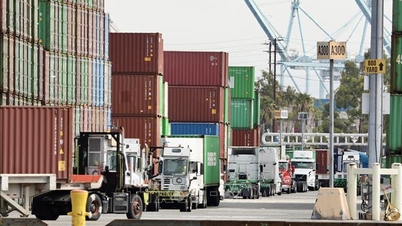
Value-added tax (VAT) applies to most import and export activities. This broad scope means that risks such as incorrect declaration of product codes, improper application of preferential treatment, and even exploitation of policies to legitimize documentation are always present. In the context of rapidly increasing import and export turnover, the need for stricter VAT management is more urgent than ever.
Since the beginning of the year, the number of customs declarations has increased significantly, leading to a corresponding increase in value-added tax revenue. Along with the pressure of processing documents, controlling risk indicators such as incorrect declaration codes and improper application of tax reductions is crucial. However, this has had a positive impact on the procedural process for businesses.
Mr. Nguyen Bang Thien from Nippon Express's Bac Ninh branch said: "In my opinion, tightening value-added tax regulations is very necessary because when the documentation is clear, customs clearance procedures are faster. This is convenient for both businesses and authorities."
However, from an implementation perspective, value-added tax is closely tied to the documentation system and specialized regulations, a factor that requires businesses to constantly update their knowledge to avoid errors.
Ms. Nguyen Thi Minh, Finance Director of K-FLEX Vietnam Company, said: "Value-added tax is heavily related to documentation and regulations, and these regulations often change. Failure to update them can lead to unnecessary errors."
To ensure effective control, risk management is implemented at customs branches right from the declaration stage. In high-risk cases, inspections are carried out at a more detailed level.
"Value-added tax (VAT) is considered a tax that businesses can easily exploit in their declarations. To control VAT, the Customs agency is strengthening risk control, standardizing data, and coordinating with inter-agency bodies to monitor businesses without affecting their import and export activities," said Mr. Luong Xuan Truong, an officer of the Tien Son Customs Team, Customs Sub-department Area V.
According to Mr. Pham Van Tho, Deputy Head of the Operations Department of the Customs Sub-Department Region V: "If necessary, a request for inspection can be made to determine the status of exported or imported goods. If, at the time of customs clearance, the risk issue is still unclear, the customs dossier will be transferred to the post-clearance department for processing according to regulations."
Tightening value-added tax management aims not only to combat budget revenue losses but also to create a transparent and fair foundation for import and export activities – where compliance is facilitated, and risks are identified and addressed early.
Source: https://vtv.vn/quan-ly-vat-buoc-then-chot-chong-that-thu-thue-100251217155900496.htm
![[Image] Leaked images ahead of the 2025 Community Action Awards gala.](/_next/image?url=https%3A%2F%2Fvphoto.vietnam.vn%2Fthumb%2F1200x675%2Fvietnam%2Fresource%2FIMAGE%2F2025%2F12%2F16%2F1765882828720_ndo_br_thiet-ke-chua-co-ten-45-png.webp&w=3840&q=75)
![[Photo] Prime Minister Pham Minh Chinh receives Lao Minister of Education and Sports Thongsalith Mangnormek](/_next/image?url=https%3A%2F%2Fvphoto.vietnam.vn%2Fthumb%2F1200x675%2Fvietnam%2Fresource%2FIMAGE%2F2025%2F12%2F16%2F1765876834721_dsc-7519-jpg.webp&w=3840&q=75)

![[Photo] Prime Minister Pham Minh Chinh receives the Governor of Tochigi Province (Japan)](/_next/image?url=https%3A%2F%2Fvphoto.vietnam.vn%2Fthumb%2F1200x675%2Fvietnam%2Fresource%2FIMAGE%2F2025%2F12%2F16%2F1765892133176_dsc-8082-6425-jpg.webp&w=3840&q=75)

![[Live] 2025 Community Action Awards Gala](/_next/image?url=https%3A%2F%2Fvphoto.vietnam.vn%2Fthumb%2F1200x675%2Fvietnam%2Fresource%2FIMAGE%2F2025%2F12%2F16%2F1765899631650_ndo_tr_z7334013144784-9f9fe10a6d63584c85aff40f2957c250-jpg.webp&w=3840&q=75)





















































![[Live] Closing Ceremony and Award Presentation for the "Impressive Vietnam Tourism" Video/Clip Creation Contest 2025](https://vphoto.vietnam.vn/thumb/402x226/vietnam/resource/IMAGE/2025/12/17/1765974650260_z7273498850699-00d2fd6b0972cb39494cfa2559bf85ac-1765959338756946072104-627-0-1338-1138-crop-1765959347256801551121.jpeg)


























Comment (0)