

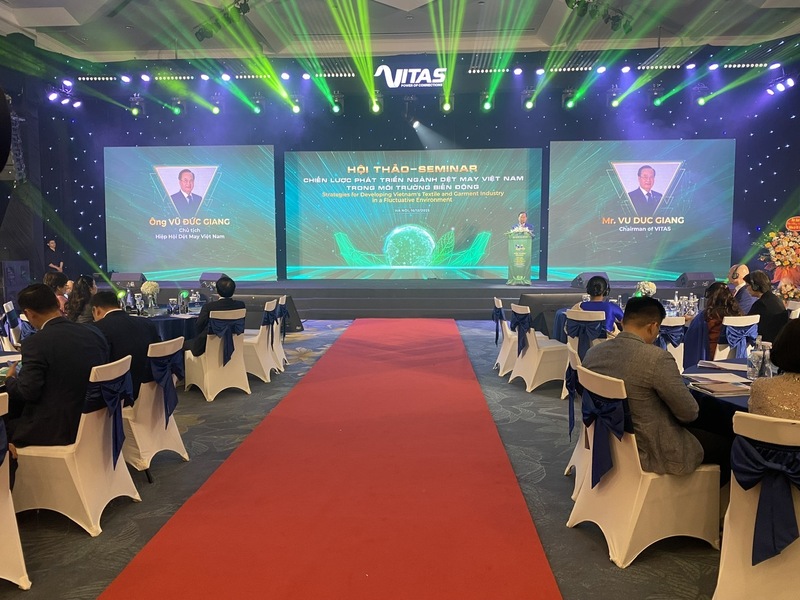
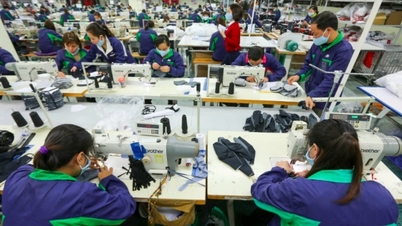
In his opening remarks at the seminar "Development Strategy for Vietnam's Textile and Garment Industry in a Volatile Environment," Chairman of the Vietnam Textile and Garment Association Vu Duc Giang emphasized that 2025 marks a crucial turning point for Vietnam's textile and garment industry in the process of global economic integration, as the industry's position and stature become increasingly clearer.
Furthermore, Mr. Vu Duc Giang frankly acknowledged that 2025 will be one of the most challenging years for Vietnam's textile and garment industry in decades. Global supply chains are disrupted; logistics costs are increasing; requirements from international brands are becoming more stringent; and purchasing policies in many major markets are changing rapidly, forcing businesses to constantly adapt.
Faced with these challenges, the Vietnamese textile and garment industry has successfully established and implemented three fundamental strategic pillars. Businesses have diversified their export markets. From being heavily dependent on a few traditional markets, Vietnamese textile and garment products are now present in 138 markets worldwide, thereby minimizing risks and increasing resilience to external shocks.
In addition, businesses have diversified their partners and customers. This strategy helps textile and garment businesses be more proactive in negotiations, adapt to changes in purchasing methods, and reduce dependence on a few large brands.
The industry has also diversified its product range, gradually shifting from simple processed products to those that better meet the increasingly diversified needs of the market and align with new consumer trends.
To realize the three strategic pillars mentioned above, the Vietnamese textile and garment industry has been implementing five key solution groups. Of particular note is the greening program for the textile and garment industry, which considers sustainable development not just a compliance requirement but a vital condition for deeper participation in the global value chain.
The textile and garment industry is also promoting the application of science and technology , automation, robotics, and gradually integrating artificial intelligence into the production and supply chains. This is considered key to improving productivity, quality, and competitiveness in the long term.
Mr. Vu Duc Giang also particularly emphasized the role of human resource development, from technical workers and management staff to design teams, in order to meet the new requirements of production methods and standards from international brands.
Another important highlight is the vision for developing Vietnam's textile and garment industry towards a multinational direction, with several companies in the industry having already invested and expanded their operations in multiple countries over the past two decades.
Furthermore, strengthening supply chain linkages is considered a key pillar, focusing on developing domestic supply sources, improving management capacity, and promoting experience sharing through specialized workshops with the participation of international organizations. It is projected that by 2025, Vietnam's textile and garment trade surplus will exceed US$20 billion, further affirming its role as a key export sector of the economy.
Speaking at the conference, Mr. Tran Thanh Hai, Deputy Director of the Import-Export Department ( Ministry of Industry and Trade ), stated that 2025 concludes with the global economy continuing to face numerous difficulties, uncertainties, and unpredictable factors. Global growth is recovering slowly; inflation, although showing a downward trend, remains high in many major economies; prolonged geopolitical conflicts are disrupting supply chains; logistics costs are increasing; and protectionist trade trends are on the rise in various forms.
In this context, the Vietnamese textile and garment business community has clearly demonstrated its resilience, proactive spirit, and flexible adaptability. Notably, according to Mr. Tran Thanh Hai, the US's application of reciprocal tariffs did not deter the Vietnamese textile and garment industry; on the contrary, it became a driving force for restructuring and value enhancement. Many businesses quickly shifted towards high value-added, technically complex products, while simultaneously promoting market diversification, thereby transforming challenges into opportunities for innovation.
However, the Deputy Director of the Import-Export Department also pointed out a series of major challenges that the Vietnamese textile and garment industry is currently facing and will continue to face. These include an increasingly complex and unpredictable international trade environment, with the rise of trade protection measures, technical barriers, green barriers, and labor barriers. Major markets not only demand price and quality but also set strict criteria regarding traceability, carbon emissions, circular economy, and social responsibility.
Notably, regional and global competitive pressure is intensifying. Many countries maintain a cost advantage in labor, while major competitors continue to recover and upgrade their technology. Without strong innovation, the Vietnamese textile and garment industry faces the risk of declining competitiveness.
In particular, the bottleneck in the localization of raw materials and components remains a persistent challenge, especially in the weaving, dyeing, and finishing stages, limiting domestic added value and making businesses vulnerable to external fluctuations.
Based on that experience, Mr. Tran Thanh Hai suggested that the Vietnamese textile and garment industry needs to focus on several major directions: restructuring towards increasing added value; developing domestic supply chains; effectively utilizing free trade agreements; considering green transformation as a core competitive advantage; and simultaneously promoting human resource development and digital transformation.
Representatives from the Import-Export Department also emphasized that the Ministry of Industry and Trade will continue to support and create favorable conditions for Vietnam's textile and garment industry to maintain its role as a key export sector of the country.
Source: https://baotintuc.vn/kinh-te/nganh-det-may-viet-nam-tim-huong-di-chien-luoc-trong-boi-canh-kinh-te-toan-cau-bien-dong-20251216175817929.htm
![[Image] Leaked images ahead of the 2025 Community Action Awards gala.](/_next/image?url=https%3A%2F%2Fvphoto.vietnam.vn%2Fthumb%2F1200x675%2Fvietnam%2Fresource%2FIMAGE%2F2025%2F12%2F16%2F1765882828720_ndo_br_thiet-ke-chua-co-ten-45-png.webp&w=3840&q=75)
![[Photo] Prime Minister Pham Minh Chinh receives the Governor of Tochigi Province (Japan)](/_next/image?url=https%3A%2F%2Fvphoto.vietnam.vn%2Fthumb%2F1200x675%2Fvietnam%2Fresource%2FIMAGE%2F2025%2F12%2F16%2F1765892133176_dsc-8082-6425-jpg.webp&w=3840&q=75)

![[Photo] Prime Minister Pham Minh Chinh receives Lao Minister of Education and Sports Thongsalith Mangnormek](/_next/image?url=https%3A%2F%2Fvphoto.vietnam.vn%2Fthumb%2F1200x675%2Fvietnam%2Fresource%2FIMAGE%2F2025%2F12%2F16%2F1765876834721_dsc-7519-jpg.webp&w=3840&q=75)

![[Live] 2025 Community Action Awards Gala](/_next/image?url=https%3A%2F%2Fvphoto.vietnam.vn%2Fthumb%2F1200x675%2Fvietnam%2Fresource%2FIMAGE%2F2025%2F12%2F16%2F1765899631650_ndo_tr_z7334013144784-9f9fe10a6d63584c85aff40f2957c250-jpg.webp&w=3840&q=75)






































![[Photo] Prime Minister Pham Minh Chinh attends the Vietnam Economic Forum 2025](https://vphoto.vietnam.vn/thumb/402x226/vietnam/resource/IMAGE/2025/12/16/1765893035503_ndo_br_dsc-8043-jpg.webp)

















Comment (0)