

According to the Customs Department, in implementing Decision No. 2521/QD-BTC dated October 24, 2024, of the Ministry of Finance on the issuance of the Plan for implementing tasks in Decision No. 865/QD-TTg on the pilot project for building smart border gates, on July 31, 2025, Vietnam Customs sent a letter to the General Administration of Customs of China regarding the submission of a draft Cooperation Agreement and proposing a time for the two sides to conduct negotiations on the “Cooperation Agreement between the Ministry of Finance of the Socialist Republic of Vietnam and the General Administration of Customs of China on sharing import and export goods data information for the pilot implementation of smart border gates”.
The General Administration of Customs of China assigned Nanning Customs to lead the exchange and negotiation with Vietnam Customs. Accordingly, in response to the letter from Vietnam Customs, Nanning Customs acknowledged that enhancing the "soft connectivity" of the Vietnam-China Smart Border Gate is one of the important tasks in promoting the construction of the Smart Border Gate, which includes sharing information and goods monitoring procedures.
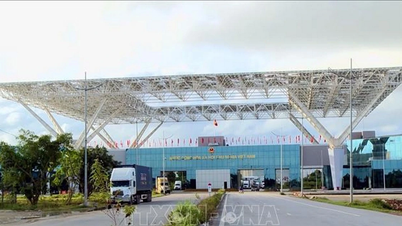
To facilitate the operation of the Smart Border Gate and improve customs clearance efficiency, Nanning Customs believes that the key task in building the Smart Border Gate is to complete the infrastructure (hard connection). At the dedicated cargo transport routes of Huu Nghi - Huu Nghi Quan and Tan Thanh - Po Chai, the Chinese side has basically completed the infrastructure.
The Chinese side requested that Vietnam quickly identify the entity responsible for building the smart border gate and expedite the completion of related tasks such as infrastructure construction, information sharing and connectivity, and monitoring procedures, in order to soon begin pilot operation of the smart border gate.
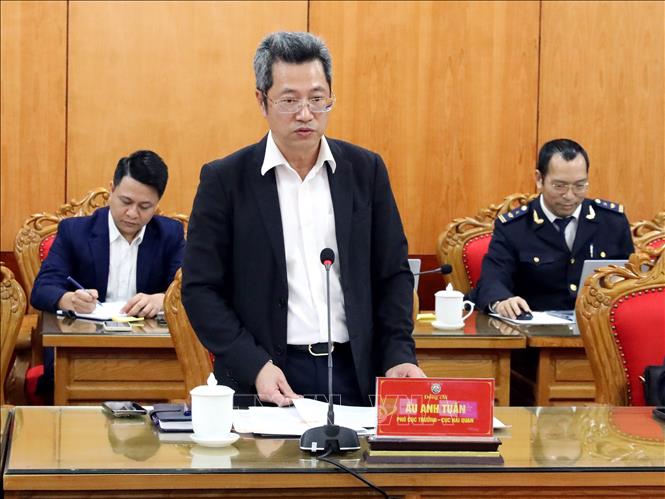
According to Deputy Director of the Customs Department Au Anh Tuan, to operate a smart border gate model, where automated guided vehicles (IGVs) and automated cranes replace human labor, absolute synergy between physical infrastructure and digital processes is necessary. Therefore, the immediate priority is to address the issue of functional zoning planning.
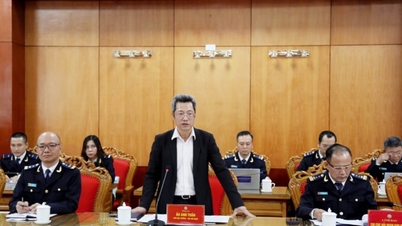
During a recent meeting with the leaders of Lang Son province, Deputy Director Au Anh Tuan requested that Lang Son province promptly determine the route for dedicated IGV vehicles, the area for installing monitoring equipment and electronic barriers, and designate a company to invest in warehouses to ensure timely infrastructure connection with the neighboring country.
Furthermore, to ensure the process is built to closely reflect the reality of the Smart Border Gate area, the Customs Department needs close coordination with the People's Committee of Lang Son province in planning the Smart Border Gate area and agreeing on management methods. "Lang Son province needs to develop a plan for purchasing specialized equipment necessary for state customs inspection, supervision, and control to implement the pilot project for building a Smart Border Gate," a representative from the Customs Department stated.
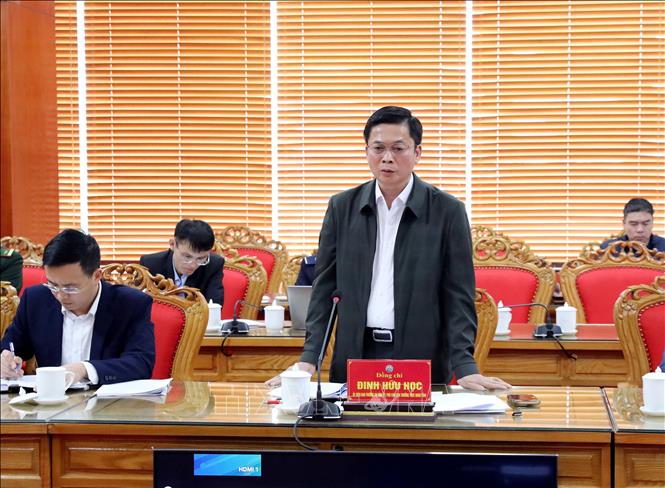
Investing in specialized equipment for state inspection, supervision, and control of customs is necessary for the pilot implementation of the Smart Border Gate project. The Customs Department also noted that the level of investment should be determined during discussions and collaborations between the Customs agency and the People's Committee of Lang Son province regarding the current infrastructure progress at the Smart Border Gate.
Specifically, in the planning of functional zones within the Smart Border Gate area, the planning diagram of the Lang Son Provincial People's Committee must clearly describe and show the locations of IGV vehicle tracks, import goods storage areas, export goods storage areas, container scanning machine installation areas, and the administrative building area for relevant agencies within the Smart Border Gate area.
Furthermore, close coordination is needed to finalize investment items and implement synchronized infrastructure and information database connections with China for the pilot operation of the smart border gate. Specifically, the People's Committee of Lang Son province needs to provide the Customs agency with information on the unit investing in and managing the IGV (Independent Gated Guided Vehicle) and automated crane systems; and the enterprise investing in warehouses and storage facilities for import and export goods in the smart border gate area.
The Customs agency is urgently implementing three key tasks assigned by the Prime Minister and the Ministry of Finance. Accordingly, Customs is accelerating negotiations on an agreement with the General Administration of Customs of China to standardize commodity categories and establish a mechanism for real-time data sharing of customs declarations, creating a foundation for electronic customs clearance.
The Customs agency is actively developing temporary regulations on specific customs procedures and supervision for smart border crossings. This process will transfer all administrative procedures to the National Single Window (NSW) portal, ensuring that goods are processed before vehicles reach the border. The Customs agency is also working to finalize investment plans and procure modern specialized equipment (container scanners, AI camera systems, vehicle tracking systems, etc.) to meet the requirements for managing unmanned transport vehicles.
The project will be implemented from Q3 2024 to Q3 2029; in which, Phase 1 (infrastructure construction) will be implemented from Q3 2024 to Q2 2026; and Phase 2 (pilot implementation) will be from Q3 2026 to Q3 2029.
The goal is to increase the customs clearance capacity at the dedicated cargo transport routes in the area of border markers 1119-1120 and 1088/2-1089 by 4-5 times compared to the current level by 2030. Specifically, the dedicated cargo transport route in the area of border markers 1119-1120 will increase from 800 vehicles/day to 3,000-3,500 vehicles/day; and the dedicated cargo transport route in the area of border markers 1088/2-1089 will increase from 400 vehicles/day to 2,000-2,500 vehicles/day.
The total import and export turnover of all types via the dedicated freight transport route in the area between border markers 1119 and 1120 reached approximately 85 billion USD, while the turnover via the dedicated freight transport route in the area between border markers 1088/2 and 1089 reached approximately 25 billion USD...
Source: https://baotintuc.vn/kinh-te/som-van-hanh-thi-diem-cua-khau-thong-minh-20251217112928796.htm
![[Photo] Prime Minister Pham Minh Chinh receives the Governor of Tochigi Province (Japan)](/_next/image?url=https%3A%2F%2Fvphoto.vietnam.vn%2Fthumb%2F1200x675%2Fvietnam%2Fresource%2FIMAGE%2F2025%2F12%2F16%2F1765892133176_dsc-8082-6425-jpg.webp&w=3840&q=75)
![[Photo] Prime Minister Pham Minh Chinh receives Lao Minister of Education and Sports Thongsalith Mangnormek](/_next/image?url=https%3A%2F%2Fvphoto.vietnam.vn%2Fthumb%2F1200x675%2Fvietnam%2Fresource%2FIMAGE%2F2025%2F12%2F16%2F1765876834721_dsc-7519-jpg.webp&w=3840&q=75)

![[Image] Leaked images ahead of the 2025 Community Action Awards gala.](/_next/image?url=https%3A%2F%2Fvphoto.vietnam.vn%2Fthumb%2F1200x675%2Fvietnam%2Fresource%2FIMAGE%2F2025%2F12%2F16%2F1765882828720_ndo_br_thiet-ke-chua-co-ten-45-png.webp&w=3840&q=75)
![[Live] 2025 Community Action Awards Gala](/_next/image?url=https%3A%2F%2Fvphoto.vietnam.vn%2Fthumb%2F1200x675%2Fvietnam%2Fresource%2FIMAGE%2F2025%2F12%2F16%2F1765899631650_ndo_tr_z7334013144784-9f9fe10a6d63584c85aff40f2957c250-jpg.webp&w=3840&q=75)











































![[Live] Closing Ceremony and Award Presentation for the "Impressive Vietnam Tourism" Video/Clip Creation Contest 2025](https://vphoto.vietnam.vn/thumb/402x226/vietnam/resource/IMAGE/2025/12/17/1765974650260_z7273498850699-00d2fd6b0972cb39494cfa2559bf85ac-1765959338756946072104-627-0-1338-1138-crop-1765959347256801551121.jpeg)






















Comment (0)