

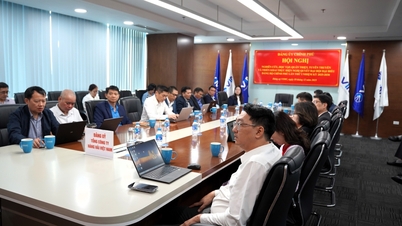
On the afternoon of December 10th, in Lang Son , the Customs Department conducted a field survey and held a meeting with the leaders of Lang Son province regarding the coordination and implementation of the pilot project to build smart border gates in the area.
The Customs Department stated that it has been assigned three tasks: Firstly, to develop an agreement between the Vietnamese Ministry of Finance and the General Administration of Customs of China on the standardization of export and import goods categories; the content, methods, and frequency of receiving and processing customs declaration data for import and export goods and means of transport crossing between the two sides, in order to pilot the smart border gate model between Lang Son province (Vietnam) and Guangxi province (China).
Secondly, establish temporary regulations on customs procedures and customs supervision and control for goods exported and imported through smart border gates.
Thirdly, a plan is being developed to procure specialized equipment necessary for state inspection, supervision, and control of customs, in order to pilot the construction of smart border gates. Currently, the Customs Department is carrying out these tasks according to plan.
During the implementation of assigned tasks, the Customs Department encountered several difficulties due to the lack of an agreement on information sharing with the Chinese side; and the absence of businesses investing in smart border gates/businesses managing and operating IGV vehicles and automated container handling cranes.
Currently, there is no planning defining functional zoning; there are no regulations on digital transformation, bringing all administrative procedures at border gates to a unified management method on the National Single Window Portal to ensure that organizations and individuals only need to declare and submit documents once and receive results online...
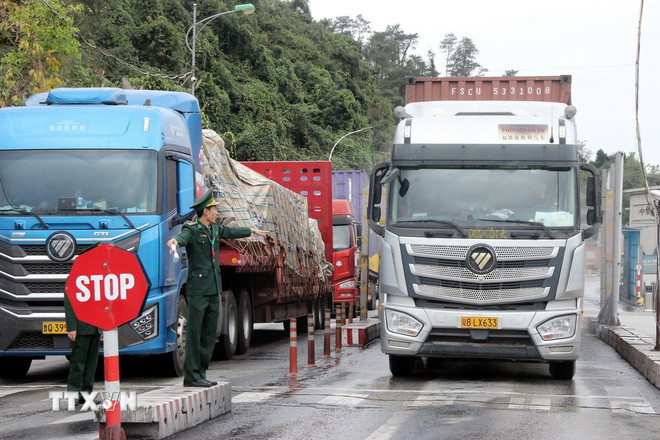
Based on this reality, central and local ministries and agencies need to research and propose solutions regarding institutional frameworks, information technology applications; solutions for border gate infrastructure, and the development of comprehensive border gate area planning, which should clearly define functional zones and traffic flow. Specialized equipment must be synchronized, modern, and meet operational requirements.
During the meeting, Mr. Au Anh Tuan, Deputy Director of the Customs Department, affirmed that building smart border gates plays an important role in socio-economic development, creating favorable conditions for import and export trade.
To complete the assigned tasks, the Customs Department and Lang Son province must regularly exchange information and coordinate closely with each other to promptly resolve any difficulties and obstacles that arise, and to accelerate the progress of this project.
According to Dinh Huu Hoc, Standing Vice Chairman of the People's Committee of Lang Son province, the province has recently led and directed relevant agencies and units to focus on implementing the components of the pilot project to build smart border gates; the requirement is to accelerate the progress of the project components.
The Standing Vice Chairman of the People's Committee of Lang Son province requested that the Customs Department promptly exchange information with the General Administration of Customs of China to receive a response on the draft Agreement and proceed with negotiations and signing of the Cooperation Agreement on sharing import and export goods data.
In addition, the Customs Department exchanged information and requested the Chinese Customs to share detailed experience on procedures, management, and operation of smart border gate technology solutions, especially autonomous vehicles (driverless container trucks) and operating systems.
The two sides will collaborate on researching and applying digital and automation technologies in the management and operation of cross-border logistics activities; gradually forming a smart, synchronized, and modern logistics management system...
The pilot project for building smart border gates is being implemented on the dedicated goods transport route in the area of border markers 1119-1120 and the dedicated goods transport route in the area of border markers 1088/2-1089, belonging to the Huu Nghi (Vietnam) - Huu Nghi Quan (China) international border gate pair.
The project will be implemented from Q3 2024 to Q3 2029; in which, Phase 1 (infrastructure construction) will be implemented from Q3 2024 to Q2 2026; and Phase 2 (pilot implementation) will be from Q3 2026 to Q3 2029.
The goal is to strive to increase the customs clearance capacity at the dedicated cargo transport routes in the area of border markers 1119-1120 and 1088/2-1089 by 4-5 times compared to the current level by 2030.
The dedicated freight transport route in the area of border markers 1119-1120 increased from 800 vehicles/day to 3,000-3,500 vehicles/day; the dedicated freight transport route in the area of border markers 1088/2-1089 increased from 400 vehicles/day to 2,000-2,500 vehicles/day.
The total import and export turnover of all types via the dedicated freight transport route in the area of border markers 1119-1120 reached approximately 85 billion USD, while the turnover via the dedicated freight transport route in the area of border markers 1088/2-1089 reached approximately 25 billion USD...
In implementing Phase 1 of the Project, the People's Committee of Lang Son province focused on directing the construction of infrastructure including: building inter-agency offices for functional forces at the dedicated goods transport road between border markers 1088/2-1089; expanding the dedicated goods transport road in the area between border markers 1119-1120 and expanding the dedicated goods transport road in the area between border markers 1088/2-1089. These are key infrastructure components, playing a fundamental role in the implementation of the Smart Border Gate Project.
Currently, two-thirds of the projects under the Smart Border Gate Scheme have commenced construction and are being implemented according to plan.
At the end of November 2025, the People's Committee of Lang Son province and the People's Government of Guangxi Zhuang Autonomous Region (China) jointly organized the inauguration and commissioning of a dedicated freight transport road (upgraded from 4 to 6 lanes) at the project to expand the dedicated freight transport road in the area of border markers 1119-1120.
Source: https://www.vietnamplus.vn/lang-son-phoi-hop-day-nhanh-tien-do-xay-dung-cua-khau-thong-minh-post1082269.vnp









![[Video] National Assembly passes the amended Civil Servant Law with 92.39% of delegates voting in favor](https://vphoto.vietnam.vn/thumb/402x226/vietnam/resource/IMAGE/2025/12/10/1765379039932_1-6690-3945-png.webp)

















![[Video] The craft of making Dong Ho folk paintings has been inscribed by UNESCO on the List of Crafts in Need of Urgent Safeguarding.](https://vphoto.vietnam.vn/thumb/402x226/vietnam/resource/IMAGE/2025/12/10/1765350246533_tranh-dong-ho-734-jpg.webp)


















































Comment (0)