

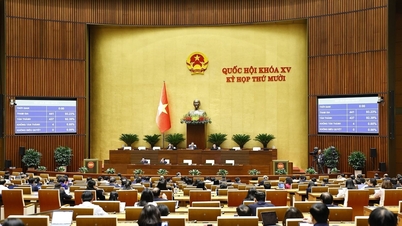
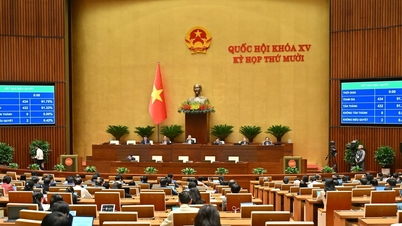
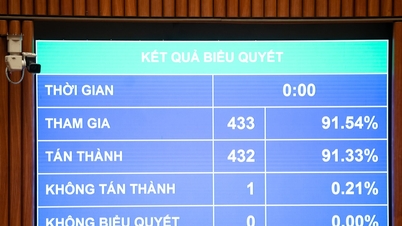
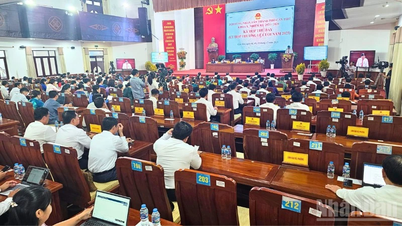
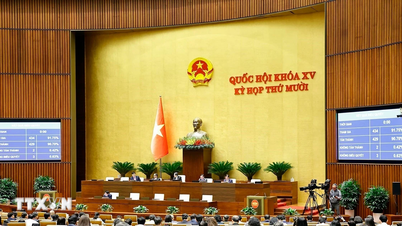
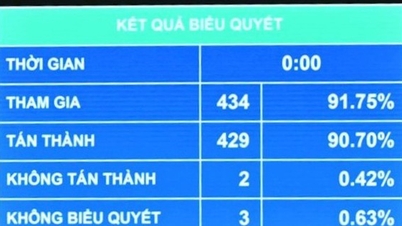
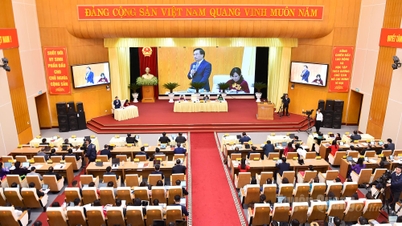
Continuing the Session's agenda, on the afternoon of December 10th, with a majority of participating delegates voting in favor, the National Assembly passed the amended Law on Civil Aviation of Vietnam.
The amended Vietnamese Civil Aviation Law comprises 11 chapters and 107 articles, and will take effect from July 1, 2026.
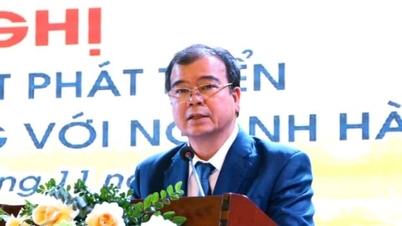
The National Assembly heard Minister of Construction Tran Hong Minh, authorized by the Prime Minister, present the report explaining, receiving feedback, and revising the draft Law on Civil Aviation of Vietnam (amended).
Taking into account the feedback, the Government conducted a review and found that the draft Law was developed in accordance with the Constitution, the Party's guidelines and policies, the State's laws, and international treaties to which Vietnam is a signatory; ensuring sovereignty , unity, and territorial integrity; inheriting and improving current regulations, and selectively incorporating international experience.
Accordingly, the draft Law includes provisions regulating civil aviation activities with specific elements regarding spatial effect and national sovereignty; ensuring consistency and uniformity with laws on the sea and borders.
Regarding low-altitude air transport, incorporating feedback, the draft Law uses the term "low-altitude" to align with the Party's current plans, strategies, and policies; simultaneously, it adds a provision entrusting the Government with the authority to regulate this activity in detail, ensuring it aligns with the current implementation situation and global development trends, as this is an activity that most developed countries are currently in the research and testing phase.
Regarding research, application of science and technology, digital transformation, technology transfer, and aviation industry development, the draft Law includes provisions allowing the application of artificial intelligence in various areas of civil aviation operations to support and enhance service quality and efficiency.
The feedback received will be further studied and incorporated into the process of drafting guiding documents for the Law to ensure feasibility, alignment with aviation development goals, and consistency within the legal system.
Regarding investment in airport construction and airport facilities, the draft Law has finalized regulations allowing competent authorities to decide on investments, permitting investors and enterprises to "invest in new construction, upgrading, expansion, maintenance, and operation of dual-use facilities at airports on national defense and security land without having to transfer land use rights or land use purposes," and added the principle that airport construction investment must ensure synchronous connectivity;
The regulations should be amended to allow for the implementation of investment projects to expand or upgrade airport facilities on land already leased from the state, without requiring approval of the investment policy, thereby simplifying procedures and shortening the process.
Regarding transportation and the carrier's liability for damages, the draft Law has been reviewed to ensure the specificity of specialized aviation law in transportation activities, adhering to the principle of prioritizing the application of international treaties, and eliminating content that overlaps with the Civil Code and the Civil Procedure Code;
The regulations are amended to stipulate that carriers are responsible for the accuracy of the information they publish and notify; and that aviation authorities are responsible for monitoring the fulfillment of carriers' obligations.
Regarding aviation safety and security, the Government is revising the draft Law to clarify the content and subjects required to develop and implement an aviation safety management system; the operating mechanism of the system for collecting, evaluating, and processing aviation safety data, etc.
To prevent and combat corruption, practice thrift, prevent waste, protect state secrets, and comply with the regulations of the International Civil Aviation Organization (ICAO) on aviation supervisors, the draft Law stipulates that the Aviation Authority may coordinate with aviation enterprises to organize training and professional development courses, and accumulate experience for civil servants performing the duties of aviation safety supervisors;
Allowing aviation safety supervisors to receive remuneration and other benefits as agreed upon when participating in training, professional development, and accumulating experience, in order to ensure strict consistency with the provisions of the Law on Cadres and Civil Servants.
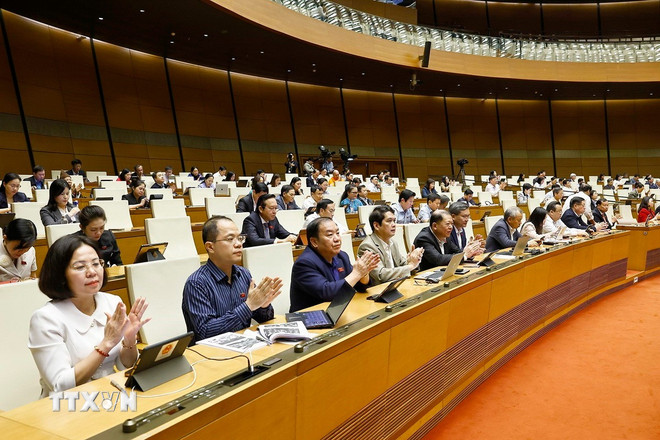
Taking into account feedback, the regulations on the Aviation Security Program were revised to stipulate that the Aviation Security Program is the responsibility of the Ministry of Public Security to develop; it does not include provisions on aviation security programs that are the responsibility of airport operators, aircraft operators, etc., in order to align with the spirit of the new legislation...
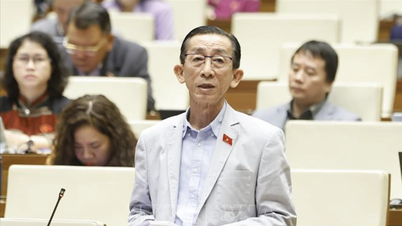
Earlier, during the discussions, delegates highly appreciated the fact that the draft law comprehensively addressed issues ranging from state management to safety, security, and civil liability, while emphasizing that including content on environmental protection and the use of SAF (Sustainable Air Fuel) was necessary and timely.
According to delegate Ta Dinh Thi (Hanoi delegation), the aviation industry is a vital transportation artery, playing a key role in economic growth, connecting global trade and tourism, but it is also one of the most difficult industries to reduce emissions.
Globally, aviation contributes approximately 2–3% of total CO₂ emissions, while in Vietnam, along with rapidly increasing travel demand, greenhouse gas emissions from this sector are also rising significantly – putting pressure on the commitment to net zero emissions by 2050.
Source: https://www.vietnamplus.vn/quy-dinh-moi-ve-hang-khong-dan-dung-se-co-hieu-luc-tu-172026-post1082242.vnp


![[Photo] Explore the US Navy's USS Robert Smalls warship](/_next/image?url=https%3A%2F%2Fvphoto.vietnam.vn%2Fthumb%2F1200x675%2Fvietnam%2Fresource%2FIMAGE%2F2025%2F12%2F10%2F1765341533272_11212121-8303-jpg.webp&w=3840&q=75)

![[Photo] The captivating scenery of the fragrant maple forest in Quang Tri](/_next/image?url=https%3A%2F%2Fvphoto.vietnam.vn%2Fthumb%2F1200x675%2Fvietnam%2Fresource%2FIMAGE%2F2025%2F12%2F10%2F1765353233198_lan09046-jpg.webp&w=3840&q=75)


















![[Video] The craft of making Dong Ho folk paintings has been inscribed by UNESCO on the List of Crafts in Need of Urgent Safeguarding.](https://vphoto.vietnam.vn/thumb/402x226/vietnam/resource/IMAGE/2025/12/10/1765350246533_tranh-dong-ho-734-jpg.webp)
























































Comment (0)