

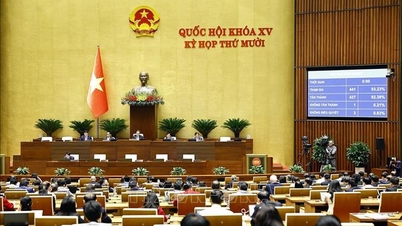
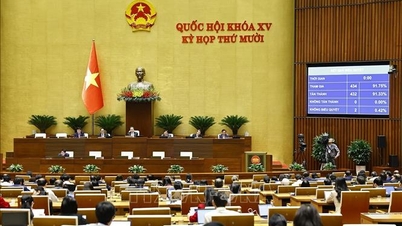
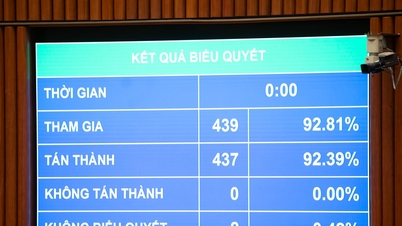
Continuing the Session's agenda, on the afternoon of December 10th, with a majority of participating delegates voting in favor, the National Assembly passed the amended Construction Law with 435 out of 437 participating delegates voting in favor, equivalent to 91.97% of delegates voting in favor.
The amended Construction Law includes many important adjustments aimed at addressing long-standing shortcomings, while simultaneously establishing a more comprehensive, transparent, and effective legal framework for construction investment activities.
One of the major focuses of this revision is ensuring the consistency of the legal system. The law has been implemented based on closely following draft laws currently being submitted to the National Assembly, such as the Land Law, the Bidding Law, the Investment Law, the Public Investment Law, the PPP Law, the Environmental Protection Law, and laws on cultural heritage, thereby eliminating overlapping points and perfecting the scope of the law.
Some important provisions that have been adjusted include regulations on urban-rural planning; construction contracts; appraisal and licensing; insurance regulations; and the process for appraising and approving projects for the preservation, restoration, and rehabilitation of historical relics.
A prominent reform of the law is clearly demonstrated in the principle that "from preparation to commencement, each project only undergoes one administrative procedure." Accordingly, the scope of exemptions from construction permits has been significantly expanded.
Projects with detailed 1/500 scale planning that have been inspected for planning compliance and safety; constructions within projects whose feasibility study reports have been appraised; and certain types of individual houses in rural areas (with clarified criteria for area and scale) are exempt from permits.
Only small-scale projects that do not require assessment need to apply for permits. These regulations are coupled with the requirement to ensure strict management, through the addition of mechanisms for notifying the commencement of construction, requiring information disclosure, installing monitoring equipment at the construction site, and strengthening the role of community oversight.
The rights of investors and residents are also guaranteed as the 2024 Land Law clearly stipulates that constructions not subject to permits will still be considered for the issuance of Certificates of Land Use Rights and Ownership of Assets Attached to Land.
In addition, the licensing procedure has been streamlined to the maximum extent in the guiding decree, including implementing the entire process online, simplifying documents and conditions, increasing the responsibility of the design unit, and minimizing the time for issuing licenses, to a maximum of 7-10 days.
These reforms are expected to reduce the time and costs for citizens and businesses by at least 30%, as required by the government .

Another significant change is the shift of some stages from "pre-approval" to "post-approval" to reduce procedures while still ensuring the quality of construction. The law abolishes the appraisal of detailed designs after the basic design phase, assigning the investor the responsibility of controlling the design after the project is approved.
Post-construction inspections will be more rigorously designed, with specialized construction agencies and the State Inspection Council conducting inspections throughout the construction process and upon completion, instead of only conducting probabilistic inspections as is currently the case.
Detailed regulations regarding the number of inspections, scope, and content of inspections will be reviewed and adjusted in the guidance document to ensure safety while avoiding disruption to construction.
To ensure feasibility during implementation, the Law only provides a framework for the decentralization of tasks, while the specific decentralization to the People's Committees at the commune level will be considered by the People's Committees at the provincial level, based on the resources and management capacity of each locality.
This approach allows for greater flexibility, avoiding placing burdens beyond the capacity of local authorities to implement.
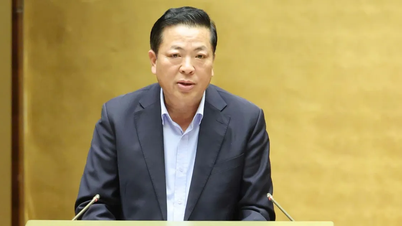
Representative Nguyen Phi Thuong ( Hanoi Delegation) highly appreciated the amended Construction Law for clearly stipulating the cases exempt from construction permits and establishing specific responsibilities of investors for projects falling under this category.
Expanding the scope of those exempt from licensing requirements and shortening the licensing time is in line with the current requirements for administrative procedure reform.
Representative Do Duc Hong Ha (Hanoi Delegation) also argued that promoting the role of the State in post-inspection, that is, checking compliance with planning, technical standards, safety, and environmental regulations through design appraisal or construction permit issuance, is correct. According to him, this is an important step to ensure the quality and safety of construction projects in the context of many pre-inspection procedures being streamlined.
The amended Construction Law demonstrates a strong spirit of innovation: simplifying administrative procedures, reducing legal overlaps, shifting the focus to post-inspection while still ensuring quality control, and maximizing convenience for citizens and businesses in implementing construction projects and works.
The law is expected to contribute to improving the investment environment, enhancing the effectiveness of state management, and ensuring the safety and quality of construction projects nationwide.
Source: https://www.vietnamplus.vn/ky-hop-thu-10-dot-pha-trong-cap-phep-xay-dung-con-tu-7-10-ngay-post1082236.vnp









![[Video] National Assembly passes the amended Civil Servant Law with 92.39% of delegates voting in favor](https://vphoto.vietnam.vn/thumb/402x226/vietnam/resource/IMAGE/2025/12/10/1765379039932_1-6690-3945-png.webp)


















![[Video] The craft of making Dong Ho folk paintings has been inscribed by UNESCO on the List of Crafts in Need of Urgent Safeguarding.](https://vphoto.vietnam.vn/thumb/402x226/vietnam/resource/IMAGE/2025/12/10/1765350246533_tranh-dong-ho-734-jpg.webp)

































































Comment (0)