

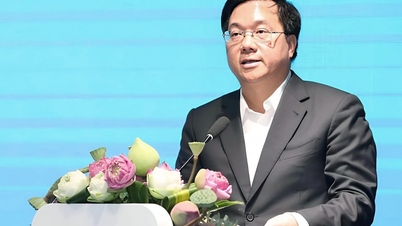
At the second session of the 19th term of the Phu Tho Provincial People's Council on December 10th, Chairman of the Phu Tho Provincial People's Committee Tran Duy Dong emphasized that the arrangement and handling of surplus public assets is a very important task, regularly given attention and direction by the Politburo , the Secretariat, the Government, and the Prime Minister.
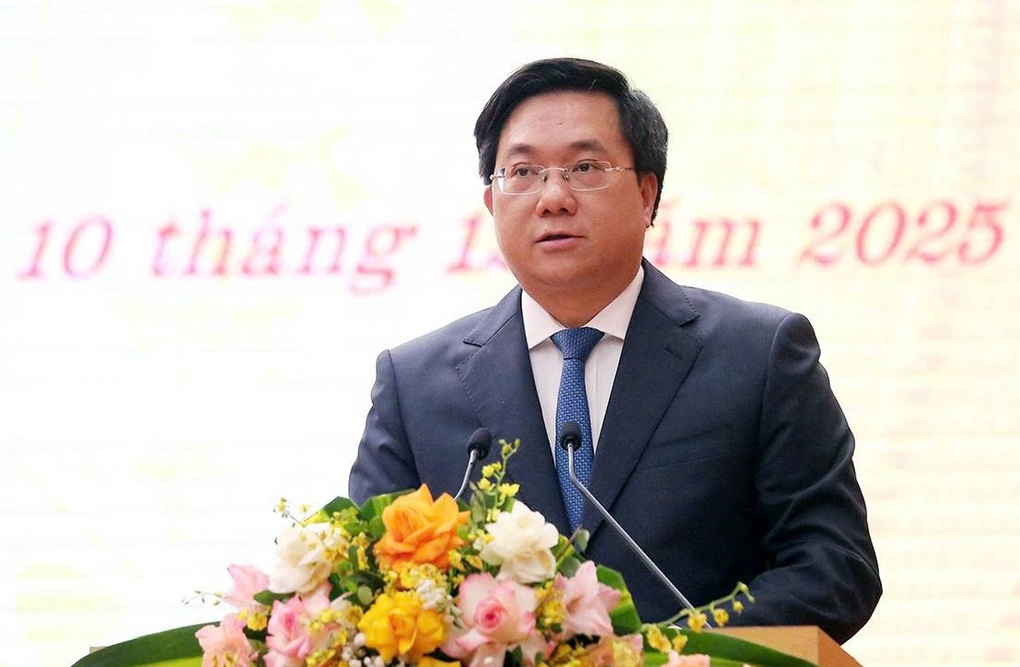
Chairman of the People's Committee of Phu Tho province, Tran Duy Dong (Photo: Khanh Trang).
"Handling public assets is a complex issue with a huge workload, requiring a step-by-step approach with a specific roadmap, but with a sense of urgency, decisiveness, and adherence to the regulations of the Law on Management and Use of Public Assets, avoiding loss, waste, and corruption," Mr. Dong said.
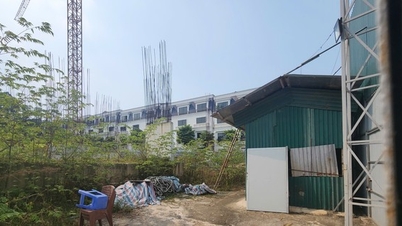
After reviewing 1,324 surplus land and buildings, Phu Tho province has completed the handling of 741 of them. The basic handling method is to transfer them to state management agencies at all levels for office space allocation. Currently, there are still 583 surplus land and buildings that need to be reorganized.
The head of the People's Committee of Phu Tho province stated that he will direct the Department of Finance to continue proposing the arrangement of surplus land and buildings according to the guidelines of the Central Government and the Phu Tho Provincial Party Committee: prioritizing the allocation of land and buildings for the headquarters of state management agencies, medical facilities, educational institutions, cultural centers, and community centers, before transferring them to the Land Fund Development Center and other organizations for auction according to regulations.
Furthermore, Mr. Dong stated that before the merger, the communes and towns basically already had approved general commune plans and general urban plans. After the merger, the communes and wards need a comprehensive plan as a basis for management and attracting investment.
However, general planning at the commune and ward levels requires time and resources. Furthermore, the current system of legal documents on urban and rural planning is being adjusted and improved. The implementation of commune and ward planning must be based on the provincial planning approved by the Prime Minister.
Therefore, for the time being, communes and wards in Phu Tho will continue to base their investment attraction efforts on existing construction plans (district and inter-district regional plans, city, town, and township general plans, and commune general plans that were approved before the merger of the three provinces of Phu Tho, Vinh Phuc, and Hoa Binh).
Specifically for the 19 communes (after merger) in the former Phu Tho province area that do not yet have a general commune plan, the Phu Tho Provincial People's Committee has agreed in principle to allow the People's Committees of these communes to act as the investor in developing the general planning project and has assigned the Department of Finance to provide guidance on the funding sources for implementation.
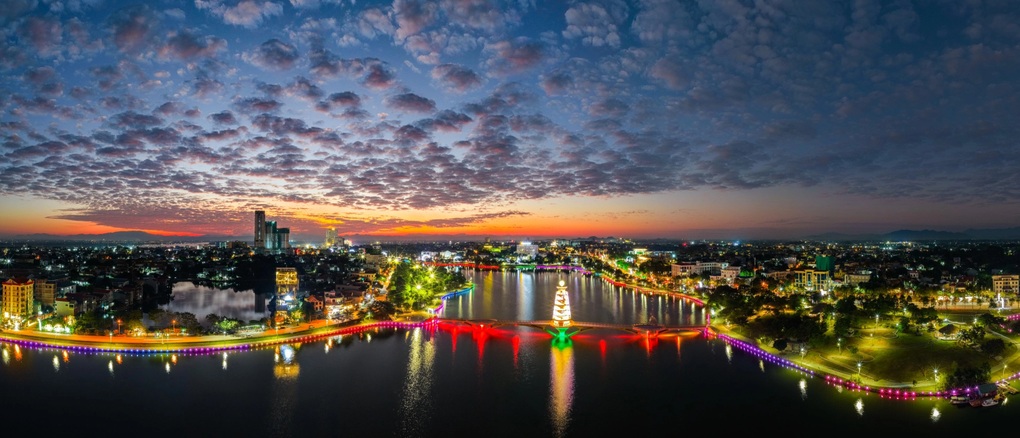
A view of Viet Tri ward, the administrative center of Phu Tho province (Photo: Tung Vy).
Phu Tho province was established on the basis of merging three provinces: Phu Tho, Vinh Phuc, Hoa Binh, and came into operation on July 1. The province has a natural area of nearly 9,400km2, a population of more than 4 million people, and 148 commune-level administrative units.
Phu Tho province ranks 15th in natural area, 11th in population, and 6th in economic scale among the 34 provinces and cities nationwide. The province borders 7 provinces and cities, including Hanoi, and is part of the capital region, situated on major economic corridors.
Source: https://dantri.com.vn/thoi-su/chu-tich-phu-tho-583-nha-dat-doi-du-phai-tiep-tiep-sap-xep-20251210195236203.htm









![[Video] National Assembly passes the amended Civil Servant Law with 92.39% of delegates voting in favor](https://vphoto.vietnam.vn/thumb/402x226/vietnam/resource/IMAGE/2025/12/10/1765379039932_1-6690-3945-png.webp)















![[Video] The craft of making Dong Ho folk paintings has been inscribed by UNESCO on the List of Crafts in Need of Urgent Safeguarding.](https://vphoto.vietnam.vn/thumb/402x226/vietnam/resource/IMAGE/2025/12/10/1765350246533_tranh-dong-ho-734-jpg.webp)













































Comment (0)