

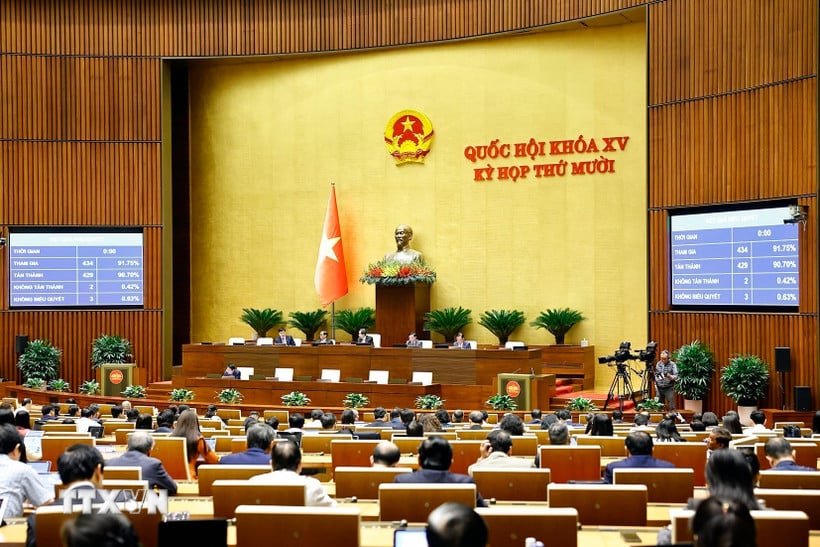
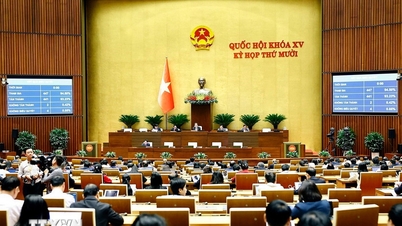
The National Assembly votes to pass the Law on Artificial Intelligence. (Photo: Doan Tan/VNA)
On the afternoon of December 10th, the National Assembly voted to approve: the Law amending and supplementing a number of articles of the Law on Intellectual Property; the Law on High Technology (amended); and the Law on Artificial Intelligence.
Accordingly, the Law amending and supplementing a number of articles of the Law on Intellectual Property (comprising 3 articles) received 432 out of 438 votes in favor, accounting for 91.33% of the total number of National Assembly delegates; the Law on High Technology (amended) (comprising 6 chapters and 27 articles) received 437 out of 441 votes in favor, accounting for 92.39% of the total number of National Assembly delegates; the corresponding figures for the Law on Artificial Intelligence (comprising 8 chapters and 35 articles) were 429 out of 434 delegates and 90.70%.
Authorized by the Prime Minister to present the report explaining, receiving feedback, and revising the draft Law on Artificial Intelligence, Minister of Science and Technology Nguyen Manh Hung stated that, regarding the necessity and perspective of drafting the Law, the vast majority of opinions highly agreed on its urgency.
However, concerns have been raised about potential overlap with the Law on Digital Technology Industry, fears of "hasty" approval, and a proposal to pass it over two sessions.
Responding to the opinions of National Assembly deputies, the Government has provided explanations on several issues. Accordingly, regarding the opinion on the necessity of enacting the AI Law, it is an urgent requirement to institutionalize the Politburo's Resolution.
To address concerns about duplication, the draft Law stipulates the complete repeal of Chapter IV on artificial intelligence in Article 33 of the Law on Digital Technology Industry, affirming that the Law on Artificial Intelligence (AI) is the only specialized legal document.
The draft law is structured as a framework law, focusing on core principles (Article 4), prohibited behaviors (Article 7), and a risk management framework (Chapter II). The approach to drafting the law is to build upon humanity's experience in managing intellectual property: managing inputs through data; managing the framework of use through law and ethics; and managing consequences through accountability mechanisms.
Regarding the balance between management and development, the draft Law is designed to harmonize the management and promotion of AI development, ensuring high security against key risks (learning from the experience of the EU and South Korea) but with policies to strongly promote development (like Japan).
Specifically, AI activities enjoy the highest incentives (Article 20); a controlled testing mechanism allows for exemption or reduction of compliance obligations (Article 21); the National AI Development Fund has a specific financial mechanism (Article 22); and a support voucher mechanism for startup businesses (Article 25).
Regarding the opinion that the process was "hasty" and the proposal to pass it in two sessions, Minister Nguyen Manh Hung stated that AI technology is developing exponentially with many new risks (deepfake, fraud, information manipulation) while current laws are insufficient to manage it.
Certain aspects, such as the list of prohibited AI categories, accountability, and financial and tax incentives directly related to citizens' rights and obligations and the state budget, can only be regulated by law as required by the Constitution.
Further explaining the legal consistency and feasibility of the Law, the Minister of Science and Technology stated that some delegates expressed concerns about overlaps with approximately 50 existing documents; conflicts between the sandbox (Article 21) and other laws; inconsistencies between penalties based on a percentage of revenue and the Law on Handling Administrative Violations; and a proposal to incorporate the Hanoi Convention into domestic law.
Regarding this matter, in response to feedback on streamlining the organizational structure, the draft Law has completely abolished the provision on the National Committee on Artificial Intelligence. State management functions are now uniformly assigned to the Government, with the Ministry of Science and Technology acting as the lead agency (Article 30).
Regarding technical standards, conformity assessment is only mandatory for high-risk AI systems included in the list issued by the Prime Minister (Clause 4, Article 13). This regulation creates a flexible "balancing mechanism": in cases where technical standards have not yet been issued, the Prime Minister will not include that system in the list of mandatory pre-approval systems, avoiding bottlenecks.
To avoid the law becoming outdated, the draft does not rigidly define specific technology categories or risk levels. Clause 4 of Article 13 assigns the Prime Minister the authority to issue and update the List of High-Risk AI Systems, allowing for "real-time" updates without amending the law.
The Artificial Intelligence Law will come into effect on March 1, 2026.
(VNA/Vietnam+)
Source: https://www.vietnamplus.vn/ky-hop-thu-10-quoc-hoi-khoa-xv-quoc-hoi-thong-qua-luat-tri-tue-nhan-tao-post1082247.vnp



























![[Video] The craft of making Dong Ho folk paintings has been inscribed by UNESCO on the List of Crafts in Need of Urgent Safeguarding.](https://vphoto.vietnam.vn/thumb/402x226/vietnam/resource/IMAGE/2025/12/10/1765350246533_tranh-dong-ho-734-jpg.webp)


























































Comment (0)