

According to Mr. Pham Dai Duong, Deputy Head of the Central Policy and Strategy Committee, the Vietnamese economy faces the requirement to create a breakthrough in reforming its growth model to realize the 100-year strategic goals set by the Party. Accordingly, by 2030 Vietnam strives to become a developing country with modern industry and high middle income, and by 2045 to become a developed country with high income. To achieve these goals, economic growth in the period 2026-2030 and subsequent years needs to reach double digits.
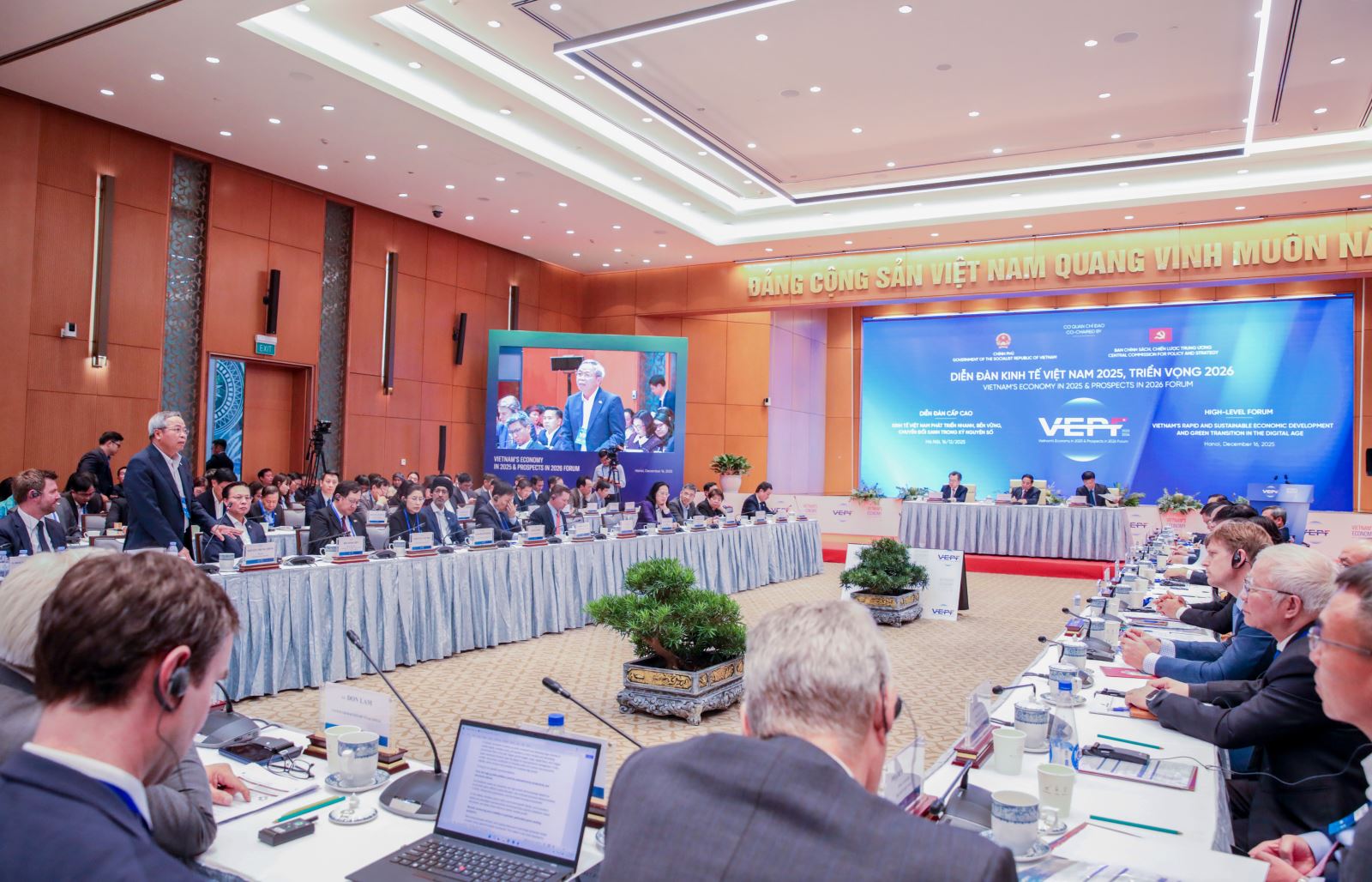
Business representatives proposed strengthening the leading role of the private sector.
The new growth model not only focuses on speed but also ensures sustainability, comprehensiveness, and inclusiveness; emphasizing the quality, efficiency, and long-term competitiveness of the economy. This model is shaped by the synchronized implementation of four revolutionary transformations: digital transformation; green transformation; energy transformation; and structural and quality transformation of human resources.
In this context, digital transformation creates speed and intelligence, overcoming physical limitations, enhancing labor productivity, and forming high-value-added digital economic sectors. Green transformation creates sustainability and humanistic values, ensuring environmental protection, social welfare, and avoiding the trade-off between long-term future gains and short-term growth. These two processes do not exist separately but are closely intertwined and blended together in a "dual transformation."
Mr. Pham Dai Duong affirmed that digital transformation and green transformation are not choices, but objective requirements of development practice. These two processes are closely linked, complementing each other, forming a "dual transformation" that will drive global growth for decades to come. The circular economy, playing a crucial role as a driver of green transformation in the digital age, is closely linked to the development of science and technology , innovation, and digital transformation, and has been identified as a strategic pillar of the new growth model.
At the Vietnam Economic Forum 2025, with a focus on the prospects for 2026, themed "Vietnam's economy developing rapidly, sustainably, and with a green transformation in the digital age," numerous opinions were gathered from experts and businesses.
Speaking as a representative of the technology business sector, Mr. Nguyen Trung Chinh – Chairman of CMC Technology Group – emphasized that Vietnam needs to steadfastly pursue the "dual transformation" model (digital transformation combined with green transformation) as a new long-term growth driver, while also more strongly leveraging the leading role of the private sector in line with major resolutions on science and technology development, innovation, digital transformation, and private sector development.
In that spirit, Chairman Nguyen Trung Chinh put forward three recommendations: National digital infrastructure – boldly entrusting it to private enterprises. The Chairman of CMC proposed that the Government continue to boldly entrust the private sector with investing in, building, and developing the national digital infrastructure (data centers, cloud, AI, shared digital platforms, etc.), instead of relying primarily on state-owned enterprises. Expanding the space for the private sector will reduce pressure on public investment, increase competitiveness, and attract high-quality capital flows.
Next is the need for a competitive data policy to become a Digital & AI Hub. Based on surveys of digital economy policies in the region, CMC believes that Vietnam needs to upgrade its institutional competitiveness to attract global technology corporations. Therefore, the Chairman of CMC proposed: Creating a comparative table of data and digital economy policies between Vietnam and regional centers (such as Singapore and Malaysia) to clearly identify the "policy gap"; Building a competitive digital data governance framework, aiming for similarity and superiority within ASEAN, if Vietnam wants to become the region's Digital & AI Hub.
The third recommendation is to develop the ecosystem and human resources model of the "three stakeholders" focusing on the innovation ecosystem and digital human resources. The Chairman of CMC proposed that Vietnam could become an innovative nation through the "three stakeholders" linkage model (State - Schools - Businesses), with science, technology, and innovation spaces linked to businesses.
Therefore, Mr. Nguyen Trung Chinh suggested that it is possible to plan large-scale technology and innovation (S&T) cities in key areas; and to consider allocating S&T spaces in Hanoi, Ho Chi Minh City, and Da Nang to university-enterprise models like CMC Uni, in order to accelerate R&D (research centers), training, and technology commercialization.
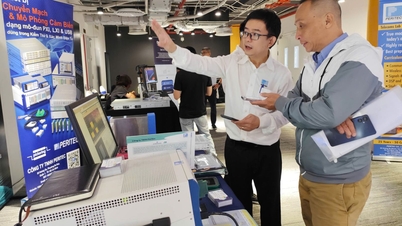
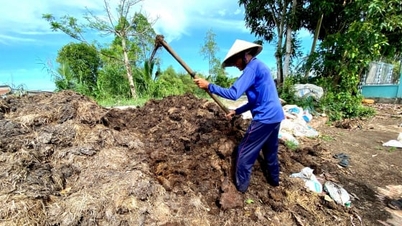
Some business representatives suggested focusing on the application of high technology and green technology to bring products to consumers; researching and applying closed-loop agricultural production processes would help save costs and reduce product prices.
In addition, delegates focused on discussing: forecasting capital needs and the ability to mobilize resources to serve high growth in the 2026-2030 period; key directions for banking credit policy and capital market development; and proposing policies to further enhance the role of financial and monetary entities in order to effectively mobilize and utilize domestic and foreign financial resources.
Francesca Nardini, Deputy Representative of the United Nations Development Programme (UNDP) in Vietnam, believes that data from Europe and the OECD show that Vietnam has the necessary foundation to implement this economic model, especially towards a circular economy.
According to forecasts, by 2030 and 2050, the circular economy could help reduce urban waste by 30 to 34%; reduce greenhouse gas emissions by 40 to 70%; create more jobs, increase the resilience of the economy; and reduce dependence on imported raw materials.
Source: https://baotintuc.vn/kinh-te/thuc-day-chuyen-doi-so-gan-voi-chuyen-doi-xanh-20251217123841759.htm


![[Photo] Prime Minister Pham Minh Chinh receives the Governor of Tochigi Province (Japan)](/_next/image?url=https%3A%2F%2Fvphoto.vietnam.vn%2Fthumb%2F1200x675%2Fvietnam%2Fresource%2FIMAGE%2F2025%2F12%2F16%2F1765892133176_dsc-8082-6425-jpg.webp&w=3840&q=75)
![[Live] 2025 Community Action Awards Gala](/_next/image?url=https%3A%2F%2Fvphoto.vietnam.vn%2Fthumb%2F1200x675%2Fvietnam%2Fresource%2FIMAGE%2F2025%2F12%2F16%2F1765899631650_ndo_tr_z7334013144784-9f9fe10a6d63584c85aff40f2957c250-jpg.webp&w=3840&q=75)
![[Photo] Prime Minister Pham Minh Chinh receives Lao Minister of Education and Sports Thongsalith Mangnormek](/_next/image?url=https%3A%2F%2Fvphoto.vietnam.vn%2Fthumb%2F1200x675%2Fvietnam%2Fresource%2FIMAGE%2F2025%2F12%2F16%2F1765876834721_dsc-7519-jpg.webp&w=3840&q=75)
![[Image] Leaked images ahead of the 2025 Community Action Awards gala.](/_next/image?url=https%3A%2F%2Fvphoto.vietnam.vn%2Fthumb%2F1200x675%2Fvietnam%2Fresource%2FIMAGE%2F2025%2F12%2F16%2F1765882828720_ndo_br_thiet-ke-chua-co-ten-45-png.webp&w=3840&q=75)































































Comment (0)