

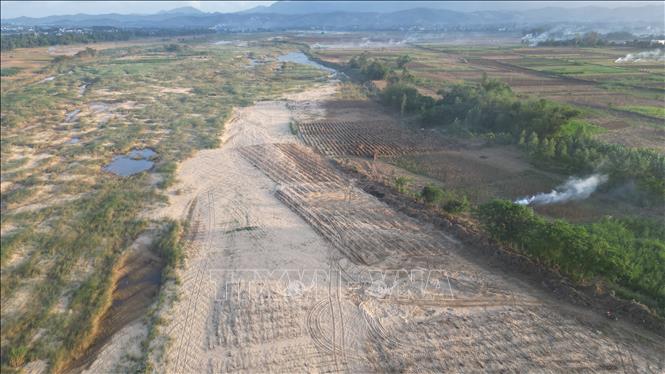
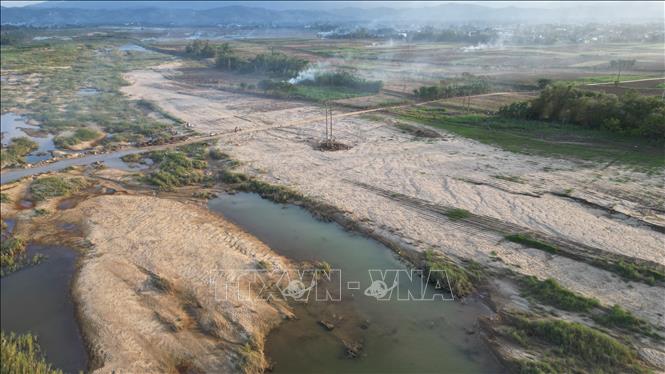
Despite surveys, assessments, and directives for remediation, people are still "waiting" while the 2025-2026 Winter-Spring planting season is approaching. On many fields along the Thu Bon River, sand covers the land, mixed with garbage and fallen trees after the floods, making it impossible for machinery to be used for cultivation, and the land is temporarily "frozen."
Farmers are "tired" of waiting for the problem to be fixed.
Go Noi commune, formed by the merger of three communes – Dien Phong, Dien Trung, and Dien Quang – is located along the Thu Bon River and was directly affected by the recent major floods. According to initial statistics, approximately 82 hectares of agricultural land in Go Noi commune were buried under sand, with an estimated volume of over 557,000 cubic meters, mainly concentrated in Phu Van, Tan Binh, and Go Dinh villages. In addition, the floods caused landslides affecting agricultural land near the Van Ly bridge, impacting many adjacent rice fields.
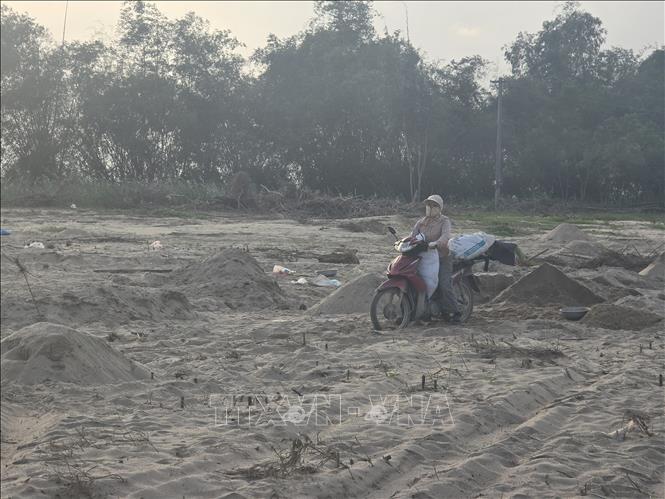
According to a TTXVN reporter at the scene, large patches of sand, mixed with garbage and dry wood, have covered many fields in Go Noi commune due to the flood. Local residents are still busy cleaning up, but it's just a drop in the ocean as the amount of sand that has washed in is too large and thick, exceeding the people's ability to cope on their own.
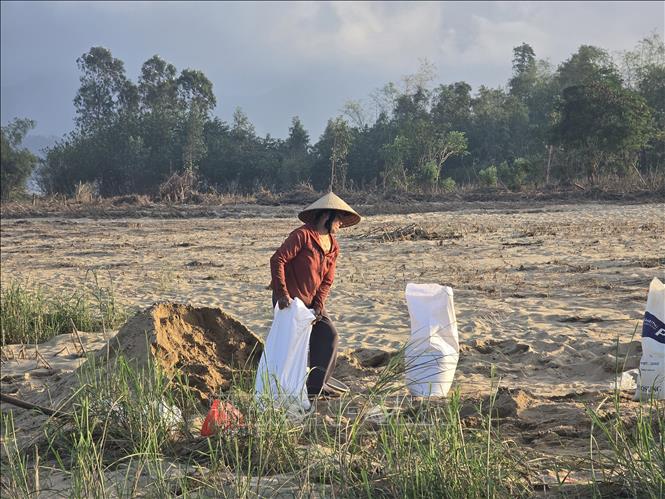
Ms. Phan Thi Be (a farmer from Go Noi commune) said, "We've been clearing the land for a whole week and it's still not finished for planting. The problem is that the sand is too thick, and people are hiring excavators to remove it elsewhere without permission from the local authorities. If this situation continues, the main crop of the 2025-2026 Winter-Spring season for farmers here will be completely lost."
Ms. Phan Thi Bon (Van Ly village, Go Noi commune) said that when people can no longer cultivate crops, they not only lose their main source of income for the whole year, but also have no means to raise livestock. Because the land is covered in sand like this, only bean sprouts can be grown, not any other crops, causing immeasurable losses for the people.
Given this situation, the people of Go Noi commune earnestly hope that all levels of government and local authorities will soon finalize a plan for land reclamation, develop a specific implementation plan with clear timelines, and mobilize machinery to comprehensively address the heavily silted areas. For the farmers, what is needed now is not just policies and directives, but timely and practical measures to restore the soil color of the fields, enabling them to plant crops in time, stabilize production, and gradually restore their livelihoods after the natural disaster.
The policy is clear, but the infrastructure remains "stuck".

To address this situation, the Da Nang City People's Committee issued Official Document No. 4436/UBND-NNMT on December 2nd regarding the restoration of agricultural production after natural disasters. In this document, Da Nang City assigned the Go Noi Commune People's Committee to develop a plan for remediation, organize the assessment and approval process, and implement remediation measures for large areas of landslides and sand deposition, striving for completion before December 5th, 2025. Furthermore, Da Nang also required the locality to strictly manage the volume of soil and sand generated during the remediation process, ensuring it is only used for public works and investment projects within the area, and preventing its sale or transportation outside the locality.
According to the People's Committee of Go Noi commune, the commune government has conducted a review of the current situation, compiled data, and developed a plan for collecting and reclaiming the fields. However, implementation is still awaiting assessment and approval according to regulations. Meanwhile, the large amount of silt deposited, unevenly distributed, with many areas covered in thick sand, makes the land unsuitable for cultivation unless it is reclaimed and restored.
However, Mr. Tran Cong Ninh (head of Phu Van village, Go Noi commune) argued that completing the necessary documents and plans within just three days would require a significant amount of time for local authorities to conduct on-site surveys and determine the extent of siltation and specific damage to each rice field. "Without a more flexible and practical approach, people will continue to delay planting, leading to the risk of crop failure and affecting the livelihoods of hundreds of households," Mr. Ninh emphasized.
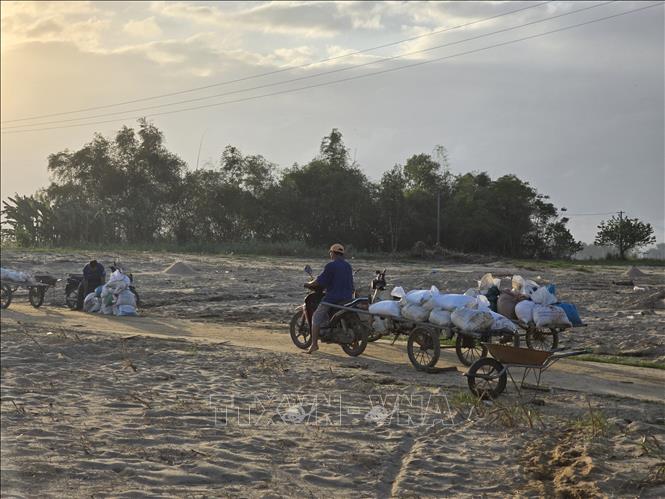

Ms. Nguyen Thi Huyen (a resident of Go Noi commune) said that farmers are anxious seeing their fields buried under white sand, as the main planting season, October 23rd (Lunar Calendar), has already passed. If a solution isn't found soon, the entire crop will be lost. In reality, the damage caused by sand accumulation in Go Noi is not limited to the area of fields buried, but also carries the risk of abandoning the crop if remediation efforts are delayed.
Source: https://baotintuc.vn/kinh-te/da-nang-cat-phu-ruong-dong-nong-dan-cho-giua-mua-vu-20251217121053270.htm




























































![[Video] Sunset at Lap An Lagoon – Where the sun sets over the fishing nets](https://vphoto.vietnam.vn/thumb/1200x675/vietnam/resource/IMAGE/2026/05/31/1780192137701_beach-landscape-sea-water-nature-grass-745871-pxhere-com.jpeg)

































Comment (0)