

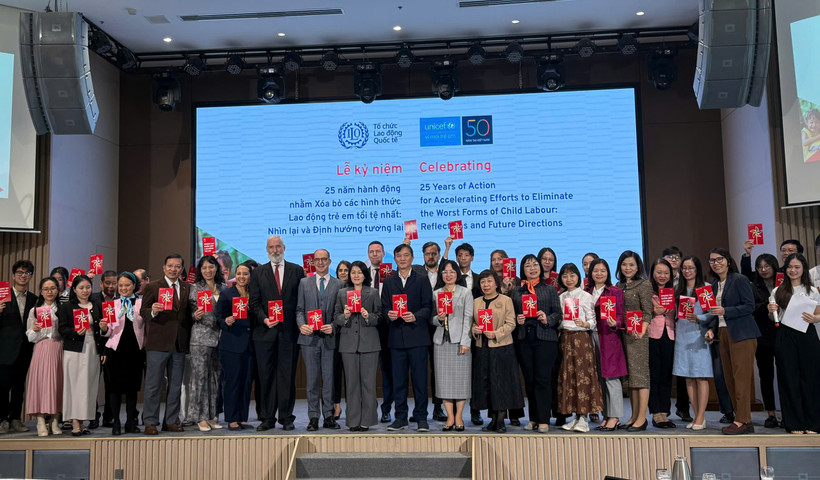
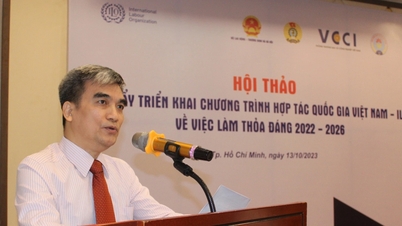
Delegates at the ceremony commemorating the 25th anniversary of Vietnam's ratification of ILO Convention No. 182 on the worst forms of child labor. (Photo: PV/Vietnam+)
On December 17th in Hanoi , the International Labour Organization (ILO) in Vietnam and the United Nations Children's Fund (UNICEF) celebrated the 25th anniversary of Vietnam's ratification of ILO Convention No. 182 concerning the worst forms of child labor. This is a significant milestone demonstrating Vietnam's strong commitment to protecting children from exploitation and ensuring their rights.
This event once again affirms Vietnam's persistent efforts in caring for and protecting children, contributing to promoting inclusive and sustainable socio -economic development, in line with international labor standards.
Notable achievements
Since ratifying Convention No. 182 in 2000, Vietnam has made significant progress in preventing and ending child labor, including its worst forms. Through improving the legal framework, implementing national programs, and strengthening coordination across sectors and levels, Vietnam has consolidated its child protection system, expanded access to education , and enhanced monitoring of children's participation in economic activities.
As a leading nation in the 8.7 Alliance, Vietnam continues to demonstrate its proactive approach and sense of national responsibility in the global effort to end child labor.
A key driver of these results is the National Program on Child Labour Prevention and Reduction for the period 2021-2025, with a vision to 2030, focusing on prevention, early detection, and the development of sustainable solutions for vulnerable groups of children. The program closely integrates child labour prevention with policies on education, poverty reduction, social security, and employment, thereby forming a comprehensive approach to protecting children's rights.
Significant progress has been made in evidence-based policymaking. According to national surveys conducted by the General Statistics Office with the support of the ILO, the proportion of children participating in economic activities decreased from 9.1% in 2018 to 3.5% in 2023.
However, approximately 94,300 children are still engaged in hazardous work, and nearly 12 out of every 100 children in child labor face health risks.
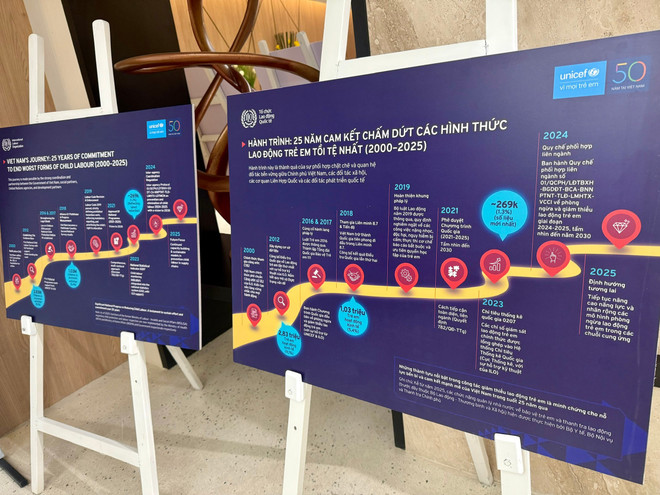
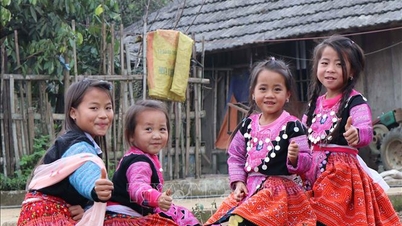
These milestones reflect on Vietnam's 25-year journey in fulfilling its commitments under ILO Convention No. 182 on the worst forms of child labor. (Photo: PV/Vietnam+)
Speaking at the event, Ms. Sinwon Park, ILO Country Director for Vietnam, affirmed: "Ending child labor is not only about protecting children's rights, but also about investing in Vietnam's future workforce and inclusive economic growth. When children go to school and develop skills, and when adults have decent and productive jobs, the benefits will spread to families, businesses, and the entire economy. Ending child labor is a strategic investment in the value and sustainability of Vietnam's economic future."
Furthermore, enhanced coordination among ministries, agencies, and local authorities has played a crucial role. Strengthened inter-agency coordination mechanisms have more effectively supported labor inspection, law enforcement, and support and referral services for children at risk. Numerous capacity-building activities have helped improve the awareness of labor inspectors, local officials, employers, and the community regarding legal responsibilities and the importance of child protection.
New challenges in the digital age
Looking ahead, relevant agencies emphasize that ending child labor requires constant attention and monitoring, especially in the context of Vietnam's increasing integration into supply chains. Children in vulnerable households – affected by poverty, migration, climate change, informal employment, and limited access to services – will continue to be a priority group in intervention efforts.
A representative from the Department of Maternal and Child Health (Ministry of Health) emphasized: "Protecting children is a shared responsibility of families, communities, state agencies, workers, employers, and businesses. No single entity can stop child labor alone. This requires the joint efforts of all parties, from strengthening social welfare policies for vulnerable families to enforcing laws and enhancing corporate responsibility."
In the context of digital transformation, new risks such as child exploitation online are emerging alongside existing vulnerabilities like poverty, migration, and informal employment. This necessitates child protection systems that are capable of responding effectively both online and offline, based on prevention, education, and effective law enforcement and compliance.
To realize this common goal and promote the achievement of high-quality economic growth, Vietnam needs to continue to focus on protecting children's fundamental rights through integrated programs, including education and social welfare.
Mr. Ly Phat Viet Linh, UNICEF representative in Vietnam, shared: "Every child has the right to a safe childhood and opportunities for learning and development. Preventing child labor begins with protecting children from harmful risks, ensuring all children have access to education and social services, and providing timely support to vulnerable families to break the vicious cycle of poverty."
At the event, the ILO, UNICEF, and the United Nations in Vietnam reaffirmed their commitment to supporting Vietnam in implementing national programs and strengthening the enforcement of labor and social laws. In the context of Vietnam's development of the National Program on Preventing and Reducing Child Labor for the period 2026-2030, this 25th anniversary is a crucial opportunity to further accelerate progress towards Sustainable Development Goal 8.7 – ending child labor in all its forms.
Source: https://www.vietnamplus.vn/cong-uoc-182-cua-ilo-hanh-trinh-25-nam-viet-nam-hien-thuc-cam-ket-bao-ve-tre-em-post1083528.vnp
![[Image] Leaked images ahead of the 2025 Community Action Awards gala.](/_next/image?url=https%3A%2F%2Fvphoto.vietnam.vn%2Fthumb%2F1200x675%2Fvietnam%2Fresource%2FIMAGE%2F2025%2F12%2F16%2F1765882828720_ndo_br_thiet-ke-chua-co-ten-45-png.webp&w=3840&q=75)
![[Photo] Prime Minister Pham Minh Chinh receives the Governor of Tochigi Province (Japan)](/_next/image?url=https%3A%2F%2Fvphoto.vietnam.vn%2Fthumb%2F1200x675%2Fvietnam%2Fresource%2FIMAGE%2F2025%2F12%2F16%2F1765892133176_dsc-8082-6425-jpg.webp&w=3840&q=75)

![[Live] 2025 Community Action Awards Gala](/_next/image?url=https%3A%2F%2Fvphoto.vietnam.vn%2Fthumb%2F1200x675%2Fvietnam%2Fresource%2FIMAGE%2F2025%2F12%2F16%2F1765899631650_ndo_tr_z7334013144784-9f9fe10a6d63584c85aff40f2957c250-jpg.webp&w=3840&q=75)

![[Photo] Prime Minister Pham Minh Chinh receives Lao Minister of Education and Sports Thongsalith Mangnormek](/_next/image?url=https%3A%2F%2Fvphoto.vietnam.vn%2Fthumb%2F1200x675%2Fvietnam%2Fresource%2FIMAGE%2F2025%2F12%2F16%2F1765876834721_dsc-7519-jpg.webp&w=3840&q=75)







































































Comment (0)