

Rekindling the flame for Vietnamese cinema.
Ajdar Ibrahimov (1919-1993) was a director, screenwriter, and People's Artist of the Soviet Union of Azerbaijani origin. Throughout his career, Ajdar Ibrahimov left his mark with many films rich in historical and humanistic spirit, such as: "Twenty-Six Baku Commissars" (1966), "The Stars Never Go Out" (1971)... His films remain an important part of Azerbaijani cinematic heritage to this day.
In addition, he was also one of the pioneers in promoting international cooperation between Soviet and Vietnamese cinema. From 1959 to 1962, at the invitation of President Ho Chi Minh and under the direction of the Soviet Ministry of Culture, he worked in Vietnam, in charge of training at Vietnam's first film school.
 |
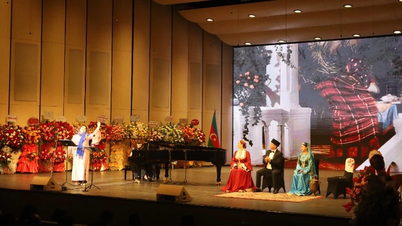
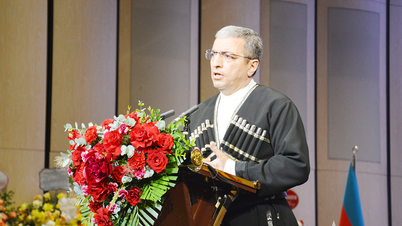
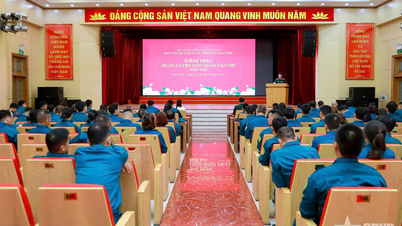
| The public learned about the life and career of director Ajdar Ibrahimov at the launch of his short story collection "What I Saw in Vietnam". |
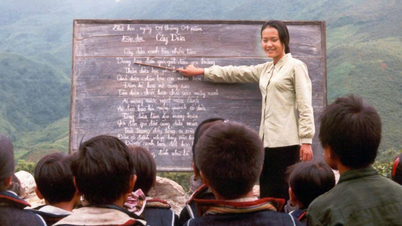
During those years, the Azerbaijani director not only lectured but also directly accompanied his Vietnamese students on field trips, living amidst wartime conditions to make films, laying the first bricks for revolutionary cinema in his country. He traveled through many rural areas, eating and living with the people to teach his students how to find film material from the reality of their homeland. The film "The Nightingale" (1962), which Ajdar Ibrahimov supported and guided Vietnamese students in making, won the special jury prize at the Karlovy Vary International Film Festival (Czechoslovakia) in 1962, contributing to Vietnam's initial approach to international cinema.
At a time when the country was facing numerous difficulties, the fact that a Soviet artist dedicated himself to training and making films in Vietnam was not only a story of cinema but also a vivid expression of the proletarian international spirit and the beautiful friendship that foreign friends extended to Vietnam. Mr. Shovgi Kamal Oglu Mehdizade, Ambassador Extraordinary and Plenipotentiary of Azerbaijan to Vietnam, emphasized: “I am very proud that Azerbaijan has always had a special affection and support for Vietnam. After President Ho Chi Minh's historic visit to Azerbaijan in 1959, cooperation between the two countries expanded in many fields. Among them, director Ajdar Ibrahimov came to Vietnam, bringing with him the experience, cinematic knowledge, and the sincere affection of the Azerbaijani people for the country and people of Vietnam.”
Vietnam through the cinematic eyes of Ajdar Ibrahimov
Ajdar Ibrahimov's years spent in Vietnam not only left their mark on his films but also became a vivid memory that he continued to recreate in his literature after returning to Azerbaijan. His collection of short stories, "What I Saw in Vietnam" (Vietnam Women's Publishing House, 2026), translated by Nguyen Van Chien, comprises 25 short stories, memoirs, and diaries. Like a film in words, it authentically portrays the life, fighting spirit, and aspirations for peace of the Vietnamese people during those brutal years.
 |
| The short story collection "What I Saw in Vietnam" by director Ajdar Ibrahimov. |
Ajdar Ibrahimov doesn't write in a purely descriptive style, but recreates memories with the cinematic thinking of a director. Each page contains close-ups of everyday faces, panoramic views of the countryside and mountains, and abrupt shifts between peace and war. Vietnamese people are depicted both concretely and evocatively. Farmers, soldiers, children, and highland girls are all placed in spaces with their own light, movement, and rhythm. Details like: "Around me, fierce mosquitoes were buzzing persistently" or "Her name was Ly Thi Son. She walked lightly on her small, bare feet, her hips swaying slightly and confidently, as if walking on a carpet..." demonstrate his keen observation and richly descriptive style. In Ajdar Ibrahimov's writing, the mountains, fields, and sky of Vietnam seem to possess emotions, resonating with the people. When war is imminent, nature seems to fall silent; When people return to their daily routines, the scenery also becomes softer and more peaceful.
Not only rich in imagery, Ajdar Ibrahimov's writing is also full of sound. The roar of airplanes, the explosions of bombs, the roar of anti-aircraft artillery, the choked sobs of a mother, or the silence of the mountains and forests after a battle are all arranged: sometimes rapid and intense, sometimes deep and poignant, all blending together to guide the reader's emotions.
Remarkably, Ajdar Ibrahimov did not view Vietnam solely through the lens of loss and bombs. In his writings, the brutality of war became a backdrop for the beauty and resilience of the Vietnamese people to shine through. “In his eyes, Vietnam was a land of perseverance and an intense desire to live. Ordinary people, despite facing war, rose above adversity with unwavering strength, optimism, and kindness,” translator Nguyen Van Chien shared.
More than six decades have passed since Ajdar Ibrahimov left Vietnam, but his legacy remains present in films, writings, and the affection that generations of artists have for him. This Azerbaijani director came to Vietnam with the responsibility of an international artist and stayed in the hearts of the Vietnamese people with a sincere and profound love for the country and its people.
Source: https://www.qdnd.vn/van-hoa/doi-song/mot-trai-tim-danh-cho-dien-anh-viet-nam-1040408

![[Image] Hanoi's urban life under the challenge of a "scorching hot" environment](https://vphoto.vietnam.vn/thumb/1200x675/vietnam/resource/IMAGE/2026/05/25/1779706979265_nang-nong-t5-2026-minh-duy-7-4636-jpg.webp)

![[Image] Close-up view of the interchange connecting the two expressways and Long Thanh Airport.](https://vphoto.vietnam.vn/thumb/1200x675/vietnam/resource/IMAGE/2026/05/25/1779703378210_ndo_br_z7863716673926-224453a31600126cce10622af6290afd-4549-jpg.webp)
























































































Comment (0)