


Behind the cascading white waterfalls, the lush green forests, and the lively sounds of gongs and traditional dances, there are countless fascinating things to discover. Try taking a stroll through the spring, the festival season, of this red soil plateau...
The ethnic groups of the Central Highlands have animistic beliefs, and anything related to production and human life must be done with the permission of the spirits (Yang) before proceeding. If things go well, they must give thanks; if they violate community rules and anger the spirits, they must atone for their sins… Therefore, numerous rituals, ceremonies, and festivals take place.
The system of festivals in the Central Highlands can be divided according to three characteristics: according to the agricultural calendar, according to the life cycle, and in relation to relationships outside the community. All festivals related to serving the interests of the entire community are always emphasized, usually focusing mainly on rituals according to the agricultural calendar, especially at the beginning of the year, when spring arrives:
Rain-praying ceremony: Usually takes place in March or April each year, when nature begins to change seasons, and families start clearing old fields or reclaiming new land.
The ceremony takes place after half of the families in the village have finished clearing weeds and burning the fields. It can be held near the water source outside the village, in the communal house courtyard, or even in the courtyard or inside the house of the water source owner (depending on the customs of each ethnic group). The offerings prepared for the largest rain-praying ceremony consist of a small pig, chicken, vegetables, and rice wine, in unlimited quantities, contributed by the entire community. The shaman will recite prayers expressing the community's wishes, hoping not only for quick rain to begin planting but also for a year of favorable weather, with sufficient water for crops to thrive.
The Bahnar Rngao people in Kon Tum used to have a very special rain-praying ceremony: first, they would worship the Thunder God (Bok Glaih), and if it still didn't rain, they would also worship the Thunder God's lover, Yang Dak, to ask the god to bring rain. The sacrificial offerings were a white goat and a white pig.
 |
| Ede girl by the water's edge. Photo: Huu Hung |
New Rice Festival: For ethnic groups belonging to the Mon-Khmer language family (South Asia), the new rice festival is usually organized by the village chief or water source owner for the entire community. The festival is typically held after the first harvest of rice, taking place in the communal house courtyard or at the water source owner's house (village chief's house) in November or early December, and can last for 2-3 days, depending on the expected harvest. Sacrificial offerings on the day of the new rice festival may include pigs or cows; for Mon-Khmer ethnic groups, if the harvest is abundant (100 baskets of rice or more), buffalo must also be offered.
This is one of the biggest community festivals of all ethnic groups in the year, signifying abundance and prosperity. It's also a time for people to rest and relax after a period of hard work, to thank the gods for their support, and to socialize with relatives and friends who have helped them throughout the year. During this festival, people often invite neighboring villages, relatives, or children who have married or moved to other villages to join in the festivities, socialize, and forge bonds of brotherhood.
The water source worship ceremony (drinking the water drop, offering water troughs): This is a very important thanksgiving ceremony for the entire community to the deities who oversee the water source, water drop, or water trough. This ceremony can take place in the last days of the year, around December, but can also be held at the beginning of the new year, before the farming season.
On the appointed day, the entire village must participate in cleaning up the village, especially around the water source, clearing weeds, replacing damaged water pipes, and restoring the flow of water. The rituals may vary slightly among different ethnic groups, but they are primarily held near the water source, the water landing, or the base of a banyan tree or blang tree along the path from the water source to the water's edge, to thank the water spirit and to pray for a year of sufficient water for people and plants.
These are the three most important rituals among the many festivals of most ethnic minority communities in the Central Highlands. In addition, depending on the circumstances and time, there are also ceremonies celebrating the completion of a new communal house (when establishing a new village), ceremonies opening the forest at the beginning of the hunting season (January - February), ceremonies for forging alliances between villages, etc.
In the villages of the Central Highlands, festivals and ceremonies, whether family or clan-related, involve the participation of the entire community. Neighboring villages are invited to these events, accompanied by the resounding sounds of gongs and the gentle flow of wine from curved bamboo pipes. Old and young, men and women alike, rejoice. Therefore, these ceremonies are always lively and joyful, becoming a celebration for a village, hamlet, or even the entire region…
To prepare for the festival, the village chief, the elders, the fortune teller, and the shaman discuss and choose the date. The men are assigned to tidy up the communal house, making it neat and clean; they go into the forest to select trees for the gơng poles. The poles can be made of bamboo or kapok tree trunks (a type of white, soft wood that is easy to carve). In major ceremonies, the people of the Central Highlands always use buffaloes, tied to these poles, as offerings to the gods.
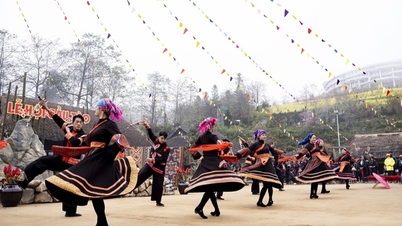
On the appointed day, the entire village, hamlet, and town gather at the communal house, dressed in beautiful skirts, blouses, and loincloths, adorned with numerous copper or silver necklaces, armbands, and anklets, or strings of beads. Families possessing valuable gongs or large, well-sounding drums are encouraged to bring them along to contribute to the festivities. A buffalo or any other animal intended for sacrifice is led and tied to a pole; beside it is placed a winnowing basket containing other offerings such as wine, salt, rice, grains, vegetables, gourds, and pumpkins that have just been harvested.
After the entire village had gathered, the village chief and elders went to each house to invite the shaman to perform the ceremony. After the ceremony, those who had been assigned to do the work would butcher the buffalo and help the women cook the food. The council of elders would then go to the communal house, the village chief's house, with the shaman and other important figures in the village to discuss business matters for the new year. Those who did not have work at the communal house would go home to cook sticky rice and prepare additional food, and at the appointed time, they would gather back at the communal house to share with the rest of the village.
As the feast progressed, the wine dwindled, and everyone became more enthusiastic amidst the lively sounds of gongs and drums. Young men and women held hands, joining in the joyful xoang dance, their footsteps boisterous, the alcohol taking effect, and no one could stand outside the circle anymore. Those who were tired rested, those who were hungry ate, and after eating and drinking, they continued. This could last for several days…
H'Linh Niê
Source: https://baodaklak.vn/van-hoa-xa-hoi/van-hoa/202602/mua-c-b8651f6/








![[Photo] A large number of people offer incense and visit the Ho Chi Minh Memorial Church.](https://vphoto.vietnam.vn/thumb/1200x675/vietnam/resource/IMAGE/2026/02/21/1771668099014_ndo_br_12-resize-7721-jpg.webp)


































Comment (0)