

In the days leading up to Tet (Lunar New Year), when the streets are less noisy and people's hearts slow down, I often read the newspaper with a different mindset. Not to find news, but to rediscover myself. Amidst the transition between the old year and the new, the pages of the newspaper suddenly become more like a realm of memories than a stream of current events. And in that moment, I realize: journalism, ultimately, not only accompanies the present, but also contributes to preserving the shared memory of the nation.
I've been a journalist for many years. Long enough to understand that each article not only answers a question of today, but also leaves a mark for tomorrow. There are words that seem insignificant, but as time passes, they become fragments of sediment, piling up to form the spiritual shape of society. Journalism, in that sense, does not stand outside the homeland. It lies within the homeland, like an underground stream, flowing silently but persistently.
For journalists, the homeland has never been an abstract concept. It manifests itself in the very real stories that journalism allows me to touch: a night bus full of people returning home for Tet (Lunar New Year), a year-end market with a few late-blooming peach blossoms remaining, a remote classroom still brightly lit in the middle of winter. These things are not noisy, but they are what give weight to the nation. And journalism, if it does its job properly, is the place that keeps these images from fading away in haste.
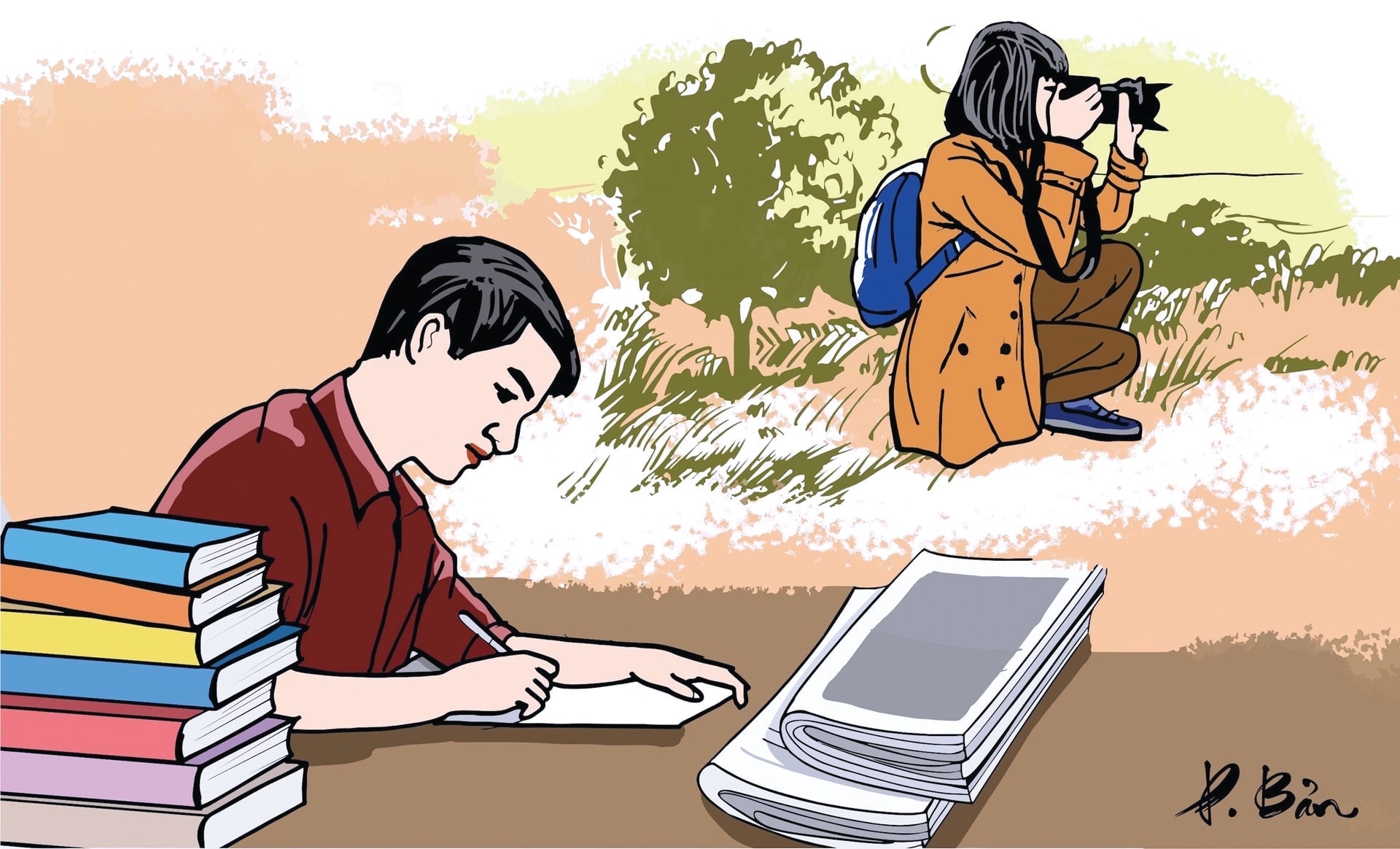
We are speaking of an era of self-improvement. Standing on the boundary between the old and new year, I perceive this era not only through strong pronouncements, but also through subtle shifts in people's consciousness. Self-improvement is not just about moving faster, but about daring to look back at ourselves more deeply. It's not just about external development, but about inner maturity. Journalism, if it retains its depth, is one of the rare spaces that helps society carry out this self-reflection.
Journalism in this day and age is not easy. Information is overwhelming, the truth is fragmented, and trust is easily eroded. Readers don't lack news, but they lack the time to understand it. In this context, journalism cannot simply chase speed. The power of journalism lies not in being the first to speak, but in speaking truthfully and with depth. When journalism loses its depth, it becomes noise. When it maintains its depth, it becomes a spiritual uplift.
As the year draws to a close, a time for reflection, I often think about what journalism should carry into the spring. Not every event deserves to be remembered for a long time. But there are small stories that, if written with honesty and respect for people, will remain in society's memory for a very long time. What to write, how far to write, and when to remain silent – these are quiet choices that determine the quality of a journalist.
Spring always has a special light. It's not dazzling, but enough to reveal unfinished business. For journalists, spring is a time to ask themselves: Have I written deeply enough? Have I stood close enough to people? Have I dared to step outside my comfort zone? These questions aren't pleasant, but avoiding them will only empty the profession.
The homeland during Tet (Lunar New Year) is very close. Not in grand pronouncements, but in family meals, in the anticipation of those who couldn't make it home, in the quiet hopes entrusted to the new year. When the press tells stories of spring, it is essentially preserving the bond between people. And it is this bond that creates the resilience of the nation.
When these words are read during the Lunar New Year, perhaps outside, flowers have bloomed, people have returned home, and a new year is unfolding. I don't know what the new year will bring to journalism. But I believe that as long as journalists write with responsibility, with memory, and with faith in humanity, journalism will remain a reliable part of the nation's spiritual life – a quiet, unassuming voice, yet powerful enough to lift people up and help them stand taller through the years.
Source: https://congluan.vn/mua-xuan-cua-chu-10329501.html



![[Image] A brilliant symphony and explosive power in the skies of Da Nang.](https://vphoto.vietnam.vn/thumb/1200x675/vietnam/resource/IMAGE/2026/05/31/1780196945787_anh-man-hinh-2026-05-31-luc-10-08-51.png)





















![[Video] Sunset at Lap An Lagoon – Where the sun sets over the fishing nets](https://vphoto.vietnam.vn/thumb/340x192/vietnam/resource/IMAGE/2026/05/31/1780192137701_beach-landscape-sea-water-nature-grass-745871-pxhere-com.jpeg)



































































Comment (0)