

In spring, Lao Xa village transforms with the colors of peach and pear blossoms blooming alongside the traditional earthen houses and stone fences of the Hmong people.

In recent years, Lao Xa, a small village nestled deep in the Sung La valley, about 6 km from the center of Sung La commune, has gradually become known to many tourists for its pristine and peaceful beauty. Spring is the most beautiful time for Lao Xa, when this border village changes its colors. Pink peach blossoms, white pear blossoms, and yellow mustard flowers bloom on the rocky slopes and in the gardens of local households, attracting many tourists to take photos and relax.

The village of Lao Xa is home to over 100 Hmong households. Within the village, there are still some traditional houses with yin-yang tiled roofs and a three-bay architecture, surrounded by fences and stone walls, with peach and plum trees planted in the courtyard. Each such traditional house resembles a self-contained architectural complex with a courtyard in the center, low wooden doors, and stone walls surrounding it.

Visiting Lao Xa for the first time in spring, Mr. Nguyen Van Ngo from Hanoi was impressed by the traditional rammed-earth houses and stone fences that the locals have preserved. Thanks to this, spring in Lao Xa is not only beautiful but also possesses an ancient charm and the unique characteristics of the Mong ethnic group. Mr. Ngo spent three days exploring the villages, capturing photos of flowers blooming on this rocky plateau.
Lao Xa is located about 130 km from Ha Giang City and can be reached by motorbike or car.

Following the paths leading deep into the village, the image that Ngo encountered most often was that of peach and pear trees in full bloom.
As a village with a developed economy in Sung La commune, the people of Lao Xa are conscious of preserving and protecting the distinctive cultural features of their ethnic group. Besides the naturally growing trees scattered along the roads and hillsides, the people of Lao Xa also plant peach and plum trees in their gardens and near their houses to make the spring colors here more prominent and create a lasting impression on tourists.

According to Nguyen Van Trai, a local tourism worker in Ha Giang, peach blossoms in Lao Xa begin to bloom in mid-February and last until around the end of March. This year, Lao Xa is one of the places where peach blossoms bloom earliest in Ha Giang. Starting around the end of February, many tourists have come here to admire the peach blossoms, a symbol of spring in the Ha Giang rocky plateau.

Interspersed with the peach blossom season is the season of white pear blossoms, lasting until around the end of March. The trees in full bloom, set against a backdrop of earthen walls and yin-yang tiled roofs, have become a characteristic image of Lao Xa in particular and the Mong villages in Ha Giang in general.
Previously, Lao Xa had a famous photo spot with a peach blossom tree growing in front of a stone wall about a meter high, behind which was a traditional earthen house. "Unfortunately, that photo spot is gone," shared Nguyen Sy Duc, who has worked in tourism in Ha Giang for 5 years.

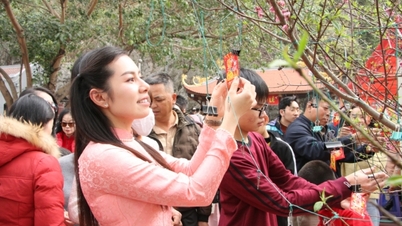
Arriving here on February 18th, Lao Xa impressed Ms. Mai Nguyen from Hanoi (pictured) from the very first encounter with its beauty, a blend of nature, culture, and people. "In this highland region, which is mostly barren land and rocks, perhaps only in spring do you feel the vibrant life truly," she shared.

Lao Xa is beautiful not only because of its natural scenery but also because of the simplicity and honesty of its people. The locals are friendly and the children are as innocent as their age, "without as much commercialization as some other places," Ngo and Mai commented.

To have more time to explore the village, Mr. Ngo advises tourists to stay overnight in an old house in the village for 300,000 - 500,000 VND per night. The homestay owner is a local, so the furnishings, decorative details, and scenery all reflect the cultural identity of the Mong ethnic people. Tourists can touch the time-worn earthen walls, admire the moss-covered yin-yang roof tiles, and live and work like the locals.
(According to 24h, March 13, 2024)
Source

![[Photo] National Assembly Chairman Tran Thanh Man attends the policy seminar to promote Vietnam-Türkiye cooperation.](https://vphoto.vietnam.vn/thumb/1200x675/vietnam/resource/IMAGE/2026/04/16/1776351415367_vna-potal-chu-tich-quoc-hoi-tran-thanh-man-du-toa-dam-chinh-sach-thuc-day-hop-tac-viet-nam-tho-nhi-ky-8705791-jpg.webp)





















![[Image] Bridges and roads connecting the eastern part of Ho Chi Minh City](https://vphoto.vietnam.vn/thumb/1200x675/vietnam/resource/IMAGE/2026/04/16/1776328595108_ndo_br_bh-vt5-jpg.webp)





























![[Infographic] Details of the Hanoi-Quang Ninh High-Speed Railway Project](https://vphoto.vietnam.vn/thumb/402x226/vietnam/resource/IMAGE/2026/04/16/1776338188424_anh-man-hinh-2026-04-16-luc-18-16-10.png)

![[Photo] National Assembly Chairman Tran Thanh Man meets with the Speaker of the Georgian Parliament](https://vphoto.vietnam.vn/thumb/402x226/vietnam/resource/IMAGE/2026/04/16/1776338494029_anh-man-hinh-2026-04-16-luc-18-21-21.png)

























Comment (0)