

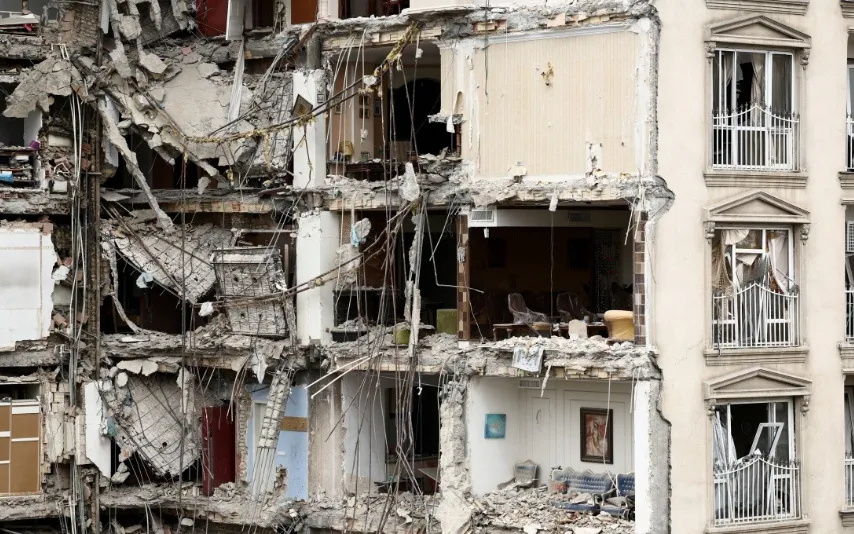
The building was damaged during the US-Israel attack on Tehran (Photo: WANA/Reuters)
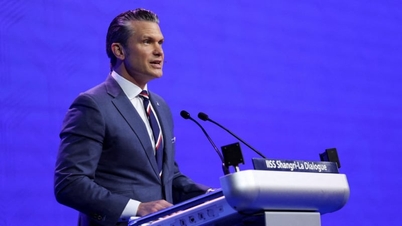
"The U.S. could resume attacks on Iran if necessary; we are fully capable," U.S. War Secretary Pete Hegseth said at the Shangri-la Dialogue in Singapore. "We are focused on maintaining our posture and preparing to re-engage if necessary."
Along with defense ministers from other countries – but without a Chinese representative – Hegseth raised the possibility of the U.S. supplying weapons to allies in the region amid the ongoing war with Iran.
"Our weapons stockpiles are perfectly suited for resuming attacks on Iran, both there and globally. So we are in a very good position," the Pentagon chief added.
Acting U.S. Navy Secretary Hung Cao told senators on May 22, referring to the operation that killed Iranian leaders and targeted Tehran's missile and nuclear sites: "Right now, we're pausing to ensure we have enough ammunition for Operation Epic Fury, and we have plenty of that."

US Secretary of War Pete Hegseth (Photo: AP)
There is still no information on whether President Trump will approve a peace deal with Iran, while the international community awaits his final decision.
President Trump consulted with his security team in the White House Situation Room on May 29, but did not announce any decisions.
Secretary Hegseth said that President Trump is patient and wants to reach a "great deal" to ensure the Islamic Republic does not acquire nuclear weapons.
Meanwhile, on the same day, Omani authorities issued a warning, stating that they had spotted a "floating object"—suspected to be a mine—in the Strait of Hormuz, and urged all sailors to exercise extreme caution.
Earlier, on May 25, the U.S. Central Command stated that it had attacked Iranian mine-laying vessels in a "defensive" action. On May 29, the U.S. Central Command warned that Tehran was seeking to obstruct mine-clearing operations and would target any vessels involved in mine-laying activities.
An Iranian lawmaker claims the country's parliament is planning to pass a bill to formalize sovereignty over the Strait of Hormuz – a channel that Trump says must be kept free and open.
The agreement being considered with Iran would extend the temporary ceasefire reached on April 8 for another 60 days.
A $300 billion investment fund for Iran has also emerged as a potential part of the deal. Iranian officials describe it as a reconstruction program, following the country's commencement of peace negotiations with the US, which included a demand for war reparations.
Previously, some sources said that US negotiators had proposed real estate investment in Iran, while Tehran responded with joint energy projects with the US.
However, President Trump announced on May 29 that no money would be exchanged in any form with Iran as part of the deal.
Source: https://vtv.vn/my-san-sang-noi-lai-tan-cong-iran-neu-khong-dat-thoa-thuan-100260531065620281.htm
![[Photo] The General Secretary, President and his wife lay flowers at the Ho Chi Minh Monument in Manila.](https://vphoto.vietnam.vn/thumb/1200x675/vietnam/resource/IMAGE/2026/05/31/1780219759477_anh-man-hinh-2026-05-31-luc-16-29-07.png)





![[Weekend Podcast] World Cup 2026: When the dream of playing football becomes a game for those with thick wallets](https://vphoto.vietnam.vn/thumb/402x226/vietnam/resource/IMAGE/2026/05/31/1780220467442_anh-thumb-podcast-2.png)





![[Video] Sunset at Lap An Lagoon – Where the sun sets over the fishing nets](https://vphoto.vietnam.vn/thumb/340x192/vietnam/resource/IMAGE/2026/05/31/1780192137701_beach-landscape-sea-water-nature-grass-745871-pxhere-com.jpeg)































































Comment (0)