


The Ham Rong - Ma River region bears witness to the heroic victories of the army and people of Thanh Hoa during the resistance war against the US.
Shaping the face of Thanh Hoa province...
The Ma River, one of the rare rivers that originates deep within Vietnam, meanders along the border through neighboring Laos before returning to its homeland. When writing "The Sacred Ham Rong - Ma River," the late researcher Hoang Tuan Pho described in detail the river's journey: "Beginning its thousand-mile journey, the Ma River merges with Nam Hua at an altitude of over 2,000m in Tuan Giao, Lai Chau, and reaches Son La, where it is further strengthened by the Nam Ty, Nam Cong, Nam Le, and Nam Het branches, with the riverbed slope exceeding 90% in some places. The Ma River proves itself like a mythical horse with four powerful hooves, soaring over dense plateaus, its graceful body winding through extremely rugged mountains, towering peaks reaching the sky: Co Pia, Phu Ta Ma, Pha Tung (over 1,700m), Phu Long, Phu Sam Sao, Phu Hoat (approximately 2,000m)... It has to meander through Laotian territory for 102km, then, traversing countless treacherous rapids and waterfalls before reaching its rendezvous point, where the Dragon Mountain coils and awaits. "The Ma River, stretching over 500km through Vietnamese territory to the East Sea, overcomes all obstacles, subduing everything... Alone, with its earth-shattering roar, it conquers all and sweeps along all rivers, large and small." On that sea voyage, reaching Thanh Hoa province, the Ma River seems like a great architect.
The western region of Thanh Hoa province, with its undulating mountains, possesses both majestic and expansive beauty, as well as lyrical and poetic charm, as exemplified by the "solo journey" of the Ma River: "The Ma River is far away now, O Tay Tien! / Remembering the mountains and forests, a feeling of longing overwhelms me / Sai Khao shrouded in mist, the weary troops / Muong Lat, flowers blooming in the night air."
And then, the largest river in Thanh Hoa province, the Ma River, instead of entering the delta through a wide, straight valley aligned with the general topographical structure, it capriciously allows itself to repeatedly cut and re-cut through the limestone mountain branches, creating beautiful gorges in the bends between Hoi Xuan, La Han, and the upper reaches of Phong Y.
The northern region of Thanh Hoa province displays a labyrinth of elongated basins. Depending on the direction of the river's course, the rivers connect through valleys that pass through porphyritic or limestone mountain ranges; these collisions are also intensely manifested in a confined space across a multitude of diverse strata stacked upon one another. The individual basins amidst the densely forested hills have long held people captive.
The Ma River continues its downstream flow. The mountains have silently given way to the delta. Hidden behind the protective banks, the delta was formed by the slow deposition of river sediments. From its beginnings as a "wild horse" in the upper reaches, the Ma River now traces gentle curves through villages and riverbanks, flowing towards the city.
Sparkling cultural alluvium
Considered a gift bestowed by Mother Nature, the places along the Ma River are rich in distinctive cultural features, preserving many traces of ancient lands where people settled and lived from the earliest times. In particular, the banks of the Ma River basin have witnessed the formation, development, and flourishing of many prominent cultures throughout human history.

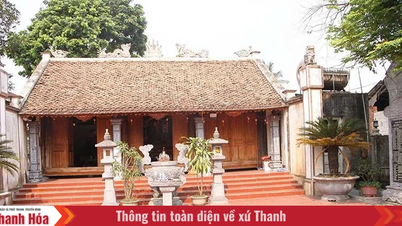
The place of worship is located on the banks of the Ma River.
On the right bank of the Chu River, at the confluence of the Chu and Ma rivers, Mount Do stands majestically, a vivid testament to the existence of the early Paleolithic culture in Thanh Hoa province. Here, in the 1960s, archaeologists discovered stone artifacts such as hand axes, crude chopping tools, stone cores, and chipped fragments... bearing the marks of rudimentary chipping and shaping techniques, confirming that prehistoric people once lived on Mount Do, approximately 300,000 to 400,000 years ago.
The "dawn of Mount Đọ" begins to illuminate the first pages of history since "the ape-like people here bid farewell to their animalistic lives to stand upright as humans." Along the Mã River, traces of prehistoric human habitation can still be found in Nuông Mountain, Quan Yên Mountain, Nổ Mountain, and other locations.
The Dong Son culture was discovered in the ancient village of Dong Son (Ham Rong ward) from bronze artifacts found by a local resident along the Ma River. Subsequent archaeological discoveries of settlements and burial sites along the Ma and Chu rivers have proven the flourishing of this culture and civilization. This is not only a source of pride for Thanh Hoa province, but also a strong testament to the stature of the Dong Son culture in the historical flow of Vietnam and the region.
Among these artifacts, the most representative and deeply imprinted symbol of this culture is the bronze drum. With its delicate and meticulous carvings and patterns, the Dong Son bronze drum richly depicts the cultural activities of the people at that time. It also shows how refined and sensitive the people of the Dong Son culture were in their perception of life and how skillful they were in expressing their emotions and aesthetics.
Each time one sets foot in the ancient village of Dong Son, after marveling at the scenery and immersing oneself in its unique historical and cultural atmosphere, one often wonders: Was the discovery of the Dong Son culture in Thanh Hoa province, right on the banks of the Ma River – a river that profoundly influenced the appearance, material life, and spiritual life of Thanh Hoa – a matter of destiny, a choice of history, just as history has repeatedly entrusted this land with great missions and responsibilities? Or, to put it another way, Thanh Hoa province has etched golden imprints into the nation's history...
Living amidst the human spirit, each grain of silt from the Ma River has now become "the sweet melody of rice plants heavy with grain / The crane, the drum, folk songs, proverbs / The guns, the swords, the bows, the crossbows / The Mai An Tiem, Doc Cuoc, Ong Vom / After the raging flood, the water drops are clearer / The banks are once again overflowing with young silt" (Nguyen Minh Khiem).
The Ma River bears witness to many momentous and heroic historical events throughout the nation's two protracted wars of resistance. Countless bombs and bullets have sunk deep into the river's depths, along with the blood that stained its banks, the sacrifices of countless lives, and the youthful lives lost beside that river. Ham Rong - Ma River has become a legend, a place that commemorates the glorious victories of a time of unwavering and courageous struggle for national independence and freedom for the people.
The Ma River plays a crucial role and holds a significant position in the material, cultural, and spiritual life of Thanh Hoa province. There, the Ma River acts both as a formative element and a historical witness to the formation and development of this land. For generations to come, the beloved name of the Ma River will remain etched in the hearts of the people of Thanh Hoa...
This article uses material from the book "Thanh Hoa Province" by Charles Robequain (2012, Thanh Hoa Publishing House).
Text and photos: Thao Linh
Source: https://baothanhhoa.vn/nam-ngo-tan-man-ma-giang-278364.htm
![[Photo] National Assembly Chairman Tran Thanh Man attends the opening session of IPU-152](https://vphoto.vietnam.vn/thumb/1200x675/vietnam/resource/IMAGE/2026/04/16/1776277863731_ctqh5-jpg.webp)
![[Photo] Mrs. Ngo Phuong Ly meets and exchanges views with Mrs. Peng Li Yuan](https://vphoto.vietnam.vn/thumb/1200x675/vietnam/resource/IMAGE/2026/04/16/1776277858080_phu-nhan-1-jpg.webp)
![[Photo] The General Secretary, President and his wife meet with Vietnamese-Chinese friendship leaders.](https://vphoto.vietnam.vn/thumb/1200x675/vietnam/resource/IMAGE/2026/04/15/1776264829725_vna-potal-tong-bi-thu-chu-tich-nuoc-to-lam-gap-mat-nhan-sy-huu-nghi-viet-nam-trung-quoc-8703641-3130-jpg.webp)
![[Photo] My Son at night: A thousand-year-old heritage site amidst the Milky Way](https://vphoto.vietnam.vn/thumb/1200x675/vietnam/resource/IMAGE/2026/04/15/1776261039184_ndo_br_chon6-jpg.webp)









![[Infographic] How to register to buy social housing in the Thanh Sen ward project?](https://vphoto.vietnam.vn/thumb/402x226/vietnam/resource/IMAGE/2026/04/16/1776306626899_fb_tren-dia-ban-tinh-ha-tinh-png.webp)































































Comment (0)