


Record-breaking
Having been a victim of the historic 1999 floods in Hue , the 33 days (starting from October 22, 2025) spent following the storms and floods in Central Vietnam have been the ultimate emotional test for me.
I felt completely paralyzed when the Song Ba Ha hydroelectric dam released floodwaters at a rate of 14,740 m³/s, then 16,100 m³/s in just three hours... There were moments of extreme tension that lasted for a long time. My phone kept ringing with distress messages. I trembled as I read them. I tried to keep my spirits up, but I have to admit that feeling was the most emotionally damaging thing.
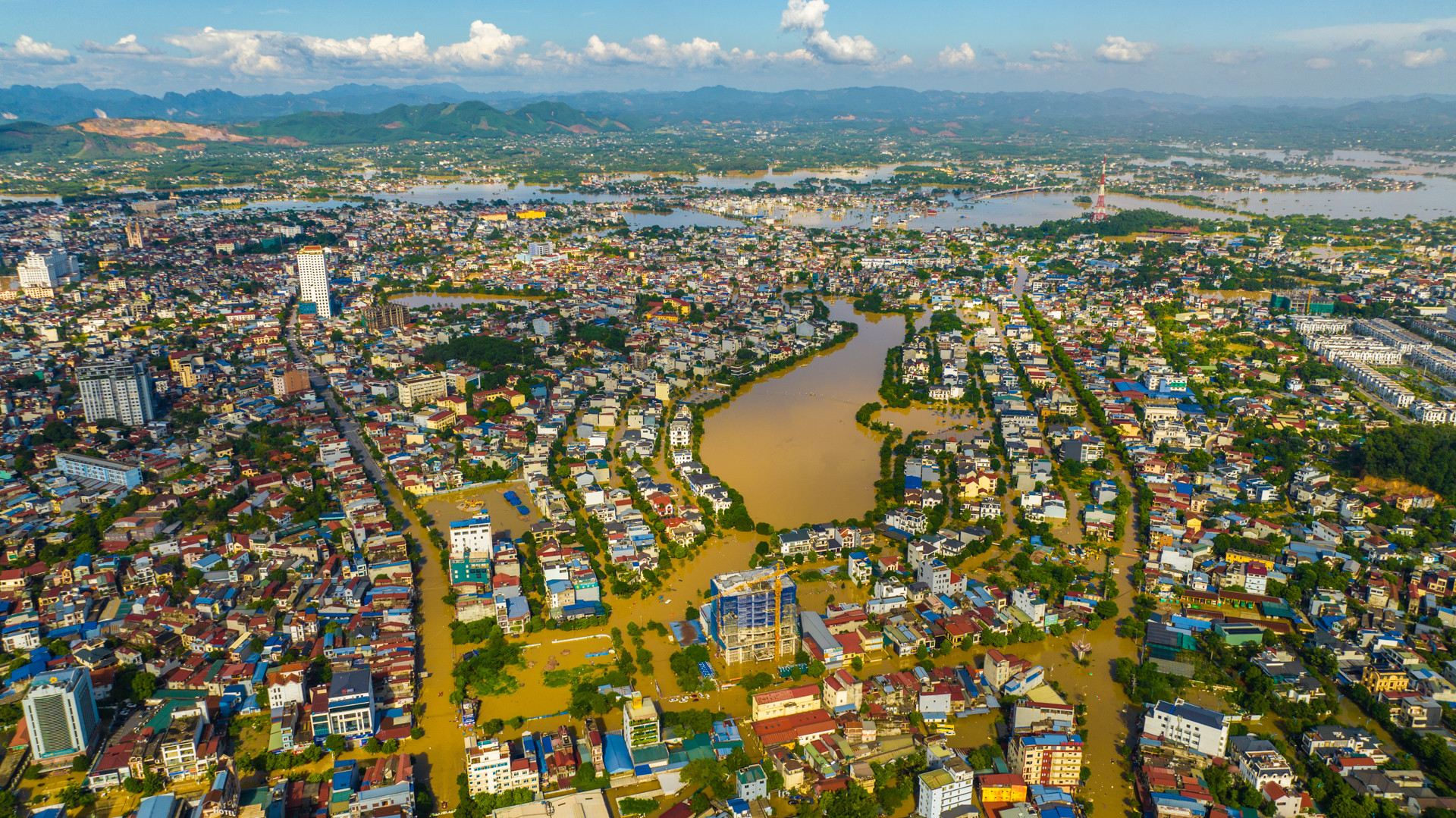
Hundreds of thousands of homes in Thai Nguyen were flooded during the record-breaking floods in early October 2025. Photo: Thach Thao
In 2025, natural disasters and extreme weather events will spread from North to South, with estimated economic losses of 100 trillion VND according to preliminary statistics; production will be disrupted and it will take many years to recover.
The year 2025 saw a record number of tropical cyclones forming and moving across the East Sea and inland, with 21 cyclones, surpassing the 2017 record. Typhoon No. 3, with its heavy rainfall, caused the water level in Ban Ve Lake to exceed the flood control level and surpass the 5,000-year flood frequency – resulting in devastating floods in western Nghe An. The historic Typhoon No. 10 had the longest total time on land, followed by the remnants of Typhoon No. 11, which caused historic flooding in Thai Nguyen, Lang Son, Bac Ninh, and Hanoi.
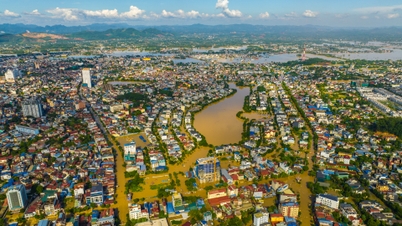
The year 2025 also saw major floods that broke flood peaks from the previous century. The water level of the Vu Gia River in Quang Nam exceeded the historical flood peak of 1964, and the water level of the Bo River in Hue exceeded the flood peak of 1999. Towards the end of the year, we again faced unprecedented floods in Dak Lak (part of the former Phu Yen), Khanh Hoa, and Lam Dong.
When natural disasters exceed tolerable limits
In disaster prevention theory, an area is considered resilient when its ecosystem, infrastructure, and the knowledge of its people are sufficient to withstand it. However, when rainfall exceeds 1,000 mm/48 hours, most infrastructure struggles to withstand flooding.
The extreme nature of the disaster was clearly demonstrated by the rainfall measurements in October and November. At the summit of Bach Ma Mountain, the daily rainfall (from 7 PM on October 26th to 7 PM on October 27th) was recorded at 1,739 mm, nearly equal to the average annual rainfall across Vietnam (1,400-2,400 mm), and the highest 24-hour rainfall recorded in the 21st century to date. The heavy rain continued for many days and in multiple waves, causing extremely complex and dangerous multi-disaster patterns that exceeded the capacity of the area. When analyzing, forecasting, and monitoring the disaster in Dak Lak, even before the flooding occurred, I had already determined that this was a dangerous combination of disasters that only occur once every hundred years.
Scientific analysis clearly shows the correlation between climate change and extreme natural disasters. Natural disasters are on the rise as global average temperatures are trending above pre-industrial levels by more than 1.5°C. The constant transition between El Niño and La Niña phases, with short neutral phases, keeps the atmosphere in a state of instability. The monsoon system, formed and "remembered" over millions of years, is showing signs of "memory loss," creating unusual convergence zones of northeasterly winds, easterly wind disturbances causing extreme rainfall, or hot, dry southwesterly winds causing prolonged droughts.
Floods and droughts will alternate, and both will affect Vietnam's economic and social life. To adapt to extreme natural disasters, it is essential to raise the resilience of infrastructure and people.
Things that need to be done immediately.
To protect the achievements of socio-economic development, we must take actions to adapt to climate change and prevent natural disasters. Priority should be given to implementing urgent measures early and regularly.
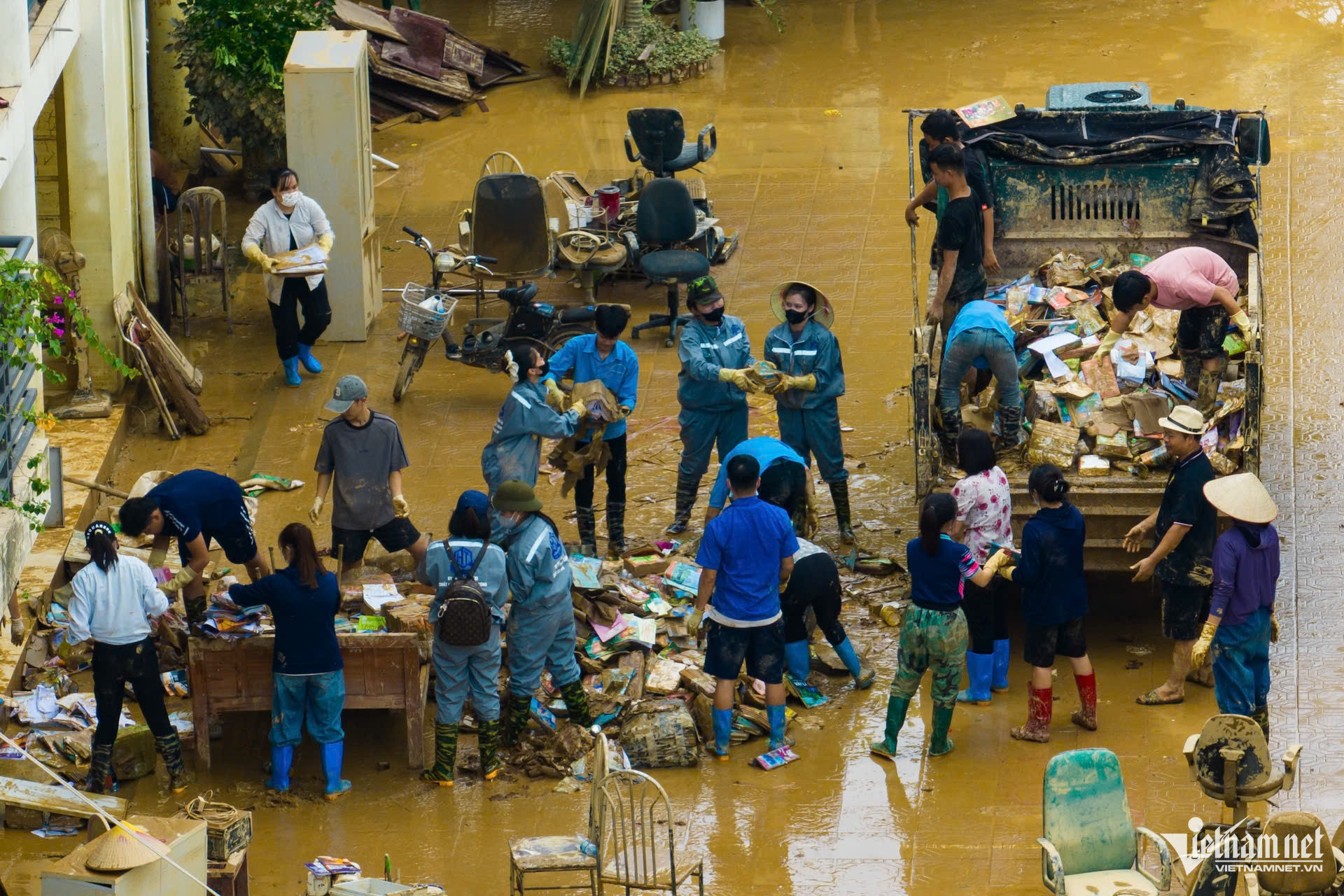
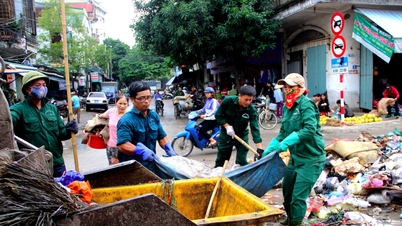
Forces are helping people clean up and recover from the aftermath of the natural disaster. Photo: Thach Thao
First, develop a response plan.
Each unit, from the village and commune level to the provincial level, needs to develop a plan to respond to extreme natural disasters according to different scenarios and types of disasters; it must have an action plan and a corresponding level of mobilization of human and material resources. Vietnam has experience in successfully implementing the "four on-the-spot" principle, but still needs to be more proactive.
Secondly, disseminate information about natural disaster risks to the general public.
In nearly 20 years of research on disaster risk management, I've observed that areas experiencing frequent natural disasters tend to have better response skills. Therefore, pre-disaster response efforts, such as reinforcing homes, elevating belongings, and finding safe shelters, are of paramount importance.
This preparation needs to be based on forecasts. Forecast and warning information needs to be more specific. People will understand better if they are told whether the storm will enter their area, rather than just "what coordinates it will reach." For river flood forecasts, it is essential to convert information from alert levels 1, 2, and 3 into forecasts of flood levels in residential areas.
Thirdly, modernize disaster warning systems.
The disaster warning information system has been integrated into the Vietnam Disaster Information System website https://vndms.dmc.gov.vn . Now, developing applications for forecasting and warning of natural disasters via mobile phones is necessary and timely. Investment is needed to install real-time camera-based water level monitoring systems in reservoirs and river systems, and to build flood scenario models based on historical flood levels and predicted meteorological factors. In areas at high risk of storms and floods, flood and storm warning systems should be installed. For example, the flood warning system in Hue and the river water level monitoring system integrated into the Hue-S application in Hue.
Fourth, build teams of volunteers and resources for rescue and relief operations.
In 2025, we managed to establish a rescue team, tentatively called the "Three Regions Disaster Response Team," with approximately 50 members including canoe and drone operators and logistics personnel. While there was a large pool of volunteer resources from the public, the process also encountered several inefficiencies. For example, we had to transport canoes by truck from over 500km away from the flooded areas, while many local canoes and rescue boats were not mobilized. Some areas had canoes but lacked drivers; others had drivers but lacked organized teams for coordinated efforts. Therefore, in each flood-prone area, it's essential to establish well-trained rescue canoe teams, recognized and coordinated by the local authorities. These teams could also participate in a national rescue network to provide mutual support.
Fifth, develop disaster relief and recovery scenarios.
The solidarity and compassion among our people are immense, but the lack of a comprehensive relief plan has rendered this work ineffective. Some areas received a large amount of aid because of extensive media coverage of the damage, while just 5km away were areas that received no visits from any charity groups. This imbalance of surplus and shortage, inappropriate selection of essential supplies, and poor logistics organization also resulted in waste.
In addition to preparing response and recovery scenarios, immediately after a natural disaster occurs, localities need a set of tools to quickly assess urgent needs and adjust response scenarios. These needs should be shared and updated in real time on a transparent online platform so that charitable organizations can access them.
Along with the impact of extreme natural disasters, humans also contribute by deforestation, polluting emissions, and shrinking their safe living spaces. The successive extreme natural disasters force us to question when we will no longer have to worry about the risk of storms and floods. We can raise the foundations of our houses to avoid flooding – but that's only a spontaneous adaptation, a case of "when the water rises, the weeds float." A more sustainable adaptation requires looking beyond our homes and taking action to replant and protect forests, preserving every tree, lake, and river, and thereby protecting our living space in harmony with nature.
Throughout the relief efforts, from the floods in Thai Nguyen to the floods in South Central Vietnam, what impressed me most about the Vietnamese people was their resilience and solidarity. In places that had just suffered historic floods and seemed beyond recovery, such as Thanh Hoa, Thai Nguyen, Hue, and Quang Nam, they were the first to take the lead in providing aid to the newly affected areas. Source: https://vietnamnet.vn/vuot-bao-lu-ky-luc-2490266.html |

































































Comment (0)