


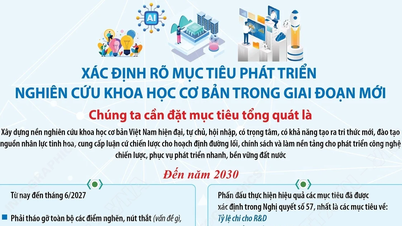
In the context of increasingly fierce global technological competition, the Party and State have issued many important policies, including Resolution No. 57-NQ/TW (dated December 22, 2024) of the Politburo on breakthroughs in the development of science, technology, innovation and national digital transformation, which identifies the development of strategic technologies as a pillar of rapid and sustainable growth. This orientation continues to be institutionalized in the Law on Science, Technology and Innovation 2025 and the Law on High Technology 2025, creating a legal foundation for the development of scientific products.
Lesson 1: When policies pave the way
Currently, the funding mechanism is shifting strongly towards science and technology development funds to concentrate resources, overcome the problem of scattered allocation, and improve the efficiency of investment in research and development. On this basis, the National Science and Technology Development Fund (Nafosted) plays a key role, not only as a channel for resource allocation but also as a tool to guide and direct research and development in strategic technology fields, contributing to enhancing technological self-reliance and realizing national development goals.
An effective mechanism for mobilizing and allocating resources is needed.
Over the past period, the Government has implemented a comprehensive range of policies, from identifying 11 strategic technology groups and 35 priority products to issuing the National Science, Technology and Innovation Program for the development of priority strategic technology products. The Ministry of Science and Technology is responsible for implementation, initially focusing on six strategic technology products: Big Language Modeling; virtual assistants; AI cameras; autonomous mobile robots; 5G; blockchain; and unmanned aerial vehicles (drones).
For these directions to be put into practice, a key requirement is an effective mechanism for mobilizing and allocating resources. Science and technology development funds play the role of intermediary financial institutions, with the Nafosted Fund expected to become a "facilitator" contributing to promoting the science, technology, and innovation ecosystem.
According to Minister of Science and Technology Vu Hai Quan, the development and implementation of strategic technology and product lists have been carried out decisively and synchronously nationwide. Ministries, sectors, and localities have proactively issued action plans and developed roadmaps for technological innovation until 2030 and 2035, while gradually concretizing them into implementation programs. Resources for science and technology continue to be strengthened with large-scale investments, resulting in some initial achievements such as the development of specialized virtual assistants, the creation of digital maps of raw material areas, and the implementation of a traceability system for agricultural products based on blockchain technology...
In recent times, the development and implementation of strategic technology and product portfolios have been carried out decisively and synchronously nationwide. Ministries, sectors, and localities have proactively issued action plans and developed roadmaps for technological innovation until 2030 and 2035, while gradually concretizing them into implementation programs. Resources for science and technology continue to be strengthened with large-scale investments, resulting in some initial achievements such as the development of specialized virtual assistants, the creation of digital maps of raw material areas, and the implementation of a traceability system for agricultural products based on blockchain technology...
The system of higher education institutions and research institutes is beginning to form nuclear research centers in key areas such as AI, semiconductors, and new energy. Many domestic enterprises are gradually mastering core technologies to develop strategic products, such as: researching some fundamental quantum technologies; achieving a localization rate of over 50% in the field of AI cameras and smart surveillance; Viettel mastering approximately 85% of 5G core technology; deploying autonomous robots for logistics and manufacturing; mastering approximately 70% of unmanned aerial vehicle technology; and gradually mastering natural language processing technology…
The Nafosted Foundation is affirming its crucial role in funding and supporting research organizations and scientific communities. Between 2015 and 2025, the Foundation will fund over 300 projects annually, supporting more than 12,000 scientists. This contributes to maintaining in-depth research directions, especially basic research, while gradually building a high-quality scientific workforce. Notably, approximately 70% of the projects are implemented at universities, thereby strengthening the link between research and training and creating a human resource foundation for strategic technology fields in the long term.
Unlocking resources, creating momentum for breakthroughs.
Despite achieving some results, in the initial stages, fully utilizing the role of science and technology development funds, especially national funds, still faces bottlenecks that need to be addressed in order to unlock resources and create breakthrough momentum for the development of strategic technologies.
According to Associate Professor, Dr. Dao Ngoc Chien, Director of the Nafosted Fund, the main challenge in implementing strategic technology tasks, although still in the initial stages, lies in the mechanisms. Many regulations are still framework-based, lacking specificity and detail for effective implementation; some policies are not suitable for the specific characteristics of different target groups. For example, research institutes and universities need flexible budget allocation mechanisms that accept research risks, while businesses are more interested in tax incentives, land, technical standards, and intellectual property protection. Based on this reality, the requirement is to continue improving the institutional framework by classifying target groups and designing flexible policies that closely match the needs of research institutes, universities, and businesses, instead of applying a single general mechanism.
The implementation of strategic technology tasks, although still in its initial stages, faces significant challenges in its mechanisms. Many regulations remain framework-based, lacking specificity and sufficient detail for effective implementation; some policies are not tailored to the specific characteristics of different target groups. For example, research institutes and universities need flexible budget allocation mechanisms that accept research risks, while businesses are more interested in tax incentives, land use, technical standards, and intellectual property protection. Based on this reality, the requirement is to continue improving the institutional framework by categorizing target groups and designing flexible policies that closely match the needs of research institutes, universities, and businesses, rather than applying a single, universal mechanism.
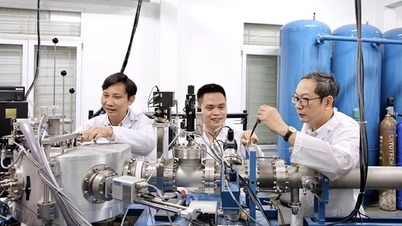
Associate Professor, Dr. Dinh Van Trung, Director of the Institute of Physics (Vietnam Academy of Science and Technology), believes that the implementation of the directions outlined in Government Decision No. 1131/QD-TTg, which promulgates the List of Strategic Technologies and Strategic Technology Products, is still in its early stages and requires more time to fully assess its effectiveness and impact.
Furthermore, research also reveals challenges such as limited domestic demand for specialized products; unstable post-registration resources; lengthy and disruptive funding procedures; and increasing competitive pressure from imported goods. This necessitates a strong role for science and technology development funds, ensuring resources and continuous support from research to commercialization; improving the fund's mechanisms; and accepting and managing risks to unleash innovation and promote breakthrough research directions.
In reality, the role of science and technology development funds, especially national funds, in financing strategic technology projects has not been fully utilized, and its impact remains limited, particularly within the business sector.
According to Mr. Nguyen Trung Kien, General Director of MK Vision, many businesses are unaware of the fund or still believe that it mainly supports academic research and is not linked to product development needs. Therefore, it is necessary to strengthen communication about the fund's activities, especially the groundbreaking innovations in the new Charter, so that the science and technology business community can have a clearer understanding.
(To be continued)
Source: https://nhandan.vn/nang-cao-hieu-qua-dau-tu-thuc-day-cong-nghe-chien-luoc-post961163.html

![[Image] Close-up view of the interchange connecting the two expressways and Long Thanh Airport.](https://vphoto.vietnam.vn/thumb/1200x675/vietnam/resource/IMAGE/2026/05/25/1779703378210_ndo_br_z7863716673926-224453a31600126cce10622af6290afd-4549-jpg.webp)



![[Image] Hanoi's urban life under the challenge of a "scorching hot" environment](https://vphoto.vietnam.vn/thumb/1200x675/vietnam/resource/IMAGE/2026/05/25/1779706979265_nang-nong-t5-2026-minh-duy-7-4636-jpg.webp)




















































































Comment (0)