

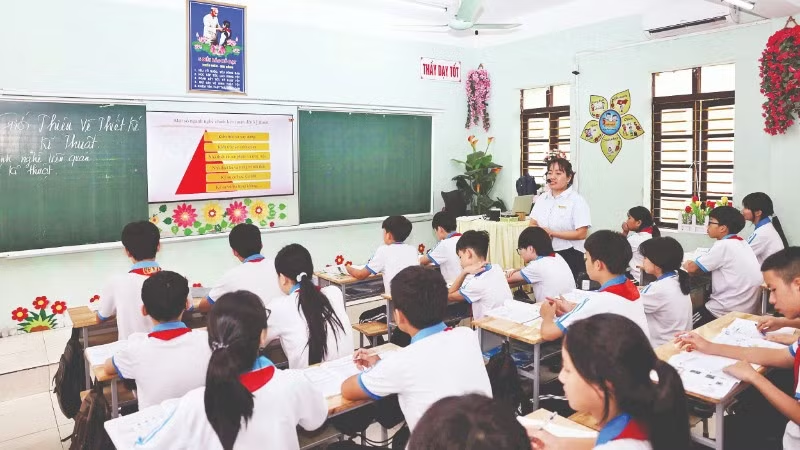
Education and training have always been a top national priority. Resolution No. 71-NQ/TW dated August 22, 2025, of the Politburo on breakthroughs in education and training development (Resolution No. 71) has outlined many specific solutions to promote educational innovation and development, including clearly stating that the education sector and localities should complete universal education; build a network of schools and classrooms to meet the learning needs of students; and strengthen the teaching and learning of foreign languages...
Efforts to universalize education
Over the past years, the education sector in Tuyen Quang province has strived to universalize education, gradually improving the quality of teaching and learning. For many years, like many of her colleagues in the locality, Ms. Vu Nhat Linh, a physical education teacher and head of the youth group at Quang Trung Primary School (Ha Giang 2 ward), has been assigned to investigate student information and encourage students to attend school. Because the area has many ethnic minority students whose parents often work far away and leave their children with grandparents, Ms. Linh has encountered many "funny and frustrating" situations during her work in universal education. In some cases, when teachers ask for phone numbers to verify information, many parents are wary, believing it to be a scam, and therefore refuse to cooperate or provide information. This ironic situation arises because primary school teachers have to investigate information for preschool children as well, so the children's relatives often don't know the teacher's face, leading to a feeling of apprehension when a stranger enters the house.
This work is usually done by Ms. Linh and other teachers outside of regular working hours or on weekends. For families who are away or cannot meet the head of the household, teachers have to patiently return multiple times at different times. In many cases, children live with their grandparents but their household registration is in a different location. When teachers inquire, grandparents often state that the child is currently living with them, leading to discrepancies with the national population database...
According to the Principal of Quang Trung Primary School, Nguyen Thi Anh Nguyet, in addition to doing a good job in universal education, the school effectively implements two breakthrough initiatives: reforming management practices and training the staff and teachers to gradually improve quality and ensure equity in education. The school proactively selects capable teachers to assign professional tasks in order to exploit the strengths and potential of each individual; it empowers teachers and subject heads to implement the curriculum content and commit to educational quality.
Meanwhile, Pham Thi Hoai Huong, Principal of Yen Bien Junior High School in Ha Giang 2 Ward, shared that the school always strives for higher standards in educational quality and learning experiences for students. Through professional development sessions organized by the Department of Education and Training, the school understands the situation and proactively shares solutions with disadvantaged units…
Thanks to the efforts of teachers and local authorities, the universal education program in Tuyen Quang province has achieved many positive results. The enrollment rate of 5-year-old children in school reached 99.95%; 100% of children completed the preschool education program. At the primary school level, nearly 100% of 6-year-old children entered grade 1; 97% of children aged 14 and over completed the primary school program; most communes achieved level 3 universal primary education standards. For lower secondary education, the graduation rate for young people reached over 90%, with many localities achieving levels 2 and 3 universal education standards.
With the results achieved, Tuyen Quang province is eligible to meet the standards for universal preschool education for 5-year-old children, universal primary education at level 2, universal lower secondary education at level 1, and literacy eradication at level 1 in 2025.
In 2026, the province aims to improve the quality of universal education, striving to achieve level 3 for primary education and level 2 for lower secondary education; and to continue consolidating the results of literacy eradication.
Enhancing foreign language teaching and learning.
In the current context, foreign languages are identified as one of the important tools for international integration. Ly Thi Huong Mai, Principal of Le Quy Don Junior High School (Minh Xuan Ward, Tuyen Quang Province), stated that, in implementing Resolution No. 71, the school has been reforming its English teaching and learning methods. With the initiative "teacher learns, students learn together," starting from March 24, 2026, during the 5th period on Mondays and Tuesdays, all staff and teachers participate in conversational English classes. Currently, teachers are applying bilingual teaching (writing lesson titles in both Vietnamese and English).
After a period of implementation, Ms. Vu Van Anh, an English teacher, shared that teachers of other subjects have become more confident and are able to use basic greetings and communication phrases in English within the school grounds and in the classroom. Teachers' participation has been more active and enthusiastic compared to the initial phase. Recognizing that teachers are a key factor in educational reform, alongside the efforts of English teachers, other subject teachers are also making increasingly significant contributions to promoting and improving the quality of foreign language teaching and learning in secondary schools. As for students, generally, they have a good foundation in English and are able to use it consistently in class. Many students are confident and have the skills to communicate directly with foreigners.
In Hanoi, the English subject has provided supplementary English instruction for all grades and classes, focusing on developing students' competencies and aligning with the 2018 general education curriculum.
According to Le Hong Chung, Principal of Yen Hoa High School (Yen Hoa Ward, Hanoi City), the school regularly organizes thematic teaching, focusing on essential skills such as listening, speaking, reading, and writing, especially reading and writing. The thematic units are designed flexibly, closely aligned with the students' needs and learning outcomes. The subject group develops diverse exercises suitable for each student, ensuring the highest learning effectiveness. In addition, the school emphasizes supplementary learning to foster students' self-study. Students are guided on methods for reading comprehension and encouraged to read foreign newspapers daily to expand their vocabulary, enhance their social knowledge, and develop critical thinking skills. English teachers also introduce students to effective self-study websites, helping them access a wealth of resources and practice exercises.
The universalization of primary and lower secondary education continues to receive attention from localities in order to consolidate and maintain achievements and gradually strive to reach higher standards. Implementing the policy of gradually making English the second language in schools, the Ministry of Education and Training has issued numerous directives and guidelines to improve the quality of foreign language teaching and learning, especially English, at all levels of education and training.
Permanent Deputy Minister of Education and Training Pham Ngoc Thuong
Permanent Deputy Minister of Education and Training Pham Ngoc Thuong assessed that the universalization of primary and lower secondary education continues to receive attention from localities to consolidate and maintain results and gradually strive to achieve higher standards. Implementing the policy of gradually making English the second language in schools, the Ministry of Education and Training has issued many directives and guidelines to improve the quality of foreign language teaching and learning, especially English, at all levels of education and training. To date, all educational institutions have implemented compulsory English teaching. “Although it is no longer a compulsory subject in the high school graduation exam in 2026 and recent years, in reality, hundreds of thousands of candidates still choose to take the English exam, which shows the interest of educational institutions and students in this subject,” Deputy Minister Pham Ngoc Thuong emphasized.
Source: https://nhandan.vn/nang-chat-luong-tao-cong-bang-trong-giao-duc-post964268.html

![[Image] Hanoi's urban life under the challenge of a "scorching hot" environment](https://vphoto.vietnam.vn/thumb/1200x675/vietnam/resource/IMAGE/2026/05/25/1779706979265_nang-nong-t5-2026-minh-duy-7-4636-jpg.webp)



![[Image] Close-up view of the interchange connecting the two expressways and Long Thanh Airport.](https://vphoto.vietnam.vn/thumb/1200x675/vietnam/resource/IMAGE/2026/05/25/1779703378210_ndo_br_z7863716673926-224453a31600126cce10622af6290afd-4549-jpg.webp)






































































Comment (0)